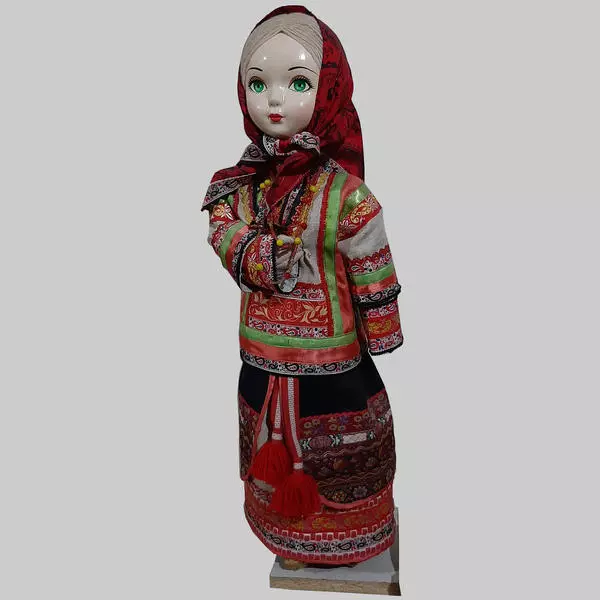
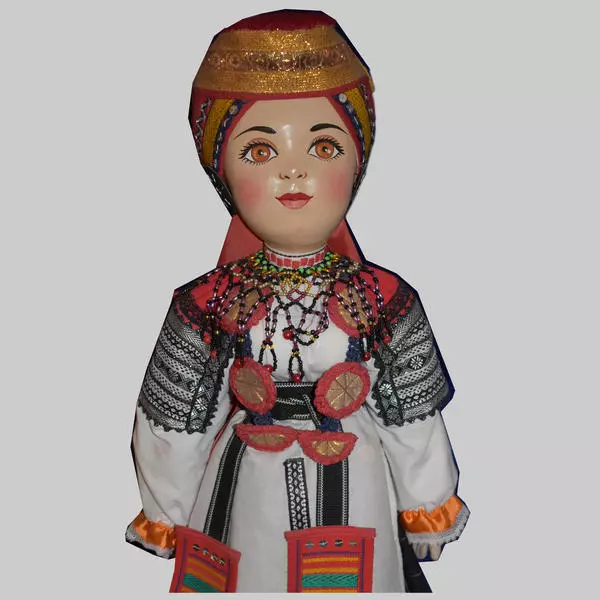
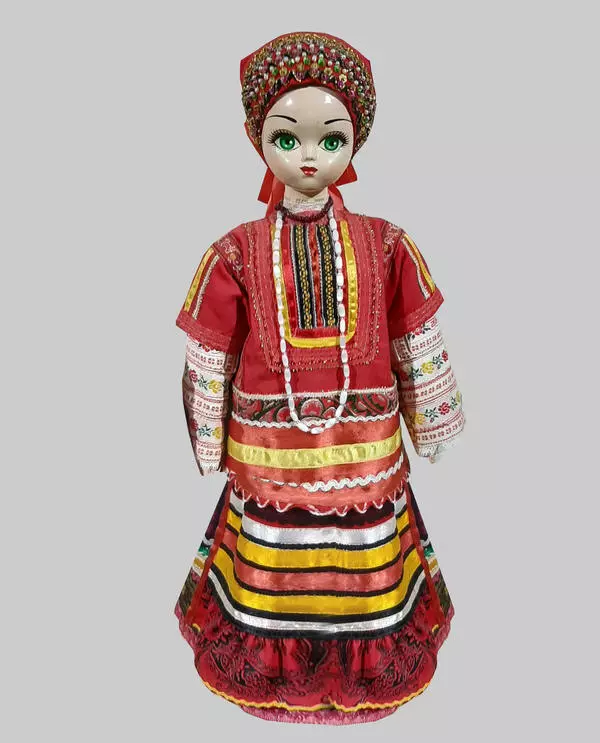
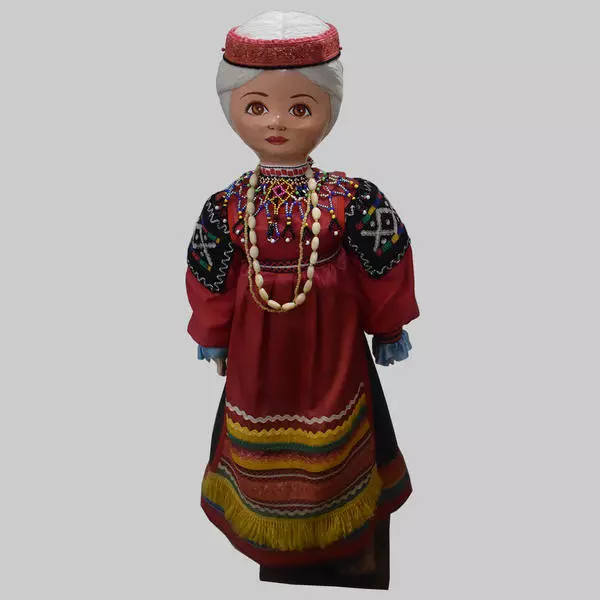
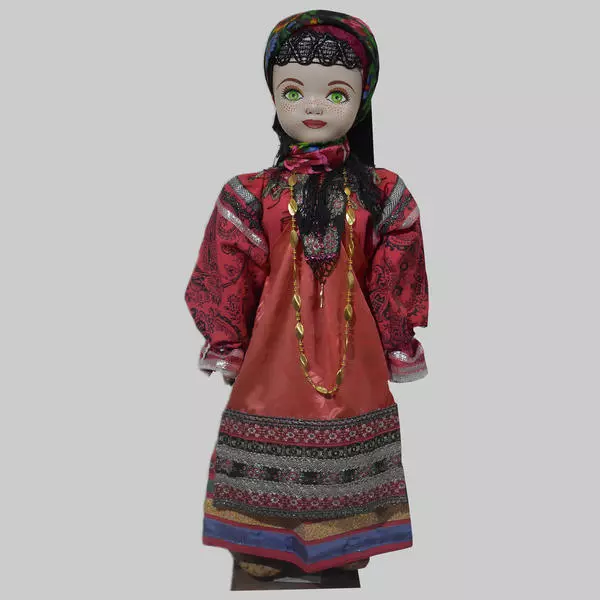
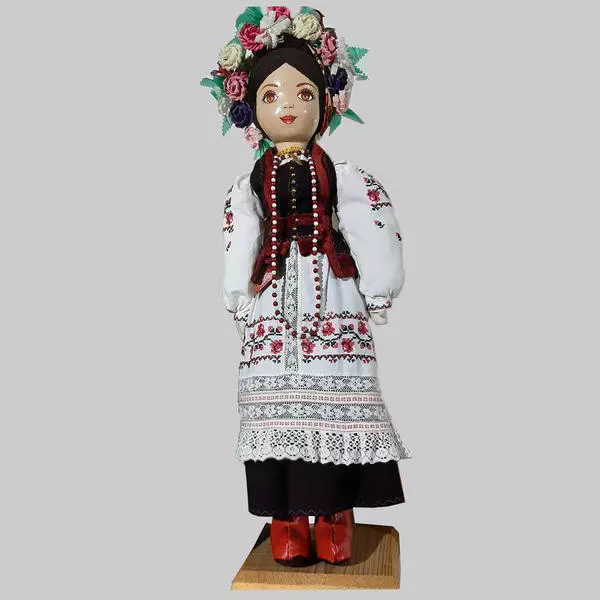
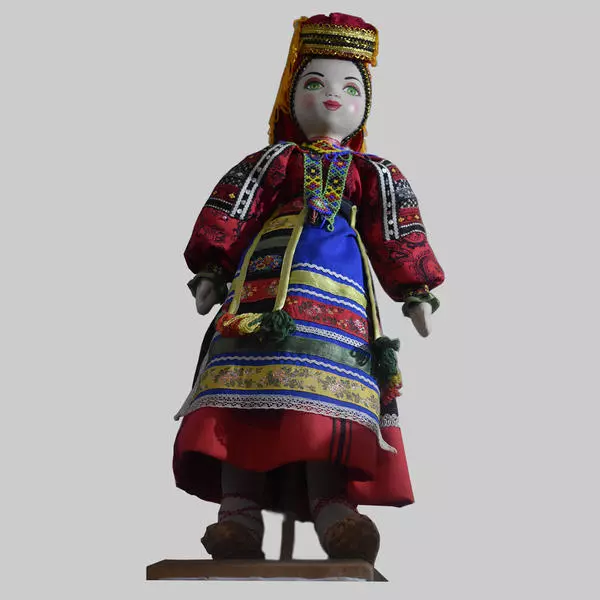
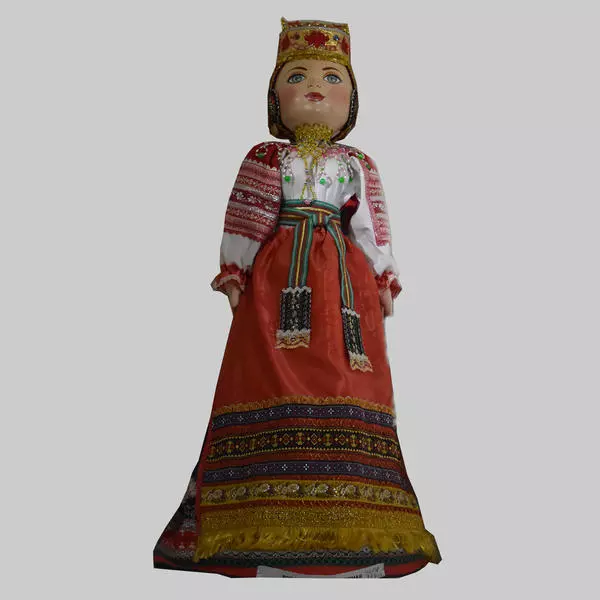
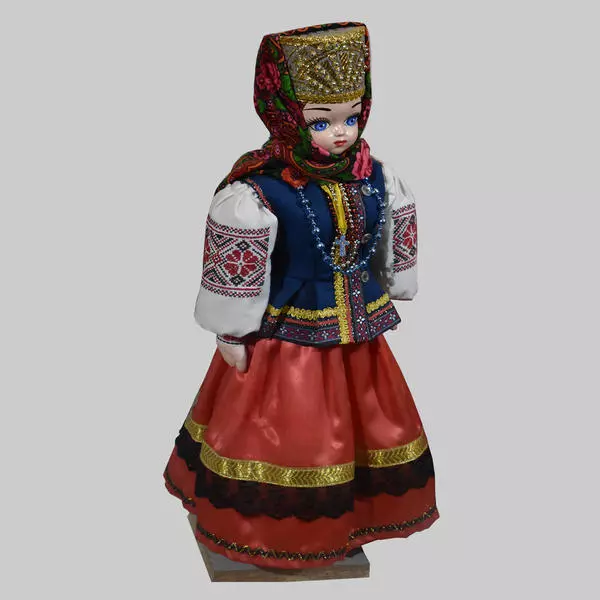
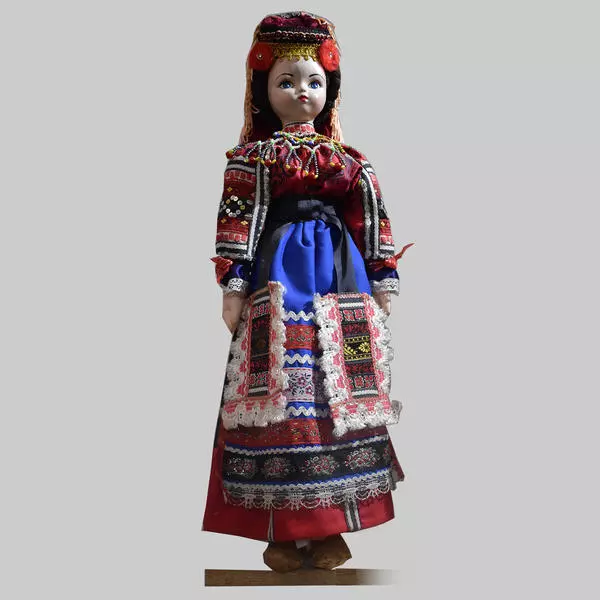
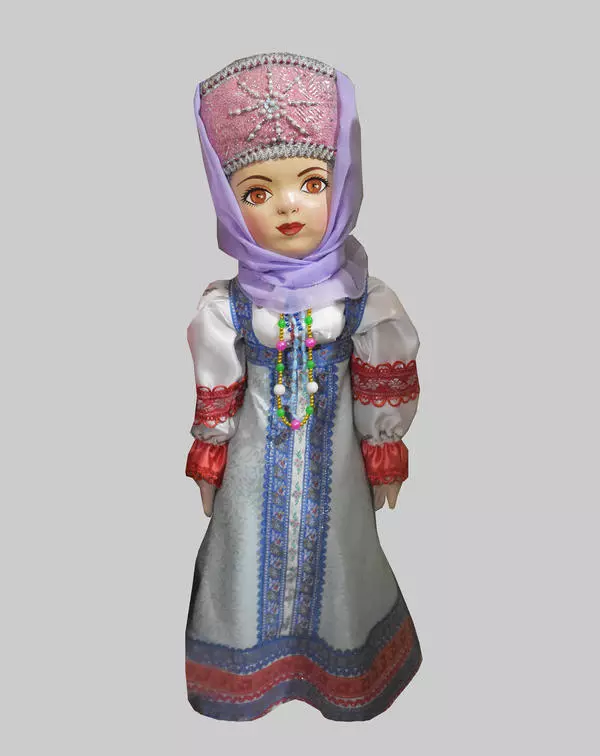
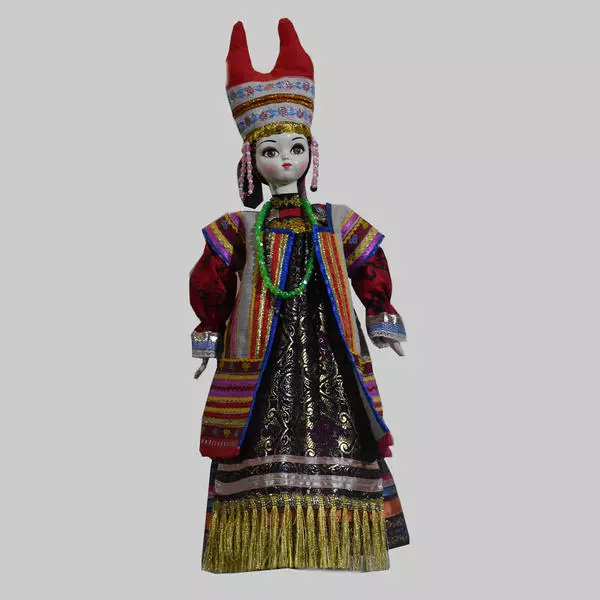
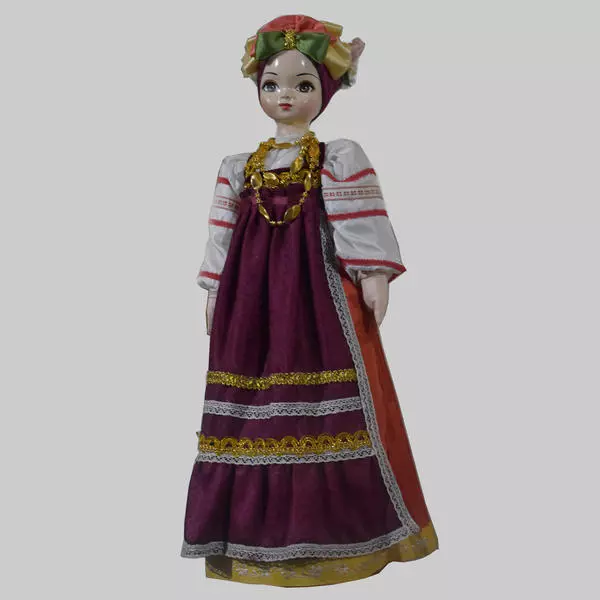
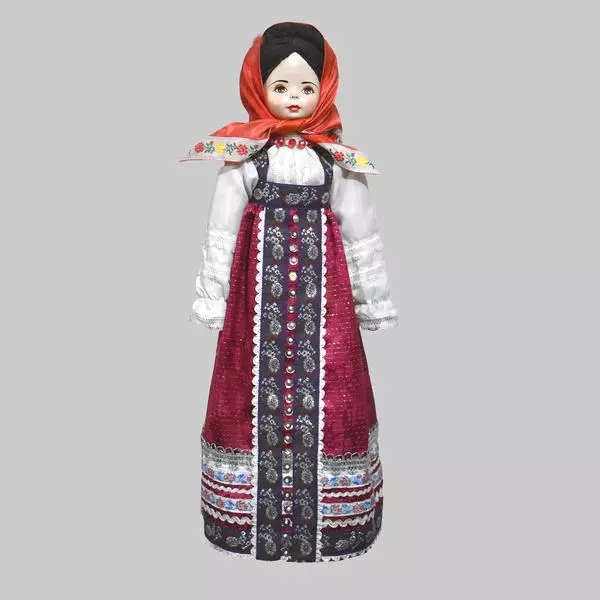
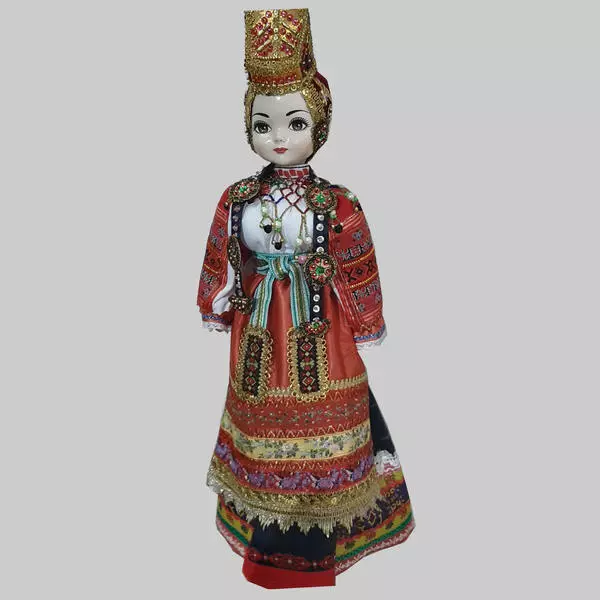
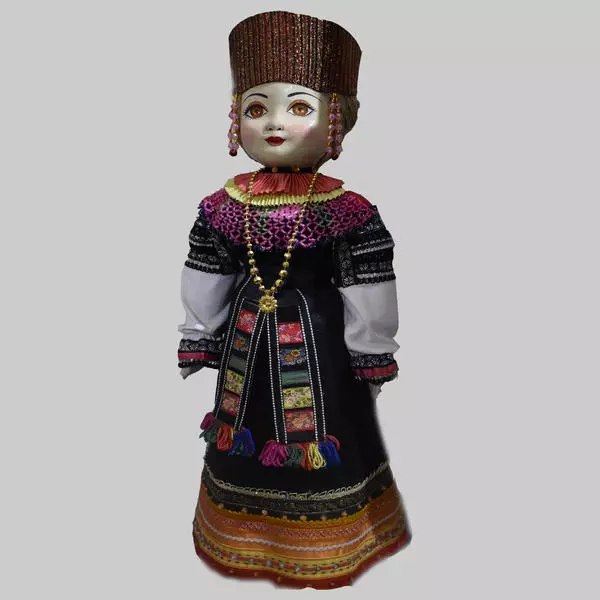
This big-eyed doll with a blush on her white face is wearing the Ostrogozhskiy district festive female costume. Every detail of a traditional gown has an ethnographic value. The costume base is a white shirt made of a homespun fabric with a sleeve gathered to the bottom, decorated with a white lace and a scarlet ribbon. She has a black-stitched woolen ponyova skirt over her shirt. The white ''curtain'' / ''veil'' (apron) at the bottom is richly decorated with lacing. A belt tightly encircling the doll’s waist — called “pokromka” — is also made of lacing. It slightly expands to the bottom, the ends are edged with gold lacing and decorated with bright geometric ornament.
We see on her head an example of the most luxurious folk dress — ''soroka'' — made of red fabric with beads and sparkling lacing. On the doll’s neck there is a traditional ''gribatka'' — an ornament of circles sewn together with gold and silver threads, a circular ''monist'' (necklace) complements the image. The doll is shod in neat bast shoes.
The festive folk costume colour palette consists of bright shades. Orange occupies a special place in it, or, ''yellow-hot'', as it is called in the Ostrogozhskiy district, due to its similarity to the hot sun colour. Crimson and pale pink colours in the outfit symbolize sunsets and sunrises, and underlined with green or blue, they seem even brighter, as if they were burning.
The symbol of all vegetation is green, it reminds of crops on peasant fields, generous garden beds, lush grasses of numerous Russian meadows, splendid tree crowns in gardens and dense forests, and leafy groves. Green symbolizes freedom, peace and abundance, however it is used in folk costumes not as actively as scarlet or red.
Yellow in a costume symbolizes short-term separations, ultramarine — rivers, seas and skies, as well as fidelity and chastity. White means death and mourning. Cold blue is rarely used, and only in the form of thin stripes or beads. Blue which means fear, bad weather and bloodlessness, emphasizes the brightness of red.
Black symbolizes eternal peace and rich lands, it is often and willingly used in the Voronezh region costumes — festive ponyova-skirts, for example, are always black. This helps emphasize the rhythm of colour combinations, multi-colour and shine of lacing, beads, gold and silver threads which decorate the gown. Black does not muffle other colours, thanks to it the joyful sound of bright colours becomes only more distinct.
In every element of festive attire thought out to the smallest detail, we feel not only a hand of a master and an innate taste, but also an aspiration to beauty and harmony.
We see on her head an example of the most luxurious folk dress — ''soroka'' — made of red fabric with beads and sparkling lacing. On the doll’s neck there is a traditional ''gribatka'' — an ornament of circles sewn together with gold and silver threads, a circular ''monist'' (necklace) complements the image. The doll is shod in neat bast shoes.
The festive folk costume colour palette consists of bright shades. Orange occupies a special place in it, or, ''yellow-hot'', as it is called in the Ostrogozhskiy district, due to its similarity to the hot sun colour. Crimson and pale pink colours in the outfit symbolize sunsets and sunrises, and underlined with green or blue, they seem even brighter, as if they were burning.
The symbol of all vegetation is green, it reminds of crops on peasant fields, generous garden beds, lush grasses of numerous Russian meadows, splendid tree crowns in gardens and dense forests, and leafy groves. Green symbolizes freedom, peace and abundance, however it is used in folk costumes not as actively as scarlet or red.
Yellow in a costume symbolizes short-term separations, ultramarine — rivers, seas and skies, as well as fidelity and chastity. White means death and mourning. Cold blue is rarely used, and only in the form of thin stripes or beads. Blue which means fear, bad weather and bloodlessness, emphasizes the brightness of red.
Black symbolizes eternal peace and rich lands, it is often and willingly used in the Voronezh region costumes — festive ponyova-skirts, for example, are always black. This helps emphasize the rhythm of colour combinations, multi-colour and shine of lacing, beads, gold and silver threads which decorate the gown. Black does not muffle other colours, thanks to it the joyful sound of bright colours becomes only more distinct.
In every element of festive attire thought out to the smallest detail, we feel not only a hand of a master and an innate taste, but also an aspiration to beauty and harmony.