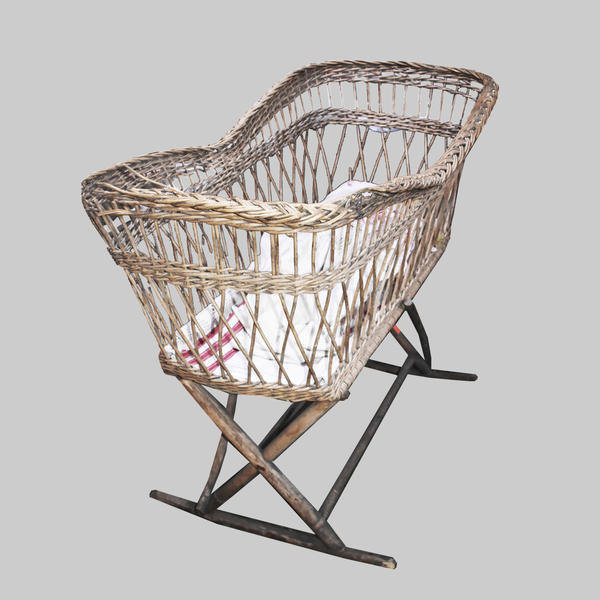
When did the first cradle appear? Probably when the first human was born. The child got used to motion when still in the warmth of its mother’s tummy, however, the busy mother could not constantly rock the newborn in her arms. A cradle is a hanging or floor-mounted crib that was the baby’s first home. Here they fell asleep and woke up, grew and learned about the world.
Hundreds of years ago, Siberian peoples believed that the first man had been lowered by gods from heaven in a patterned cradle on a gold chain. Every cradle existing on Earth was created in its image. Every newborn repeated the path of the first man.
At the same time, before cutting teeth and being named, babies were considered defenceless and so could be captured by evil spirits. The cradle protected the baby on its own; besides, parents placed knives, matches, or grindstones under it to scare away evil spirits. Hanging the cradle above the ground was considered a fool proof way to protect the baby from weak evil spirits.
Sometimes a log was laid next to the child, saying: “Sleep, baby, sleep as well as this log”. It was very important to please Budiha — an evil but not dangerous spirit that woke up kids just for fun, for the sake of its pleasure. They also left sweets in the cradle for Budiha and if the child continued to sleep restlessly, they hung the cradle in a new place.
As cradles were considered a strong pagan charm, Orthodox priests forbade putting babies in them before christening. In Christian families, the cradles were decorated with carved crosses and small icons.
Since pagan times, cradles were not allowed to be made from aspen. This tree was considered friendly with evil spirits and it could interfere with the baby’s happy and long life. Most of the time, cradles were made from linden bark, reed, pine shingles or bast. In some villages, it was customary for the child’s father to personally choose a tree somewhere far into the forest if he wanted his family to be large and strong and to see many future babies grow up in that cradle.
If possible, cradles were ordered from a local master, who did not just do quality work but sincerely prayed for it from the heart. Such cradles were expensive and not every family could afford them.
Cradles were usually hung in the back of the hut, behind a small stove. A ring was driven into the log on which the ceiling boards were held. A jib — a coil made out of thick wire — was attached to it, and the cradle would then be suspended from it.
Rocking a cradle was not as easy as it might have seemed at first glance. With one sharp, incorrect movement, the baby could just fall out. At 8-10 year old girls were often taught to rock cradles and were entrusted with the important job of calming the baby. It was strictly forbidden to rock empty cradles, so as not to give babies weak health or restlessness. This superstition has survived to modern times.
Many families treated cradles as heirlooms, which were passed down from generation to generation. Over 10 children could grow up in the same cradle.
Hundreds of years ago, Siberian peoples believed that the first man had been lowered by gods from heaven in a patterned cradle on a gold chain. Every cradle existing on Earth was created in its image. Every newborn repeated the path of the first man.
At the same time, before cutting teeth and being named, babies were considered defenceless and so could be captured by evil spirits. The cradle protected the baby on its own; besides, parents placed knives, matches, or grindstones under it to scare away evil spirits. Hanging the cradle above the ground was considered a fool proof way to protect the baby from weak evil spirits.
Sometimes a log was laid next to the child, saying: “Sleep, baby, sleep as well as this log”. It was very important to please Budiha — an evil but not dangerous spirit that woke up kids just for fun, for the sake of its pleasure. They also left sweets in the cradle for Budiha and if the child continued to sleep restlessly, they hung the cradle in a new place.
As cradles were considered a strong pagan charm, Orthodox priests forbade putting babies in them before christening. In Christian families, the cradles were decorated with carved crosses and small icons.
Since pagan times, cradles were not allowed to be made from aspen. This tree was considered friendly with evil spirits and it could interfere with the baby’s happy and long life. Most of the time, cradles were made from linden bark, reed, pine shingles or bast. In some villages, it was customary for the child’s father to personally choose a tree somewhere far into the forest if he wanted his family to be large and strong and to see many future babies grow up in that cradle.
If possible, cradles were ordered from a local master, who did not just do quality work but sincerely prayed for it from the heart. Such cradles were expensive and not every family could afford them.
Cradles were usually hung in the back of the hut, behind a small stove. A ring was driven into the log on which the ceiling boards were held. A jib — a coil made out of thick wire — was attached to it, and the cradle would then be suspended from it.
Rocking a cradle was not as easy as it might have seemed at first glance. With one sharp, incorrect movement, the baby could just fall out. At 8-10 year old girls were often taught to rock cradles and were entrusted with the important job of calming the baby. It was strictly forbidden to rock empty cradles, so as not to give babies weak health or restlessness. This superstition has survived to modern times.
Many families treated cradles as heirlooms, which were passed down from generation to generation. Over 10 children could grow up in the same cradle.