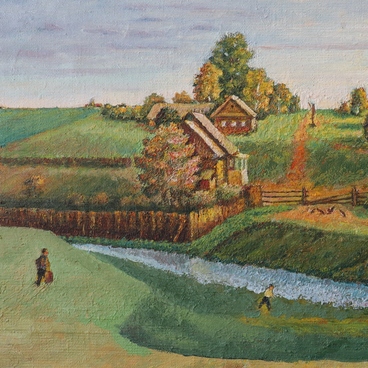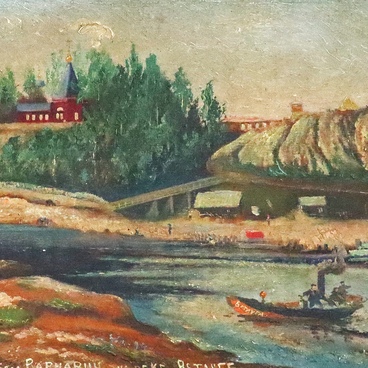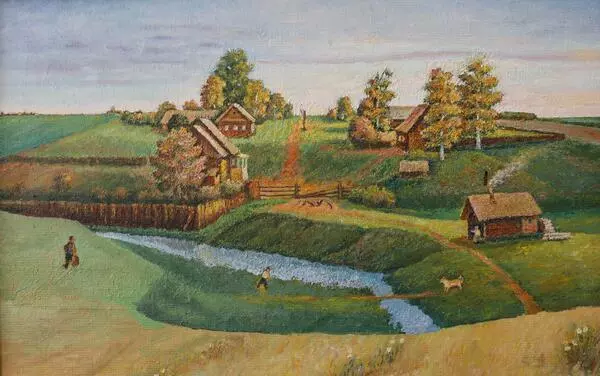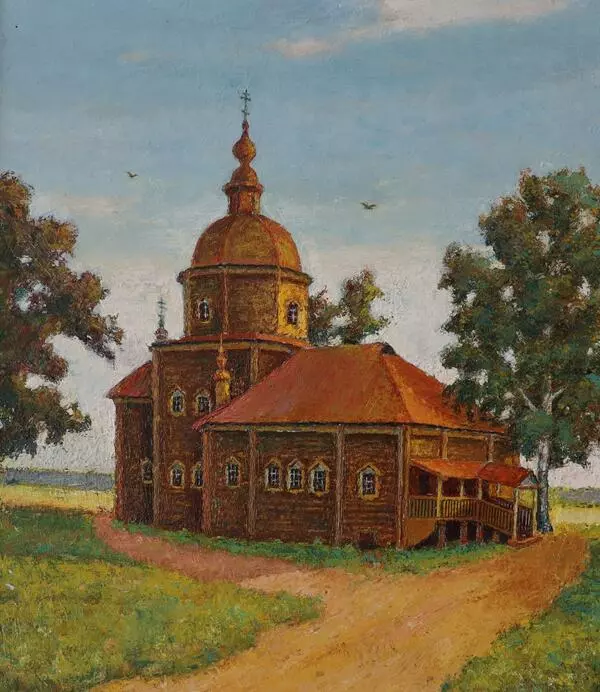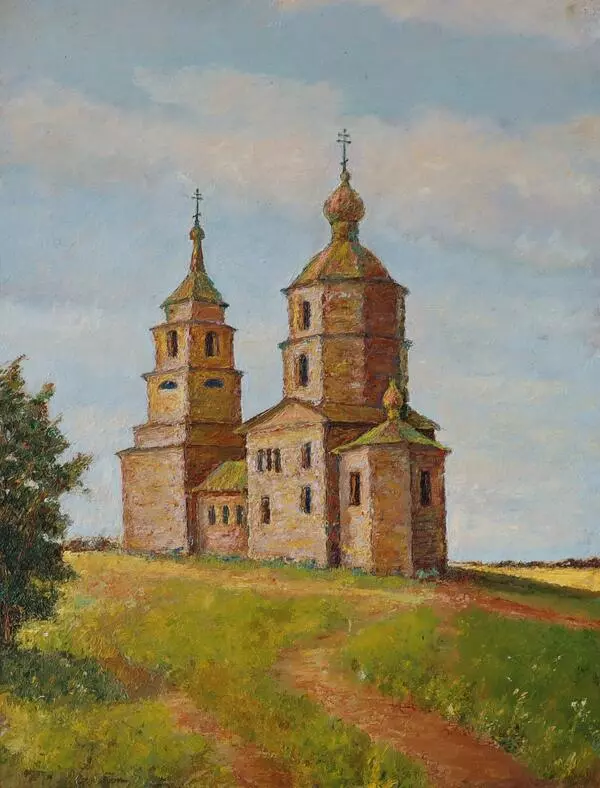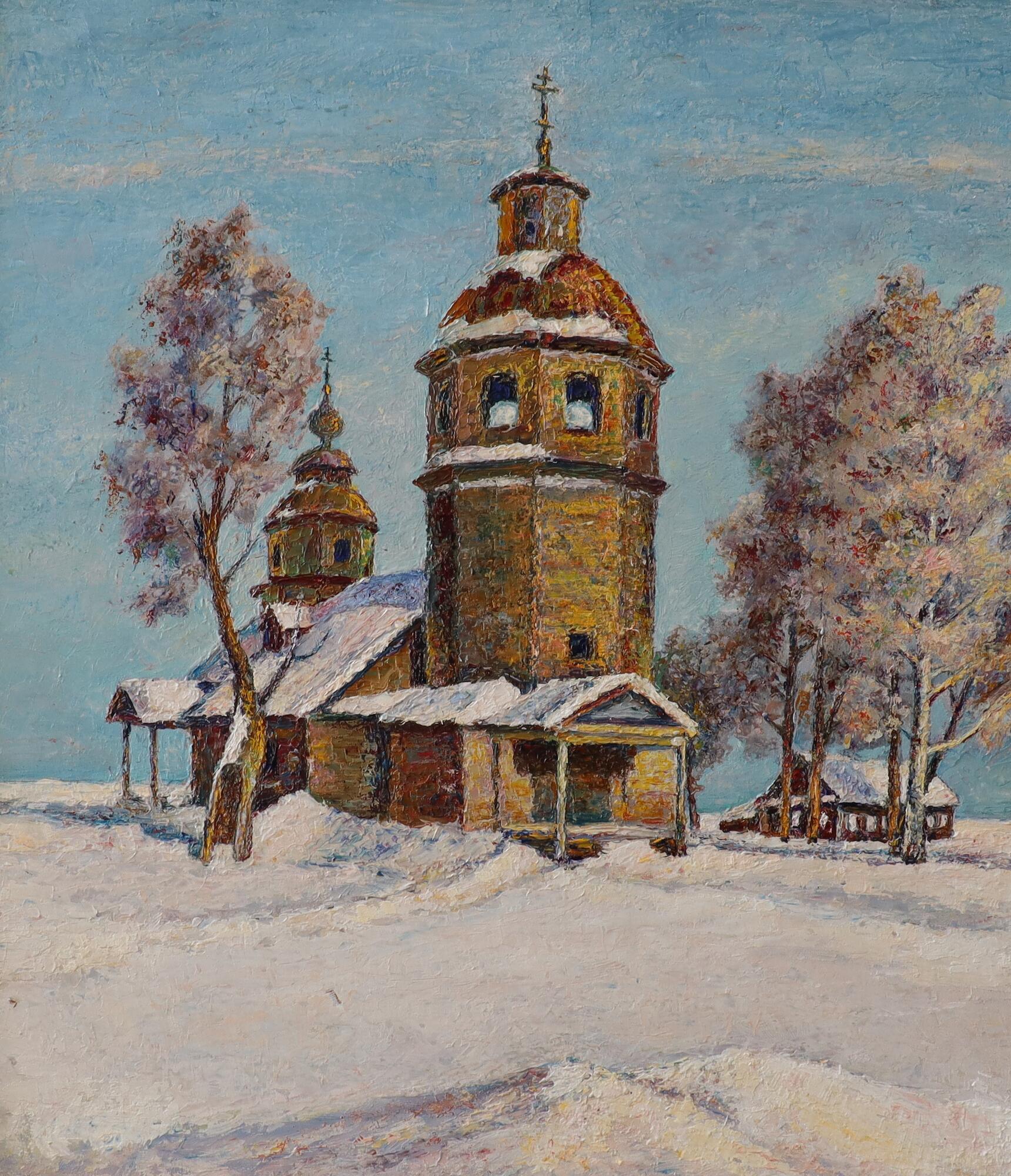


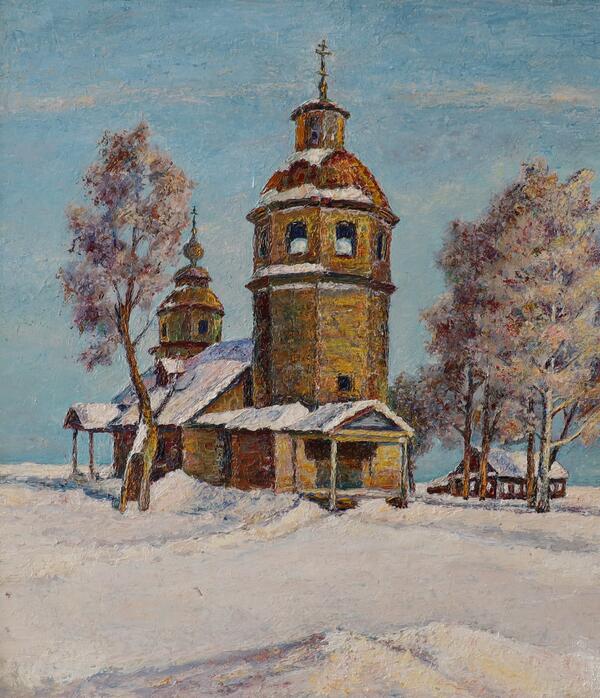
Mikhail Baldin is first of all known as an outstanding historian and ethnographer, as well as the author of lots of publications on the history of the territories near the riverbanks of the Vetluga River, the Povetluzhje. However, he was also a talented painter: he created the lyrical landscape ‘View of the Church in Winter’.
Baldin has been involved into visual arts since his youth. In the late 1930s, he studied woodworking at the Semyonov Trade School and took part in the courses of an amateur art studio. Shortly before the Great Patriotic War, he enrolled into the prestigious Gorky School of Arts, but when the War began, it was disbanded: Baldin had only managed to study there for a year.
Despite everything, throughout his life, Baldin was closely associated with visual arts. This is evidenced by the numerous paintings, drawings, and sketches put on display in the Varnavino Museum of History and Art. In this painting, completed in the 1990s, Baldin depicted a small wooden church in the midst of a snow-covered field: like a spiritual beacon, it towers over the endless Russian landscape.
The exact location of the church shown in the painting is unknown, but a legend has it that the painter painted the church in the village of Arkhangelskoe. In the middle of the 18th century, similar majestic buildings appeared in a number of Povetluzhje villages: Makarye-Prityk, Arkhangelskoe, Vosnesenye, Belyshevo, Turan.
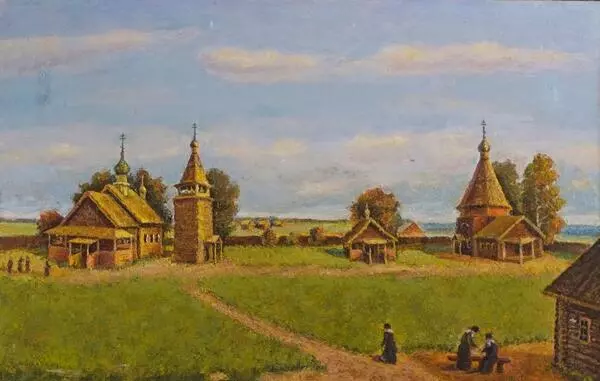
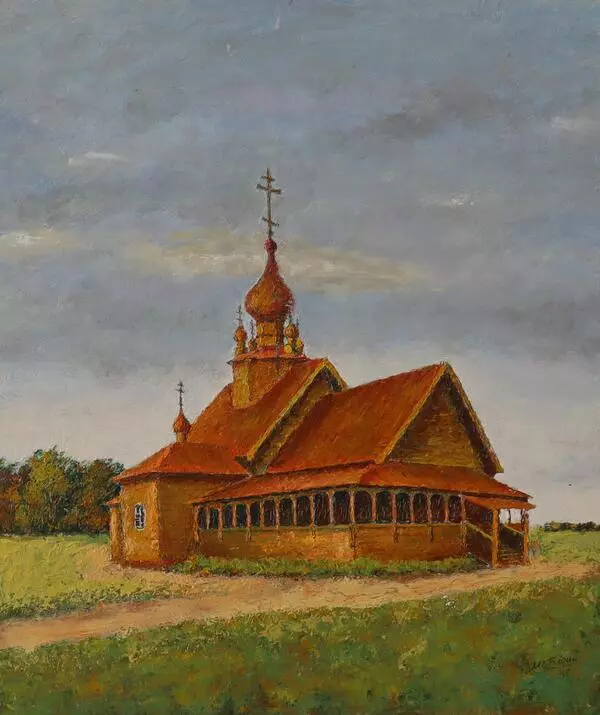
In his paintings, Baldin often depicted the churches of Povetluzhje. For example, the Varnavino Museum has such paintings as ‘The Church in the Village of Ilyinskoe in 1773’ and ‘Trinity-Varnavinsky Monastery in the 17th Century’ in its collection. An excellent knowledge of the history of the Povetluzhje allowed Baldin to authentically reconstruct the appearance of religious buildings in his paintings: he often depicted Orthodox buildings that were either lost or ruined.
Baldin has been involved into visual arts since his youth. In the late 1930s, he studied woodworking at the Semyonov Trade School and took part in the courses of an amateur art studio. Shortly before the Great Patriotic War, he enrolled into the prestigious Gorky School of Arts, but when the War began, it was disbanded: Baldin had only managed to study there for a year.
Despite everything, throughout his life, Baldin was closely associated with visual arts. This is evidenced by the numerous paintings, drawings, and sketches put on display in the Varnavino Museum of History and Art. In this painting, completed in the 1990s, Baldin depicted a small wooden church in the midst of a snow-covered field: like a spiritual beacon, it towers over the endless Russian landscape.
The exact location of the church shown in the painting is unknown, but a legend has it that the painter painted the church in the village of Arkhangelskoe. In the middle of the 18th century, similar majestic buildings appeared in a number of Povetluzhje villages: Makarye-Prityk, Arkhangelskoe, Vosnesenye, Belyshevo, Turan.
The churches of this period were usually tower-shaped, with three tiers. Their average height was about 12.5 fathoms (about 26.6 meters), and the length was 6 fathoms (almost 13 meters), and they were 4 fathoms wide (about 8.5 meters). Ceilings in such churches were shaped as a five-domed tent, and the 16 windows of the church were necessarily located in 4 tiers.
In his paintings, Baldin often depicted the churches of Povetluzhje. For example, the Varnavino Museum has such paintings as ‘The Church in the Village of Ilyinskoe in 1773’ and ‘Trinity-Varnavinsky Monastery in the 17th Century’ in its collection. An excellent knowledge of the history of the Povetluzhje allowed Baldin to authentically reconstruct the appearance of religious buildings in his paintings: he often depicted Orthodox buildings that were either lost or ruined.