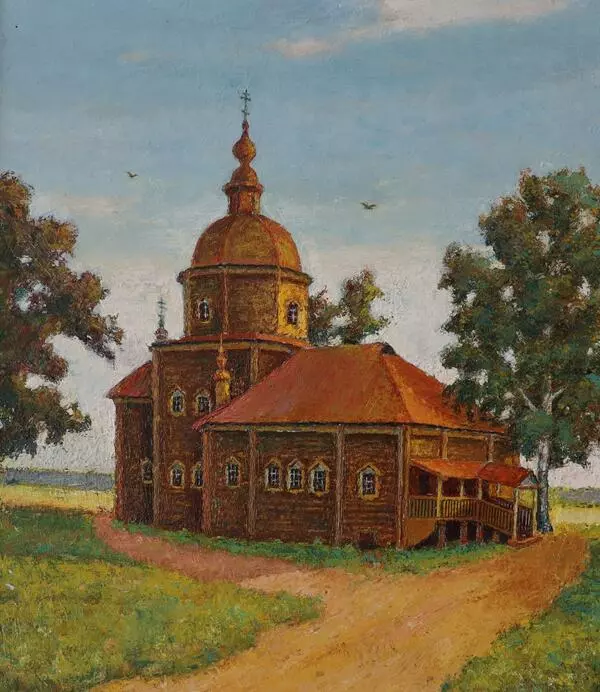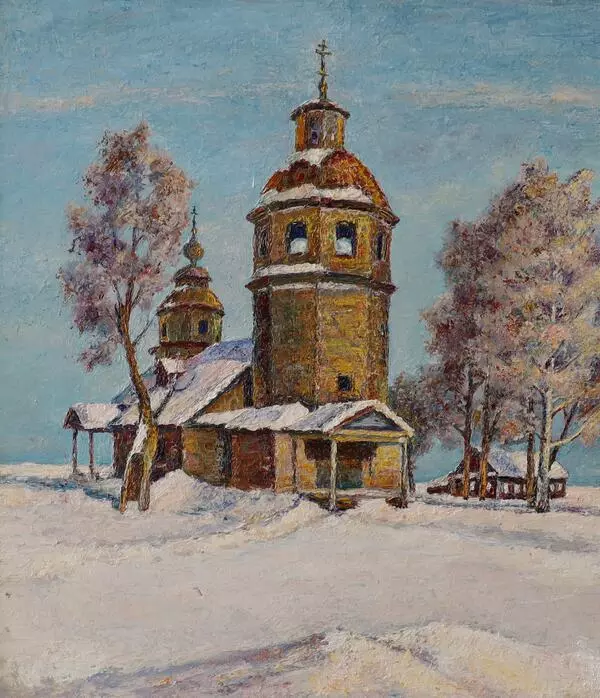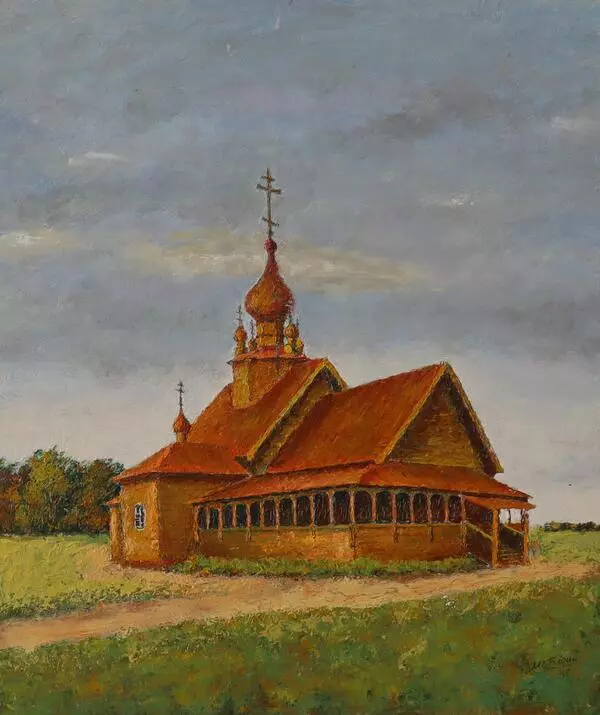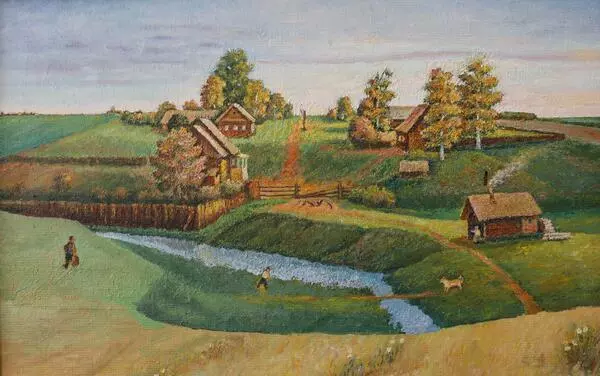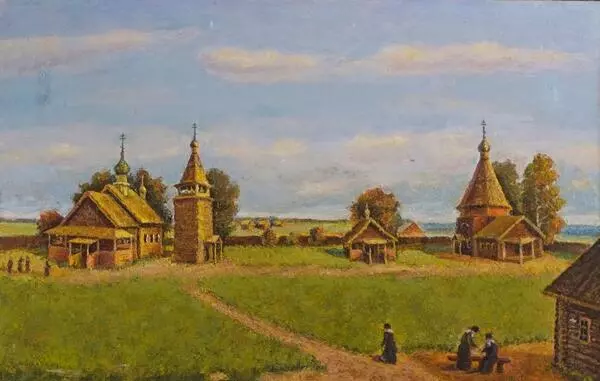
The landscape ‘The Church in the Vill. of Ilyinskoe in 1773’ was painted by Mikhail Baldin, a well-known historian and local lore specialist, and author of many publications on the history of Povetluzhje — the territories surrounding the riverbanks of the Vetluga River. Although Baldin is known primarily for his achievements in historical science, he has been involved with the visual arts since his very young age. In the late 1930s, he studied woodworking at the Semyonov Trade School and attended courses at an amateur art studio. In September 1940, he became a student at the Gorky School of Art, which was disbanded at the outbreak of the Great Patriotic War: as a painter, Baldin only had one year of professional artistic training.
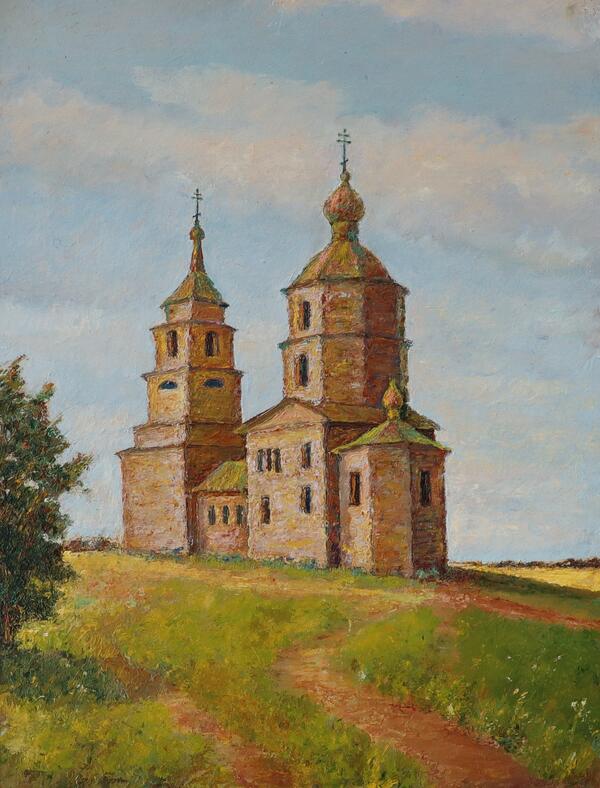
Nevertheless, his love for painting persisted throughout his life, as evidenced by the numerous paintings, drawings, sketches that are on display and are kept in the funds of the Varnavino Museum of History and Art. In this picture, Baldin depicted a wooden church built in honor of the Prophet of God Elijah in the village of Ilyinskoe, which is located on the right bank of the Vetluga River. The church, erected in 1773, is a classic example of northern Russian sacral architecture.
Russian architects have been building churches in wood and in stone since ancient times. Building churches in stone required special conditions, huge financial resources, and experienced masons should have been involved, but wooden churches could be built everywhere due to the abundance of this material. Considering the great need for such buildings, a prominent art of building wooden churches was quickly formed in Russia. Architectural forms and technical solutions used for the design of wooden churches were so progressive that soon stone architecture started to be influenced by the wooden architecture, too.
As the exact date the painting was made on is unknown, we don’t know whether Baldin painted the church from life. However, it is known for a fact that he could see the Church of Elijah before its fall into disuse, which started in the 1950s and continues to this day. The church itself was an “octagon on a quadruple”, which was the type of structure popular in wooden church construction, when a higher tower structure (“octagon”) was located on a lower quadrangular building (“quadrangle”). As Baldin’s painting shows, the two octagonal towers were crowned with crosses and elegant greenish hipped roofs. One of the towers served as a bell tower, which was not apart from other buildings, but made part of the church complex.
Nevertheless, his love for painting persisted throughout his life, as evidenced by the numerous paintings, drawings, sketches that are on display and are kept in the funds of the Varnavino Museum of History and Art. In this picture, Baldin depicted a wooden church built in honor of the Prophet of God Elijah in the village of Ilyinskoe, which is located on the right bank of the Vetluga River. The church, erected in 1773, is a classic example of northern Russian sacral architecture.
Russian architects have been building churches in wood and in stone since ancient times. Building churches in stone required special conditions, huge financial resources, and experienced masons should have been involved, but wooden churches could be built everywhere due to the abundance of this material. Considering the great need for such buildings, a prominent art of building wooden churches was quickly formed in Russia. Architectural forms and technical solutions used for the design of wooden churches were so progressive that soon stone architecture started to be influenced by the wooden architecture, too.
As the exact date the painting was made on is unknown, we don’t know whether Baldin painted the church from life. However, it is known for a fact that he could see the Church of Elijah before its fall into disuse, which started in the 1950s and continues to this day. The church itself was an “octagon on a quadruple”, which was the type of structure popular in wooden church construction, when a higher tower structure (“octagon”) was located on a lower quadrangular building (“quadrangle”). As Baldin’s painting shows, the two octagonal towers were crowned with crosses and elegant greenish hipped roofs. One of the towers served as a bell tower, which was not apart from other buildings, but made part of the church complex.