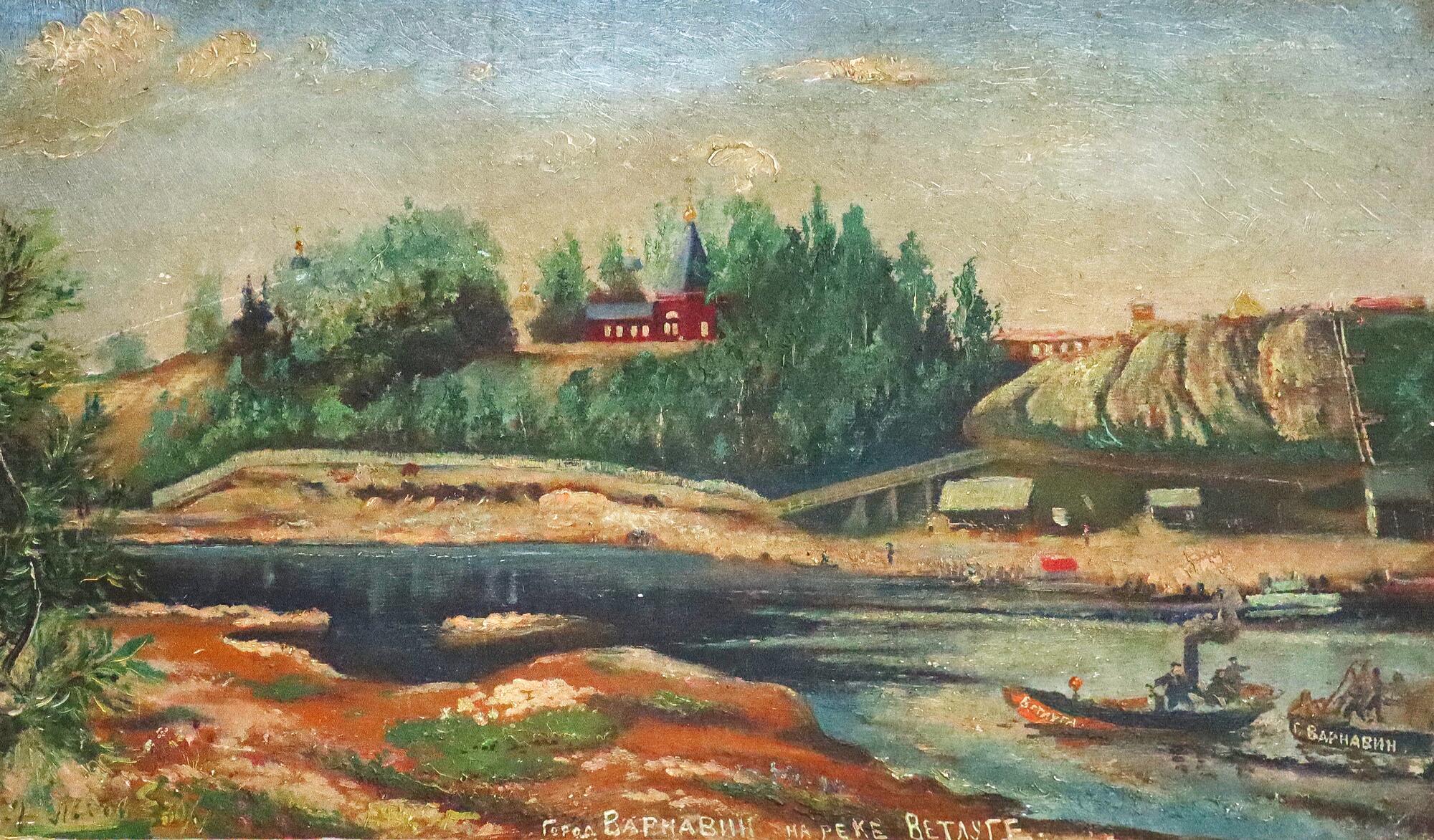


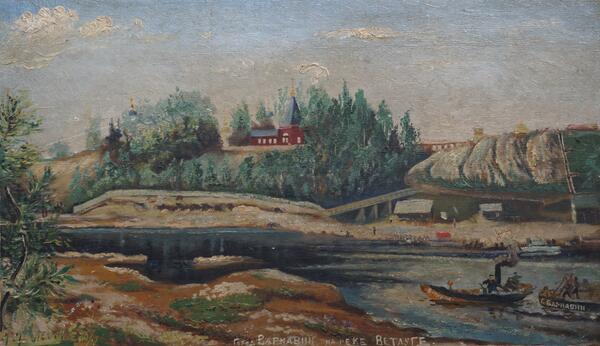
The vivid landscape ‘The Town of Varnavin on the Vetluga River’ was redrawn from a photograph of the early 20th century. The work was completed on May 30, 1945, nothing is known about its author or the circumstances of its creation. It depicts the ancient town of Varnavin from the side of the taiga river Vetluga. The viewers can see the churches of the Trinity-Varnavinsky Monastery, a well-equipped pier, and a large staircase leading from the pier to the Marketplace.
The town of Varnavin was transformed in 1778 from the village of Varnavino monastery, which by that time had 11 households and 50 residents. This was made by decree of Empress Catherine II, heiress of the glorious deeds of Peter the Great, First Emperor of All-Russia. Located on the banks of the Vetluga River, which flows into the Volga, Varnavin was the main transport artery of the entire Vetluga region.
Every winter, a lot of ships were built here, loaded with firewood, timber and other timber products in the spring and floated to Kozmodemyansk, and then further along the Volga to Saratov, Astrakhan and other towns. The navigation on the Vetluga River was limited: in spring it extended from early May to mid-June, in autumn — from late August to September.
The main means of transporting cargo and various goods for the population were various river ships. Not every chief town had a well-equipped pier. ‘Only Varnavin has a real berthing place, set up at the expense of the city for all ships, with rooms for passengers and for cargo. True, it is cramped and not that convenient, but people are still very grateful for it to the small town’s officials. The rest of the berthing places have rooms for cargo, and the public only has bare sand and the dome of heaven’, wrote Nikolai Ogloblin, the great Russian historian-archaeographer, about the Varnavin berthing place.
The two-story passenger steamships “Kommersant” and “Dmitry”, owned by large merchant-traders F.T. Mutovkin and I.G. Popov, respectively, are known to have docked. Steamships of local merchants travelled along Vetluga, too: V. Chirkin owned the passenger steamer “Pyotr”, as well as the tugboats “Misha” and “Malyutka”, the Ovchinnikov brothers owned the steamers “Rassvet” and “Ant”, and the merchant Styazhkov owned the steamer “Serezha”.
Above the pier was a large raft, from which water could be taken in buckets and barrels. Nearby was a ferry propelled by two or four people: they pulled the levers that served as the drive for its wheels. The ferry was a catamaran, which consisted of two large boats connected by a large deck-platform.
The town of Varnavin was transformed in 1778 from the village of Varnavino monastery, which by that time had 11 households and 50 residents. This was made by decree of Empress Catherine II, heiress of the glorious deeds of Peter the Great, First Emperor of All-Russia. Located on the banks of the Vetluga River, which flows into the Volga, Varnavin was the main transport artery of the entire Vetluga region.
Every winter, a lot of ships were built here, loaded with firewood, timber and other timber products in the spring and floated to Kozmodemyansk, and then further along the Volga to Saratov, Astrakhan and other towns. The navigation on the Vetluga River was limited: in spring it extended from early May to mid-June, in autumn — from late August to September.
The main means of transporting cargo and various goods for the population were various river ships. Not every chief town had a well-equipped pier. ‘Only Varnavin has a real berthing place, set up at the expense of the city for all ships, with rooms for passengers and for cargo. True, it is cramped and not that convenient, but people are still very grateful for it to the small town’s officials. The rest of the berthing places have rooms for cargo, and the public only has bare sand and the dome of heaven’, wrote Nikolai Ogloblin, the great Russian historian-archaeographer, about the Varnavin berthing place.
The two-story passenger steamships “Kommersant” and “Dmitry”, owned by large merchant-traders F.T. Mutovkin and I.G. Popov, respectively, are known to have docked. Steamships of local merchants travelled along Vetluga, too: V. Chirkin owned the passenger steamer “Pyotr”, as well as the tugboats “Misha” and “Malyutka”, the Ovchinnikov brothers owned the steamers “Rassvet” and “Ant”, and the merchant Styazhkov owned the steamer “Serezha”.
Above the pier was a large raft, from which water could be taken in buckets and barrels. Nearby was a ferry propelled by two or four people: they pulled the levers that served as the drive for its wheels. The ferry was a catamaran, which consisted of two large boats connected by a large deck-platform.