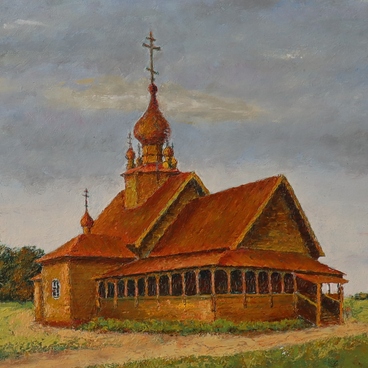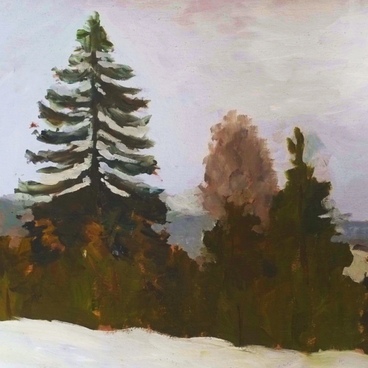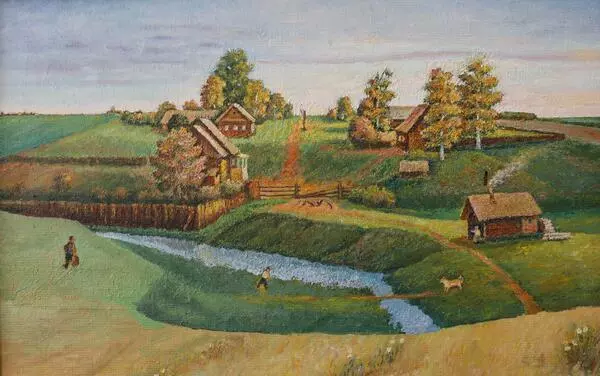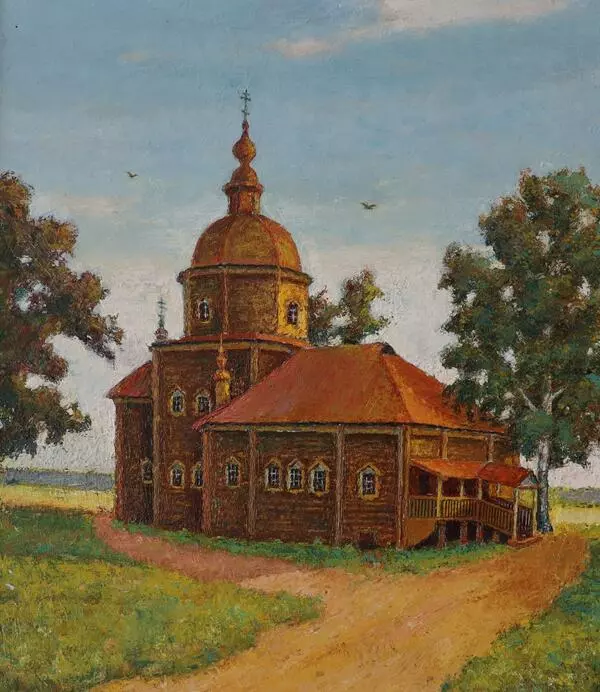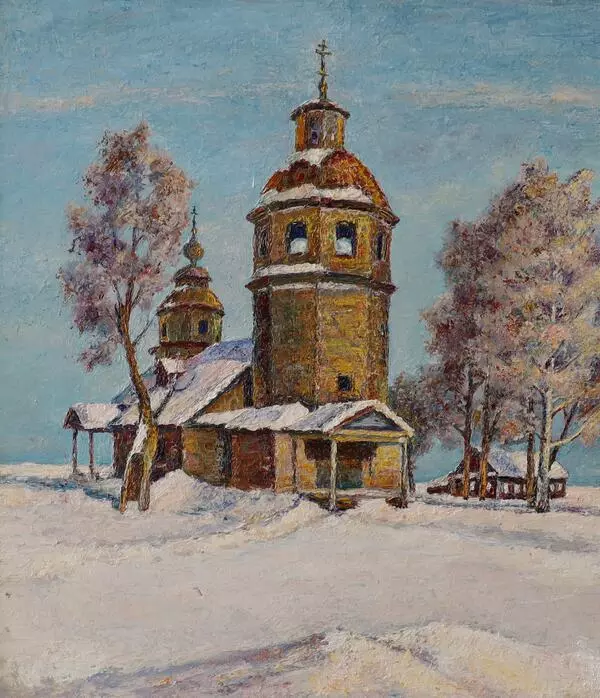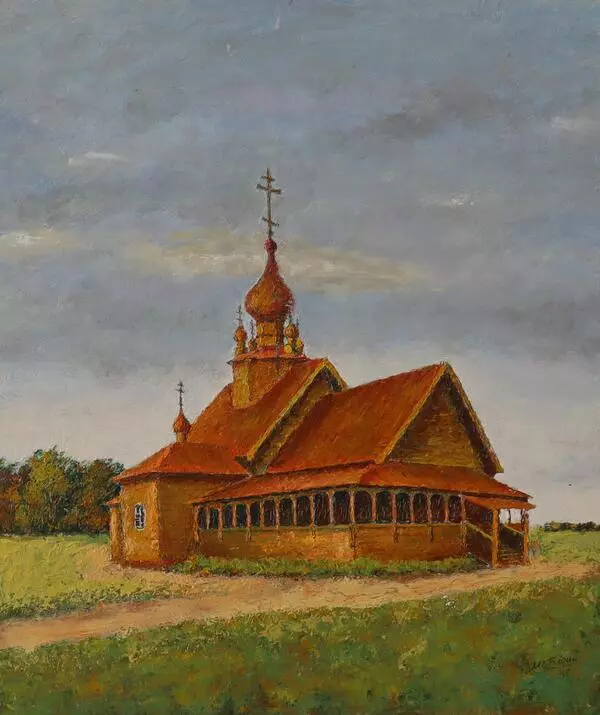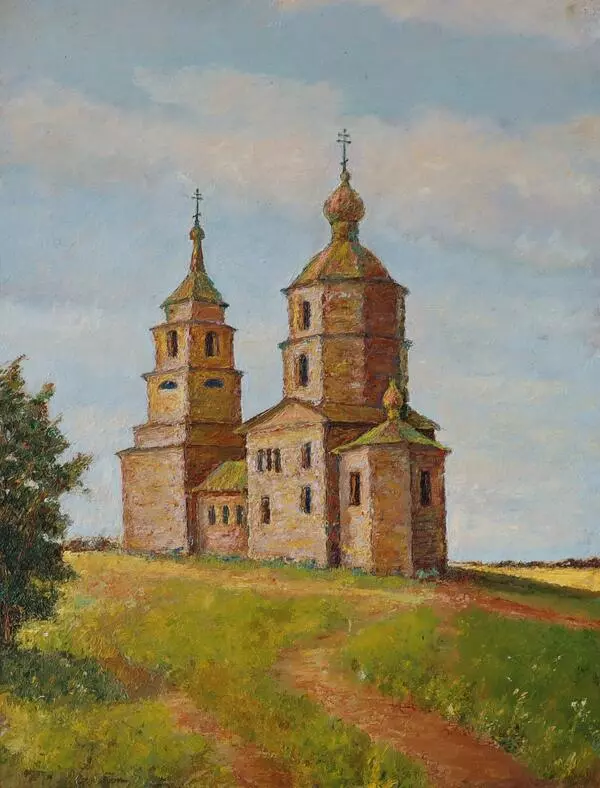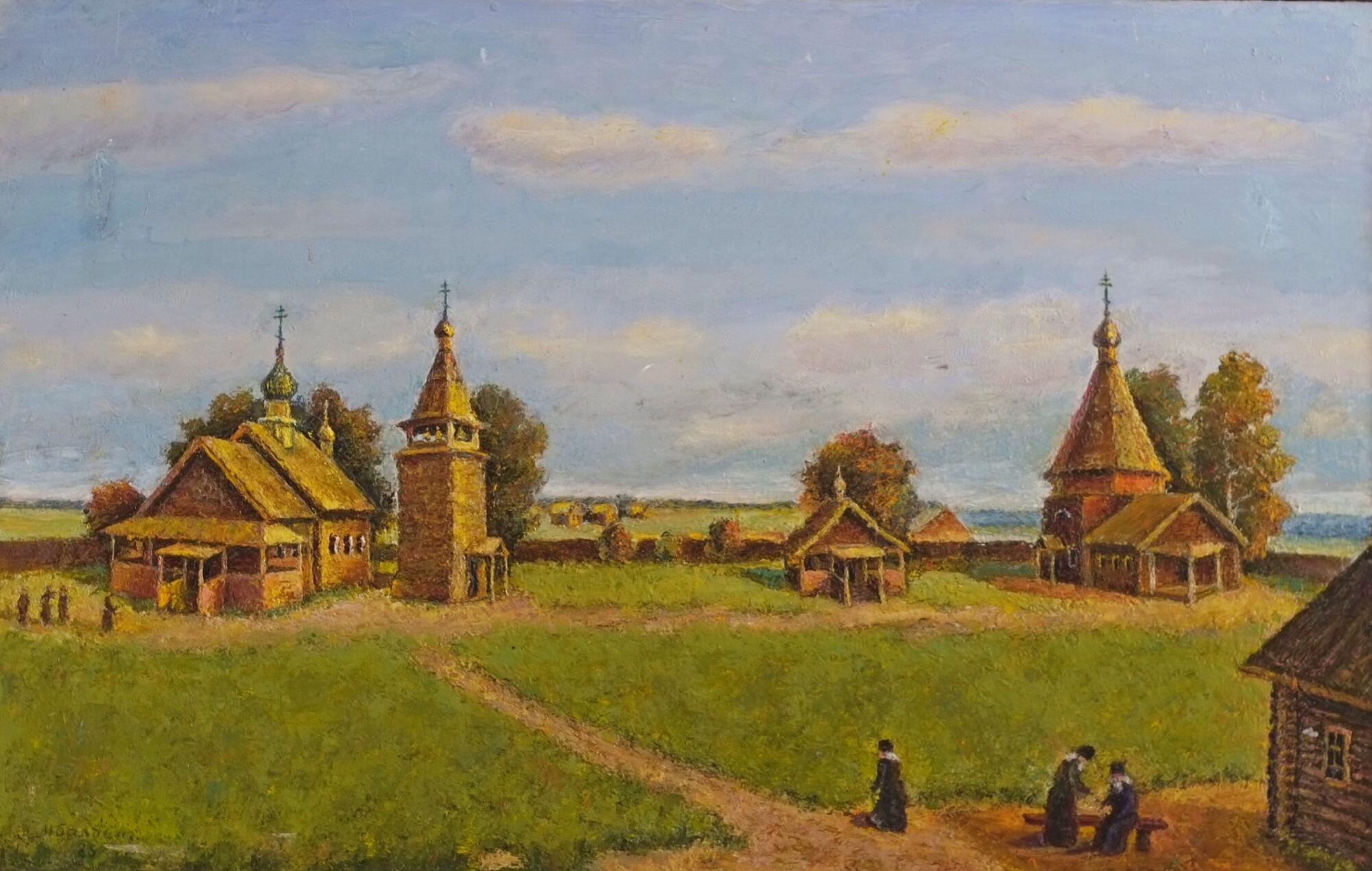


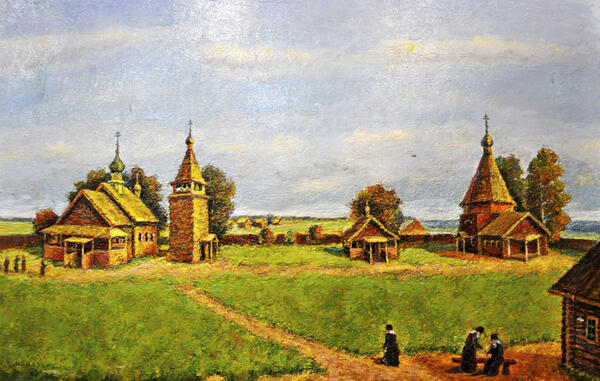
In the painting ‘Trinity-Varnavinsky Monastery in the 17th century’ Mikhail Baldin combined features of landscape and of a historical painting. This combination of genres is easy to explain, because Baldin is first of all known as an outstanding historian and ethnographer, as well as the author of lots of publications on the history of the territories near the riverbanks of the Vetluga River, the Povetluzhje.
Baldin is primarily known for his achievements in historical science, but he was involved in the visual arts since his very childhood. In the late 1930s, he studied woodworking at the Semyonov Trade School and simultaneously attended courses at an amateur art studio. In September 1940, he enrolled into the prestigious Gorky School of Arts, but when the Great Patriotic War began, it closed. Baldin’s education, as a painter, didn’t last for more than one year.
Despite the fact that then he did not continue his professional education, throughout his life Baldin was closely associated with visual arts. This is evidenced by a large number of paintings, drawings, sketches kept in the collection of the Varnavino Museum of History and Art. The historical landscape ‘Trinity-Varnavinsky Monastery in the 17th century’, painted in 1994, is among these works.
As it is clear from the title, the painting shows the Trinity-Varnavinsky Monastery. It was founded in the second half of the 15th century by the disciples of the Reverend Barnabas of Vetluga. Located in Povetluzhje, in a remote taiga territory, on the border of Russian lands, for a long time, the monastery was the only Orthodox church in a hostile environment of Meadow Cheremis tribes (Mari). The monastery was also attacked by the supporters of the rebellious Cossack Stepan Razin.
Having withstood many hostile invasions, the Trinity-Varnavinsky Monastery played a leading role in spreading the Orthodoxy among the pagan tribes of Povetluzhje. In 1666, a new church was built on the territory of the monastery in honor of St. Nicholas the Wonderworker, over the grave of St. Barnabas. For 1702, there is the following record: ‘in the Varnavina monastery, a church in the name of Nicholas the Wonderworker was chopped into the corners, with a dining table <…> the cross is brazed with white German iron’. The magnificent tent-roofed style church existed from 1666 to 1932, when the Komsomol members sawed it for firewood during a communist subbotnik.
Baldin is primarily known for his achievements in historical science, but he was involved in the visual arts since his very childhood. In the late 1930s, he studied woodworking at the Semyonov Trade School and simultaneously attended courses at an amateur art studio. In September 1940, he enrolled into the prestigious Gorky School of Arts, but when the Great Patriotic War began, it closed. Baldin’s education, as a painter, didn’t last for more than one year.
Despite the fact that then he did not continue his professional education, throughout his life Baldin was closely associated with visual arts. This is evidenced by a large number of paintings, drawings, sketches kept in the collection of the Varnavino Museum of History and Art. The historical landscape ‘Trinity-Varnavinsky Monastery in the 17th century’, painted in 1994, is among these works.
As it is clear from the title, the painting shows the Trinity-Varnavinsky Monastery. It was founded in the second half of the 15th century by the disciples of the Reverend Barnabas of Vetluga. Located in Povetluzhje, in a remote taiga territory, on the border of Russian lands, for a long time, the monastery was the only Orthodox church in a hostile environment of Meadow Cheremis tribes (Mari). The monastery was also attacked by the supporters of the rebellious Cossack Stepan Razin.
Having withstood many hostile invasions, the Trinity-Varnavinsky Monastery played a leading role in spreading the Orthodoxy among the pagan tribes of Povetluzhje. In 1666, a new church was built on the territory of the monastery in honor of St. Nicholas the Wonderworker, over the grave of St. Barnabas. For 1702, there is the following record: ‘in the Varnavina monastery, a church in the name of Nicholas the Wonderworker was chopped into the corners, with a dining table <…> the cross is brazed with white German iron’. The magnificent tent-roofed style church existed from 1666 to 1932, when the Komsomol members sawed it for firewood during a communist subbotnik.