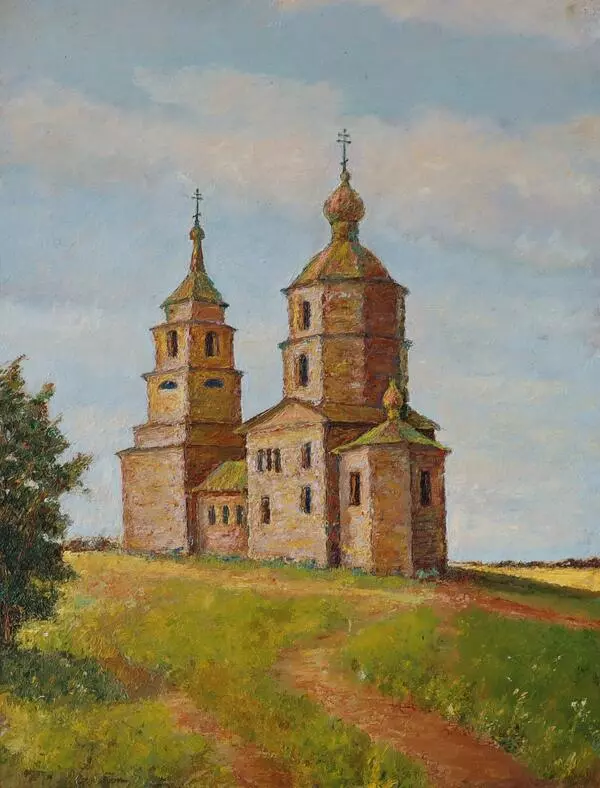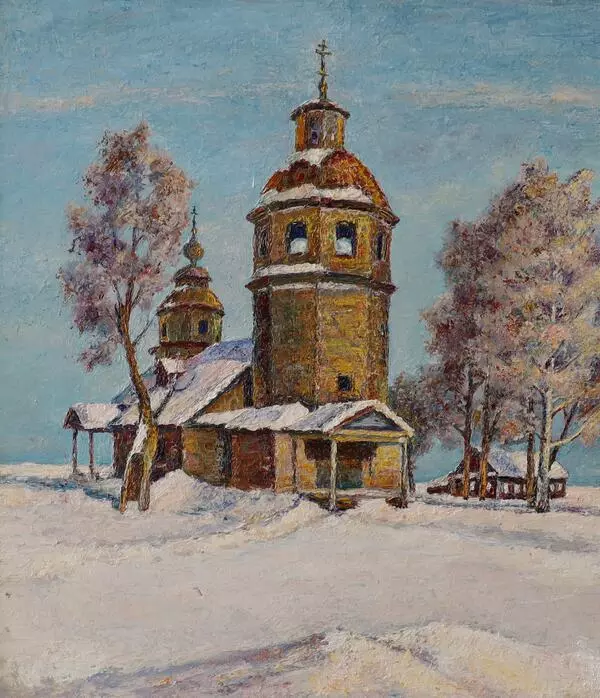
Mikhail Baldin is a rare example of a local lore specialist, for whom painting became something of a working tool. Born in Varnavino, he is known primarily as an outstanding historian, having written many important works of local lore, including the book ‘Varnavino antiquity. Essays on the history of Povetluzhje’ published in 1993. As a painter, he created both beautiful landscapes and historical paintings. One of these paintings is ‘Church in the Village of Dmitrievskoe, 1935’.
In fact, Baldin got involved in visual arts from an early age. In the late 1930s, he studied woodworking at the Semyonov Trade School and attended courses at an amateur art studio. Before the Great Patriotic War, he became a student at the Gorky School of Art, which was disbanded during the War: Baldin had only managed to study there for a year. Despite the fact that Baldin never studied painting afterwards, he didn’t stop painting for all his life. This is evidenced by the numerous paintings, drawings, and sketches put on display in the Varnavino Museum of History and Art.
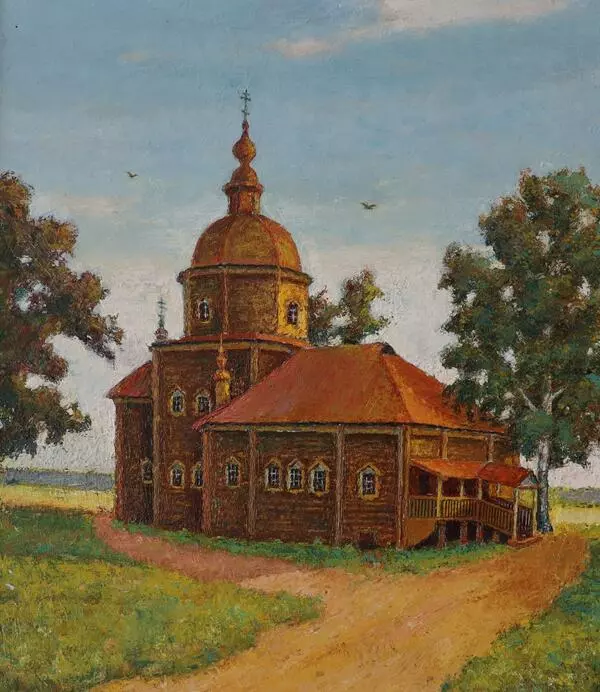
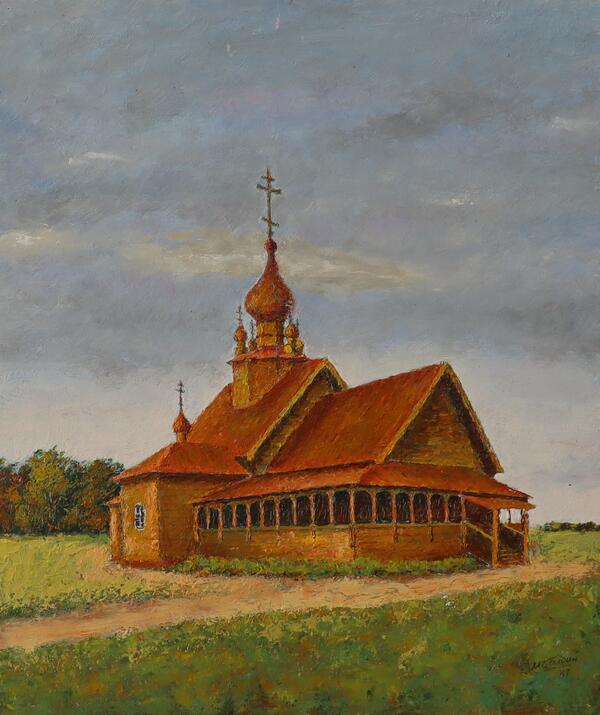
In this picture, Baldin depicts the church in the village of Dmitrievskoe, Krasnobakovsky district, Nizhny Novgorod region. This village is located on the right bank of the Vetluga River; there you can see partial remains of the Zakharyin estate - an architectural monument built in the second half of the 19th century. The local church, however, built even earlier and consecrated in honor of the holy Great Martyr Demetrius of Thessaloniki, was not so lucky: it was destroyed in the middle of the 20th century.
Baldin’s landscape shows that the lost church in the village of Dmitrievskoe was a wonderful example of wooden church architecture of the Russian north. The painting shows a wooden cage church, that is, a rectangular church with a gable roof. On the roofs of such churches one can see barrel-cylinders, from which domes are built, covered with aspen planks. The domes were crowned with wooden crosses. An altar and a refectory were added to the church. Such architectural style was brought to Povetluzhje by Russian carpenters from the woodlands of Galich-Unzhensky region.
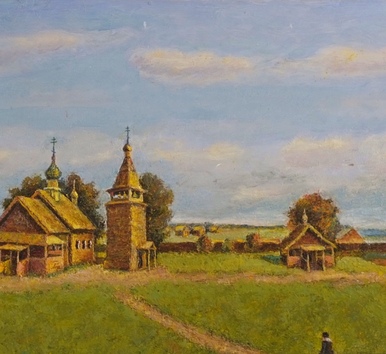
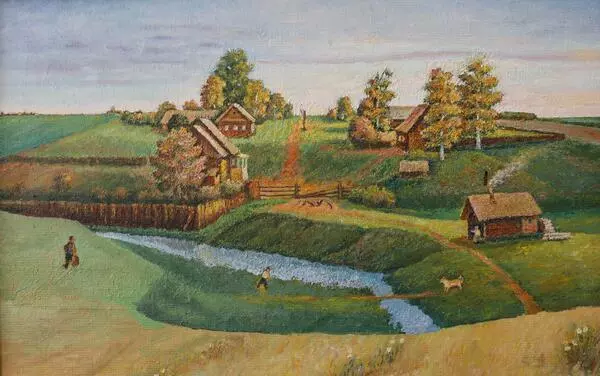
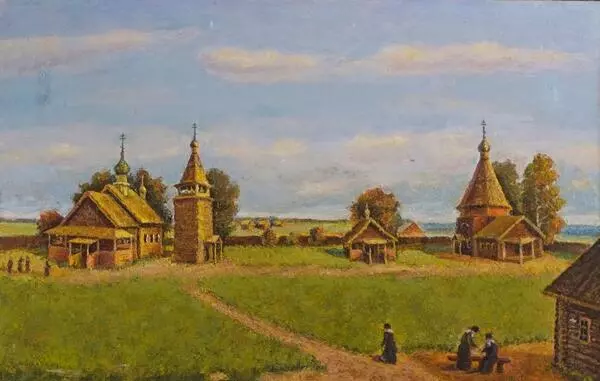
Most of Baldin’s paintings depict the buildings destroyed by the Soviet regime. For example, the painting “A View of the Church” most likely depicts the lost wooden Trinity Church in the village of Turan, and the landscape “Trinity-Varnavinsky Monastery in the 17th century” shows the monastery, sawed for firewood during the communist subbotnik by the komsomol members. The only exception is the painting “View of the Village of Zagzy, Varnavino District”, where the painter depicted his homeland.
In fact, Baldin got involved in visual arts from an early age. In the late 1930s, he studied woodworking at the Semyonov Trade School and attended courses at an amateur art studio. Before the Great Patriotic War, he became a student at the Gorky School of Art, which was disbanded during the War: Baldin had only managed to study there for a year. Despite the fact that Baldin never studied painting afterwards, he didn’t stop painting for all his life. This is evidenced by the numerous paintings, drawings, and sketches put on display in the Varnavino Museum of History and Art.
In this picture, Baldin depicts the church in the village of Dmitrievskoe, Krasnobakovsky district, Nizhny Novgorod region. This village is located on the right bank of the Vetluga River; there you can see partial remains of the Zakharyin estate - an architectural monument built in the second half of the 19th century. The local church, however, built even earlier and consecrated in honor of the holy Great Martyr Demetrius of Thessaloniki, was not so lucky: it was destroyed in the middle of the 20th century.
Baldin’s landscape shows that the lost church in the village of Dmitrievskoe was a wonderful example of wooden church architecture of the Russian north. The painting shows a wooden cage church, that is, a rectangular church with a gable roof. On the roofs of such churches one can see barrel-cylinders, from which domes are built, covered with aspen planks. The domes were crowned with wooden crosses. An altar and a refectory were added to the church. Such architectural style was brought to Povetluzhje by Russian carpenters from the woodlands of Galich-Unzhensky region.
Most of Baldin’s paintings depict the buildings destroyed by the Soviet regime. For example, the painting “A View of the Church” most likely depicts the lost wooden Trinity Church in the village of Turan, and the landscape “Trinity-Varnavinsky Monastery in the 17th century” shows the monastery, sawed for firewood during the communist subbotnik by the komsomol members. The only exception is the painting “View of the Village of Zagzy, Varnavino District”, where the painter depicted his homeland.