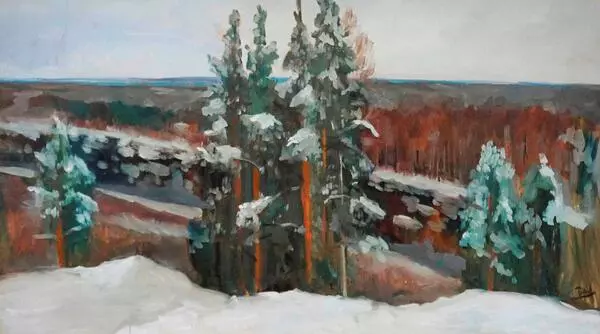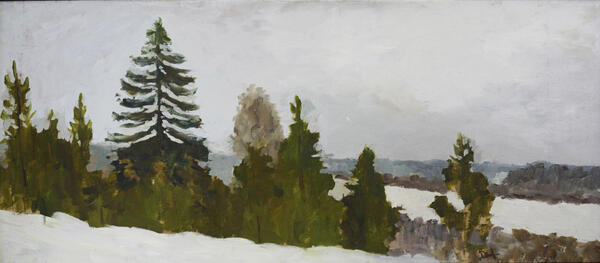
In the small painting ‘Pines’ that was done quickly, the painter Dmitry Moskvin depicted the forests of Povetluzhje, the riverbanks of the Vetluga River. His whole life revolves around these places. Moskvin was born in 1993 near Nizhny Novgorod, he graduated from the Nizhny Novgorod School of Arts as a painter and a teacher, and after that he studied at the courses of the Moscow Ilya Glazunov Academy at the Faculty of Architecture. In 2014 he returned to his native haunts and for two years taught art disciplines at the Children’s Art School in the workers’ settlement of Varnavino.
It was at this time that Moskvin wrote his sketch ‘Pines’. In painting, a sketch most often plays a supporting role: it is usually quickly drawn from life, in order to capture the evanescence of the world around. Initially, the sketches played the role of the first esquisses, which became the base of the overall picture. A sketch should cover general sensations, which will later be preserved in the process of draughtsmanship.
Nevertheless, in contemporary painting, etude increasingly transforms into a kind of independent full-fledged work. Moskvin’s “Pines” are also an independent work. Here you can see a panoramic view of the Vetluga River from the Naberezhnaya Street in the village of Varnavino. From this perspective, we can see the picturesque river and endless Vetluga forest expanses. They instantly bring back memories of Russian folk tales and legends: the robber Lyalya, the beautiful princess Luga, and other heroes of national folklore.
It is no coincidence that the beauty of the Vetluga River inspired the writer Vladimir Korolenko and the lyric poet Nikolai Rubtsov, the publicist Pavel Melnikov-Pechyorsky and the outstanding prose writer Mikhail Prishvin. There really is much to admire here: the taiga river Vetluga has lots of deep pools, dynamic shallow areas (rifts), beautiful sections of the river turned into endless reservoirs (oxbows), and it all creates a pensive mood.
During the time of the Russian Empire, Vetluga was famous for its so-called belyanas, which were unpainted flat-bottomed barges used for timber rafting in the late 19th — early 20th centuries. Every spring, as soon as the ice broke up on the Vetluga, the majestic belyanas started to float down the river. Their name describes the quality of the timber being rafted: unlike other river vessels, only processed, “white” timber could be loaded on them, as it was considered more expensive and valuable.
It was at this time that Moskvin wrote his sketch ‘Pines’. In painting, a sketch most often plays a supporting role: it is usually quickly drawn from life, in order to capture the evanescence of the world around. Initially, the sketches played the role of the first esquisses, which became the base of the overall picture. A sketch should cover general sensations, which will later be preserved in the process of draughtsmanship.
Nevertheless, in contemporary painting, etude increasingly transforms into a kind of independent full-fledged work. Moskvin’s “Pines” are also an independent work. Here you can see a panoramic view of the Vetluga River from the Naberezhnaya Street in the village of Varnavino. From this perspective, we can see the picturesque river and endless Vetluga forest expanses. They instantly bring back memories of Russian folk tales and legends: the robber Lyalya, the beautiful princess Luga, and other heroes of national folklore.
It is no coincidence that the beauty of the Vetluga River inspired the writer Vladimir Korolenko and the lyric poet Nikolai Rubtsov, the publicist Pavel Melnikov-Pechyorsky and the outstanding prose writer Mikhail Prishvin. There really is much to admire here: the taiga river Vetluga has lots of deep pools, dynamic shallow areas (rifts), beautiful sections of the river turned into endless reservoirs (oxbows), and it all creates a pensive mood.
During the time of the Russian Empire, Vetluga was famous for its so-called belyanas, which were unpainted flat-bottomed barges used for timber rafting in the late 19th — early 20th centuries. Every spring, as soon as the ice broke up on the Vetluga, the majestic belyanas started to float down the river. Their name describes the quality of the timber being rafted: unlike other river vessels, only processed, “white” timber could be loaded on them, as it was considered more expensive and valuable.