

The painter Olga Fokina thinks of art as of both an inexhaustible source of inspiration and of a strong connection with her beloved native places in the Nizhny Novgorod region. And so it happened, because since her very childhood she has dreamed of becoming a teacher: first at a regular school, and then at an art school. Therefore, having received the education as a painter in Nizhny Novgorod and Kostroma, at the beginning of 2000s she returned to the village of Varnavino that she knew and loved so much since her childhood, where she became a teacher at a children’s art school.
Together with her students, Fokina often attended outdoor classes, plain-air sessions, where they created sketches of the wonderful Russian taiga. She subsequently donated many of these works to the Varnavino Museum of History and Art: one of them is the landscape “Rural Outskirts”, made in 2006.
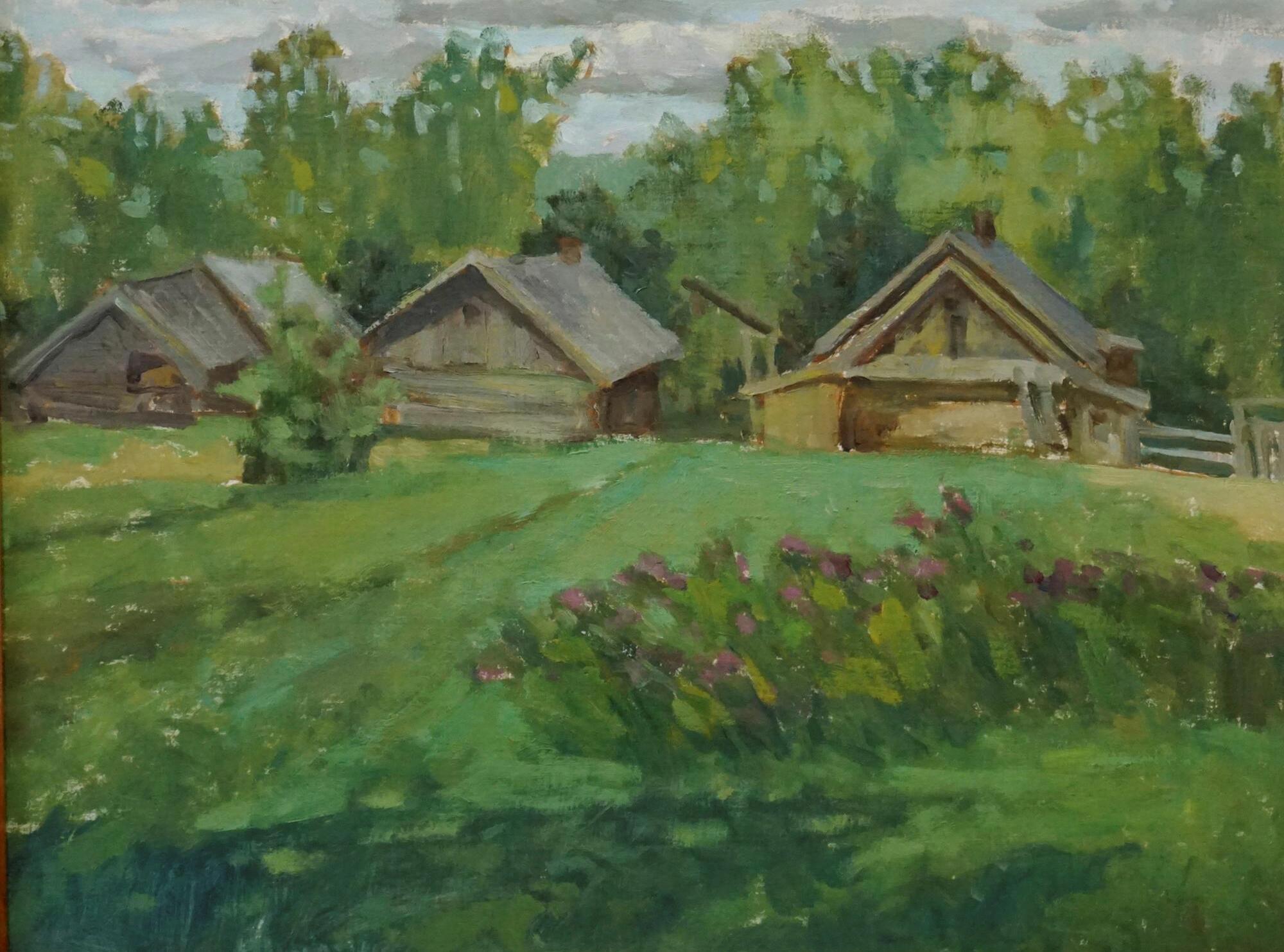
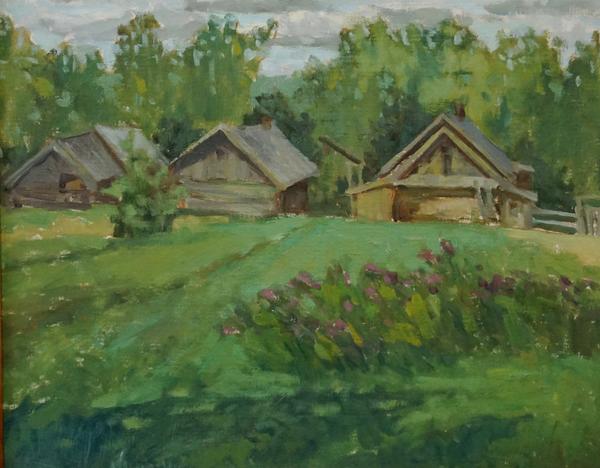
This painting is part of a series of works dedicated to the Russian countryside. Olga Fokina’s great love for this work is obvious: ‘Rural Outskirts’ are depicted in touching detail, the rich and exuberant vegetation of the taiga in this picture is in unbreakable harmony with simple wooden rural houses. Thus, the painter emphasizes that, in her opinion, people should live in unity and harmony with the nature around them.
In pre-revolutionary Russia, a locality differed from a village by the presence of a parish church. During the Soviet period, this distinction was erased due to the official atheistic ideology, and in modern Russia, from a formal point of view, there is no difference between a locality and a village, although villages are usually settlements with a smaller population. Thus, if a settlement has the status of a locality, then this largely reflects its status in the past, but not in the present.
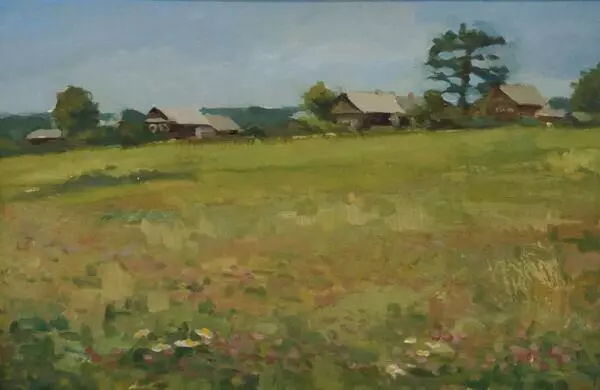
In the painting ‘Rural Outskirts’, Fokina, instead of turning to historical and religious subjects, emphasizes the austere but exciting taiga nature. At first, her image may even seem scant and monotonous, but gradually a convincing contrast with dark purple wildflowers appears in the landscape. Fokina used about the same color accent with field herbs in another painting from her plain-air series, ‘Village of Bochkarikha’. It is interesting that in this picture she views the peripheral settlement through the prism of the harmony of people and nature.
Together with her students, Fokina often attended outdoor classes, plain-air sessions, where they created sketches of the wonderful Russian taiga. She subsequently donated many of these works to the Varnavino Museum of History and Art: one of them is the landscape “Rural Outskirts”, made in 2006.
This painting is part of a series of works dedicated to the Russian countryside. Olga Fokina’s great love for this work is obvious: ‘Rural Outskirts’ are depicted in touching detail, the rich and exuberant vegetation of the taiga in this picture is in unbreakable harmony with simple wooden rural houses. Thus, the painter emphasizes that, in her opinion, people should live in unity and harmony with the nature around them.
In pre-revolutionary Russia, a locality differed from a village by the presence of a parish church. During the Soviet period, this distinction was erased due to the official atheistic ideology, and in modern Russia, from a formal point of view, there is no difference between a locality and a village, although villages are usually settlements with a smaller population. Thus, if a settlement has the status of a locality, then this largely reflects its status in the past, but not in the present.
In the painting ‘Rural Outskirts’, Fokina, instead of turning to historical and religious subjects, emphasizes the austere but exciting taiga nature. At first, her image may even seem scant and monotonous, but gradually a convincing contrast with dark purple wildflowers appears in the landscape. Fokina used about the same color accent with field herbs in another painting from her plain-air series, ‘Village of Bochkarikha’. It is interesting that in this picture she views the peripheral settlement through the prism of the harmony of people and nature.