Nikolay Nedozhdiy, an undeservingly overlooked landscape painter, created the ‘Kolkhoz “Testaments of Ilyich” on the Vetluga River’. He was born in 1910 in the village of Voronkov near Kiev, and, being a young man, he entered the Kiev School of Arts, but failed to complete his studies due to financial difficulties in his family.
Fortunately, this did not prevent Nedozhdiy from working as a painter in Leningrad, becoming a participant of the USSR’s Union of Artists, and even from taking part in a competition for the chief painter of the Kirov (Mariinsky) Theatre. Before the Great Patriotic War, he and his family moved to Tashkent, where he was enlisted into the Red Army. Having gone through the whole war, he was awarded the Order of the Red Star, as well as a Medal for Combat Service and Medal for Bravery.
Until his death in 2003, Nedozhdiy lived in the city of Gorky, which was renamed Nizhny Novgorod after the collapse of the USSR. After the war, he still devoted a great deal of time to painting. He often came to visit his son Nikolai, who lived in the village of Bogorodskoe of Varnavinsky district, and fell in love with the local landscapes and, in particular, with the Vetluga River. It is no coincidence that he dedicated his “Kolkhoz “Testaments of Ilyich” on the Vetluga River’ to these places, along with a whole series of paintings.
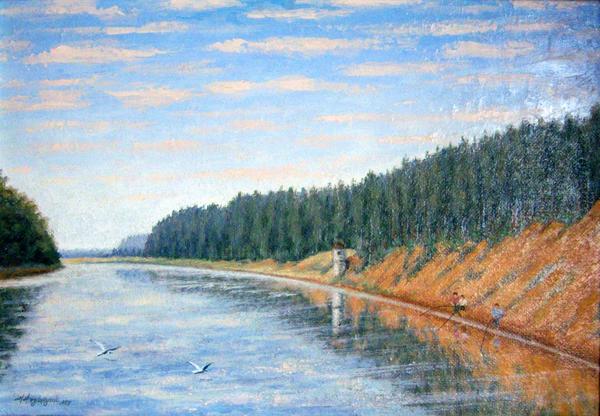
In this picture, Nedozhdiy depicted Vetluga on a clear summer day. On the right riverbank, figures of fishermen can be seen, and a little further off, one of the kolkhoz buildings. By using soft pastel colors, the painter makes his landscape feel serene and dreamy. With this picture, the painter seemed to illustrate the words of the writer Alexander Krasilnikov, from Nizhny Novgorod, about Vetluga: ‘Vetluga is a river of seagulls, forest thickets, raftsmen, of legends of wonderful divas, lakes, and treasures…’
It is widely believed that the name of the Vetluga River is translated from the Mari language as ‘the river of seagulls’, but in the literary Mari the word ‘kolshire’ is used for the seagull. Scientists explain the origin of the name of the river in a different way: in Mari, Vetluga is written as ‘Vyutlya’, where the root ‘vyut’ means water, and the suffix ‘la’ indicates a massive natural object. However, when pronouncing this word, it is necessary to add the ending ‘ga’ to indicate that it is a river in question. Therefore, the name Vetluga can be deciphered as a ‘full-flowing river’.
Until his death in 2003, Nedozhdiy lived in the city of Gorky, which was renamed Nizhny Novgorod after the collapse of the USSR. After the war, he still devoted a great deal of time to painting. He often came to visit his son Nikolai, who lived in the village of Bogorodskoe of Varnavinsky district, and fell in love with the local landscapes and, in particular, with the Vetluga River. It is no coincidence that he dedicated his “Kolkhoz “Testaments of Ilyich” on the Vetluga River’ to these places, along with a whole series of paintings.
In this picture, Nedozhdiy depicted Vetluga on a clear summer day. On the right riverbank, figures of fishermen can be seen, and a little further off, one of the kolkhoz buildings. By using soft pastel colors, the painter makes his landscape feel serene and dreamy. With this picture, the painter seemed to illustrate the words of the writer Alexander Krasilnikov, from Nizhny Novgorod, about Vetluga: ‘Vetluga is a river of seagulls, forest thickets, raftsmen, of legends of wonderful divas, lakes, and treasures…’
It is widely believed that the name of the Vetluga River is translated from the Mari language as ‘the river of seagulls’, but in the literary Mari the word ‘kolshire’ is used for the seagull. Scientists explain the origin of the name of the river in a different way: in Mari, Vetluga is written as ‘Vyutlya’, where the root ‘vyut’ means water, and the suffix ‘la’ indicates a massive natural object. However, when pronouncing this word, it is necessary to add the ending ‘ga’ to indicate that it is a river in question. Therefore, the name Vetluga can be deciphered as a ‘full-flowing river’.