

Though the painter Vladimir Zanoga was born into a military family in the atheist USSR, even while he was still studying at the Gorky School of Arts in the 1970s, he began to, according to him, ‘unconsciously’, get interested in Orthodox faith. In 2006 he became a professor at the International Slavic Academy, and in 2012 he was awarded the prestigious regional Nizhny Novgorod Award.
It is no coincidence that Zanoga’s well-seasoned works are permeated by the need to return to the origins of Russian spiritual culture. In his landscapes and still life paintings, he turns to links between generations and tries to restore the historical memory. He especially often turns to Orthodox Christianity, which he explains, among other things, by the fact that a painter’s work is directly influenced by their spiritual life.
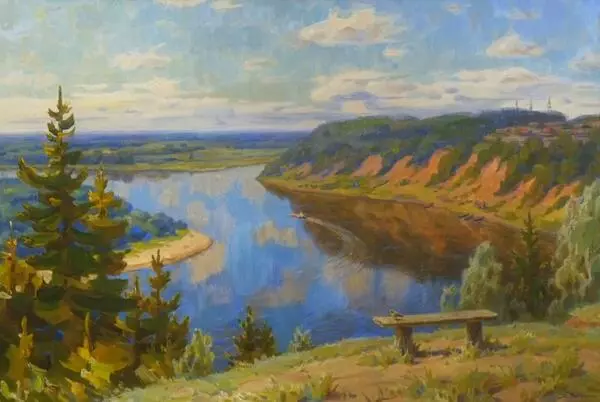
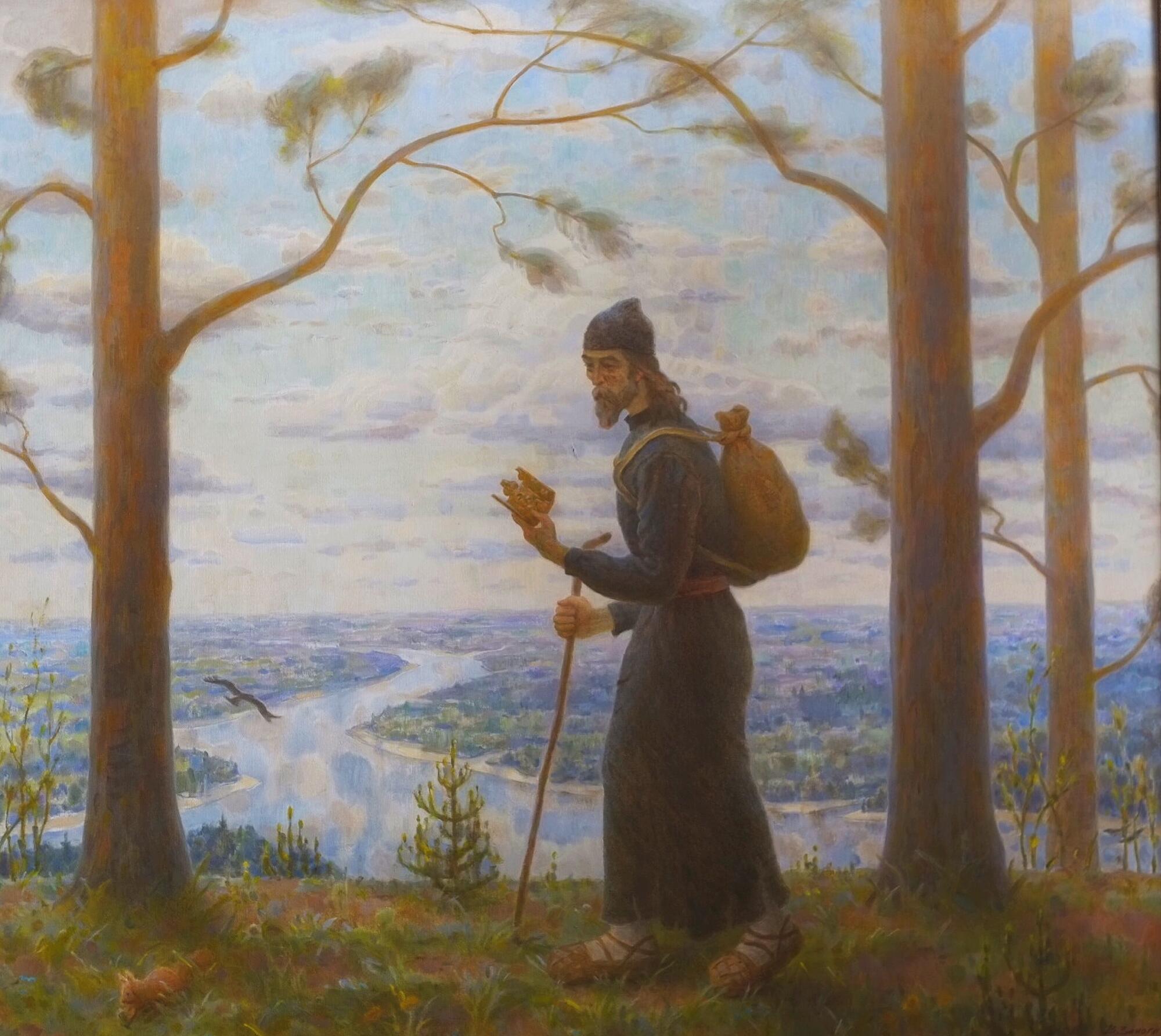
His painting ‘Barnabas of Vetluga’ is also dedicated to a religious subject: a famous Orthodox hermit is arriving to Povetluzhje. Barnabas himself is depicted by Zanoga in the foreground, almost in the middle of the painting. He wears a simple black cassock, a casual headdress (skouphos), bast shoes on his feet, and has a shoulder bag behind his back. In one hand Barnabas is holding a wooden traveling staff, and in the other, a folding: several connected icons that can be folded like a book. The reverend is depicted against the background of the Vetluga. The landscape turned out to be especially expressive, since Zanoga knows these places well.
This picture refers to the events of 600 years ago, when Barnabas came to the remote Vetluga forests, inhabited by hostile Mari tribes, in 1417. He managed to find common ground with these ancient and wild tribes: the Mari not only did not kill the monk, but started to turn to him, first for medical, and then for spiritual help. Barnabas came from his distant native Veliky Ustyug, having literally nothing, materially, but an unshakable Orthodox faith and love for his fellow beings. It was this faith and love that helped him to stay alive in the rough lands of Povetluzhje.
Subsequently, Barnabas built a small cell and a chapel for divine services on the riverbank. After his death, which came after 28 years of living like a hermit, his followers built the Trinity-Varnavinsky Monastery on this beautiful place on the riverbank of the Vetluga. Then, the village of Varnavina monastery appeared nearby, which was transformed into the city of Varnavin under the decree of Catherine the Great. Now the working village of Varnavino is here, instead.
It is no coincidence that Zanoga’s well-seasoned works are permeated by the need to return to the origins of Russian spiritual culture. In his landscapes and still life paintings, he turns to links between generations and tries to restore the historical memory. He especially often turns to Orthodox Christianity, which he explains, among other things, by the fact that a painter’s work is directly influenced by their spiritual life.
His painting ‘Barnabas of Vetluga’ is also dedicated to a religious subject: a famous Orthodox hermit is arriving to Povetluzhje. Barnabas himself is depicted by Zanoga in the foreground, almost in the middle of the painting. He wears a simple black cassock, a casual headdress (skouphos), bast shoes on his feet, and has a shoulder bag behind his back. In one hand Barnabas is holding a wooden traveling staff, and in the other, a folding: several connected icons that can be folded like a book. The reverend is depicted against the background of the Vetluga. The landscape turned out to be especially expressive, since Zanoga knows these places well.
This picture refers to the events of 600 years ago, when Barnabas came to the remote Vetluga forests, inhabited by hostile Mari tribes, in 1417. He managed to find common ground with these ancient and wild tribes: the Mari not only did not kill the monk, but started to turn to him, first for medical, and then for spiritual help. Barnabas came from his distant native Veliky Ustyug, having literally nothing, materially, but an unshakable Orthodox faith and love for his fellow beings. It was this faith and love that helped him to stay alive in the rough lands of Povetluzhje.
Subsequently, Barnabas built a small cell and a chapel for divine services on the riverbank. After his death, which came after 28 years of living like a hermit, his followers built the Trinity-Varnavinsky Monastery on this beautiful place on the riverbank of the Vetluga. Then, the village of Varnavina monastery appeared nearby, which was transformed into the city of Varnavin under the decree of Catherine the Great. Now the working village of Varnavino is here, instead.