The painter Nina Kulikovskaya was born in the village of Verkhnyaya Sosnovka, Perm Region, in 1944. She displayed the talent for painting since a very young age and started to study at the art studio in the orphanage at the Perm Art Gallery. She then studied at the Kazan School of Arts and at the Gerasimov Institute of Cinematography. Such all-round education allowed her to work for some time as a production designer on the television of Gorky.
Since 1977, Kulikovskaya joined the Union of Artists of the USSR, and in the 1990s she was the executive secretary of the Nizhny Novgorod department of the Union. From the very beginning of the 1970s, her works were constantly shown at city and regional art exhibitions, and since 1974 she has become a regular participant in large-scale zonal exhibitions ‘Big Volga’, where many talented painters from peripheral regions were discovered. The painter’s favorite genres include portrait, still life, thematic composition.
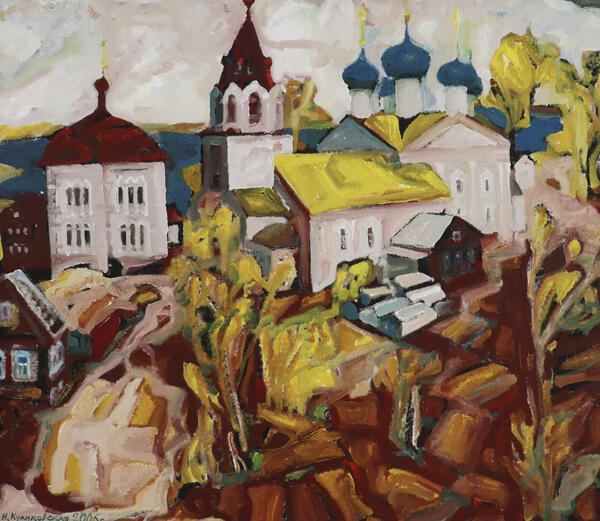
Kulikovskaya’s works are kept in public and private collections in Russia, as well as abroad. The collection of the Varnavino Museum of History and Art contains the vivid painting ‘A Day in Spring. Pechyorskaya Sloboda’. Like many other works by Kulikovskaya, this landscape is very sincere and emotional, immediately catching our attention with its freshness, unexpectedness and depth of artistic decisions. This painting can rightfully be called a passionate affirmation of life, and the painter’s aesthetic sensitivity can be immediately felt.
The painting “A Day in Spring. Pechyorskaya Sloboda” was inspired by the picturesque ensemble of the Pechyorsky Ascension Monastery in Nizhny Novgorod. On the right riverbank of the Volga, within the territory of the modern town, there is a small five-domed church and a slender tent-roofed bell tower. More than 400 years ago, there was a monastery here, founded by St. Dionysius, but at the end of the 16th century it was destroyed by a giant landslide. Only the toponyms “Pechyora” and “Pechyorskaya Sloboda” have been left of the caves that once existed here. Today, a long staircase leads to the church. Believers come here to visit the relics of St. Joasaph, as well as to collect water from the source: many believe that the local water has healing properties.
Since 1977, Kulikovskaya joined the Union of Artists of the USSR, and in the 1990s she was the executive secretary of the Nizhny Novgorod department of the Union. From the very beginning of the 1970s, her works were constantly shown at city and regional art exhibitions, and since 1974 she has become a regular participant in large-scale zonal exhibitions ‘Big Volga’, where many talented painters from peripheral regions were discovered. The painter’s favorite genres include portrait, still life, thematic composition.
Kulikovskaya’s works are kept in public and private collections in Russia, as well as abroad. The collection of the Varnavino Museum of History and Art contains the vivid painting ‘A Day in Spring. Pechyorskaya Sloboda’. Like many other works by Kulikovskaya, this landscape is very sincere and emotional, immediately catching our attention with its freshness, unexpectedness and depth of artistic decisions. This painting can rightfully be called a passionate affirmation of life, and the painter’s aesthetic sensitivity can be immediately felt.
The painting “A Day in Spring. Pechyorskaya Sloboda” was inspired by the picturesque ensemble of the Pechyorsky Ascension Monastery in Nizhny Novgorod. On the right riverbank of the Volga, within the territory of the modern town, there is a small five-domed church and a slender tent-roofed bell tower. More than 400 years ago, there was a monastery here, founded by St. Dionysius, but at the end of the 16th century it was destroyed by a giant landslide. Only the toponyms “Pechyora” and “Pechyorskaya Sloboda” have been left of the caves that once existed here. Today, a long staircase leads to the church. Believers come here to visit the relics of St. Joasaph, as well as to collect water from the source: many believe that the local water has healing properties.