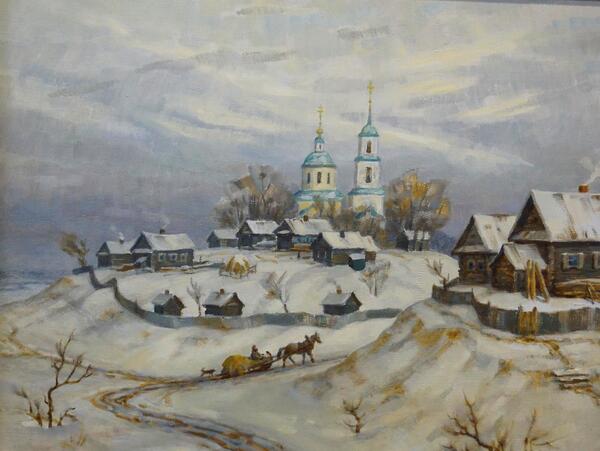
The winter landscape ‘Village of Lapshanga’ was painted by the painter Vladimir Zanoga. He was born in 1953 into a military family that lived near Nizhny Novgorod, in the early 1970s he graduated from the School of Arts in Nizhny Novgorod (then Gorky). Since 1993, Zanoga began holding personal exhibitions, and two years later he was admitted to the Union of Artists of Russia. In 2006 he became a professor at the International Slavic Academy, and in 2012 he was awarded the prestigious regional Nizhny Novgorod Award.
While he was still studying at the School of Arts, Zanoga began to get interested in Orthodox icons and iconography. It is no coincidence that his well-seasoned works are permeated by the need to return to the origins of Russian spiritual culture. In his landscapes and still life paintings, he turns to links between generations and tries to restore the historical memory. Especially often Zanoga turns to Christian motives, according to him, the most important thing is ‘to feel the spiritual connection with the Сreator, because it is the painter’s soul that pushes the brush, and it can only create something beautiful when there’s God in it’.
Spiritual themes are clearly expressed in the painting ‘Village of Lapshanga’, painted by Zanoga in 2015. It portrays a serene winter landscape in all its glory: the old village located on the high bank of the Lapshanga River can be seen. Grey smoke billows from the chimneys of the village izbas, reminding that Russian winters are harsh. A horse harnessed to a sleigh, slowly climbing the mountain, also catches our attention. At the same time, the image of the church in honor of St. Nicholas the Wonderworker is the centerpiece of the landscape.
The village of Lapshanga-Nikolskoe in Varnavinsky district of the Kostroma province was established in the 16th century. Its name comes from the Mari name of the river ‘Lapsha’ (translated into Russian as ‘burdock’) and of the church in honor of St. Nicholas the Wonderworker, built here. It is also depicted by Zanoga: a church with a bell tower in the style of high classicism, located high on a hill. Until the middle of the 20th century, there were five churches in the village, but they were all destroyed during the Soviet era, as they contradicted the official atheistic ideology.
While he was still studying at the School of Arts, Zanoga began to get interested in Orthodox icons and iconography. It is no coincidence that his well-seasoned works are permeated by the need to return to the origins of Russian spiritual culture. In his landscapes and still life paintings, he turns to links between generations and tries to restore the historical memory. Especially often Zanoga turns to Christian motives, according to him, the most important thing is ‘to feel the spiritual connection with the Сreator, because it is the painter’s soul that pushes the brush, and it can only create something beautiful when there’s God in it’.
Spiritual themes are clearly expressed in the painting ‘Village of Lapshanga’, painted by Zanoga in 2015. It portrays a serene winter landscape in all its glory: the old village located on the high bank of the Lapshanga River can be seen. Grey smoke billows from the chimneys of the village izbas, reminding that Russian winters are harsh. A horse harnessed to a sleigh, slowly climbing the mountain, also catches our attention. At the same time, the image of the church in honor of St. Nicholas the Wonderworker is the centerpiece of the landscape.
The village of Lapshanga-Nikolskoe in Varnavinsky district of the Kostroma province was established in the 16th century. Its name comes from the Mari name of the river ‘Lapsha’ (translated into Russian as ‘burdock’) and of the church in honor of St. Nicholas the Wonderworker, built here. It is also depicted by Zanoga: a church with a bell tower in the style of high classicism, located high on a hill. Until the middle of the 20th century, there were five churches in the village, but they were all destroyed during the Soviet era, as they contradicted the official atheistic ideology.