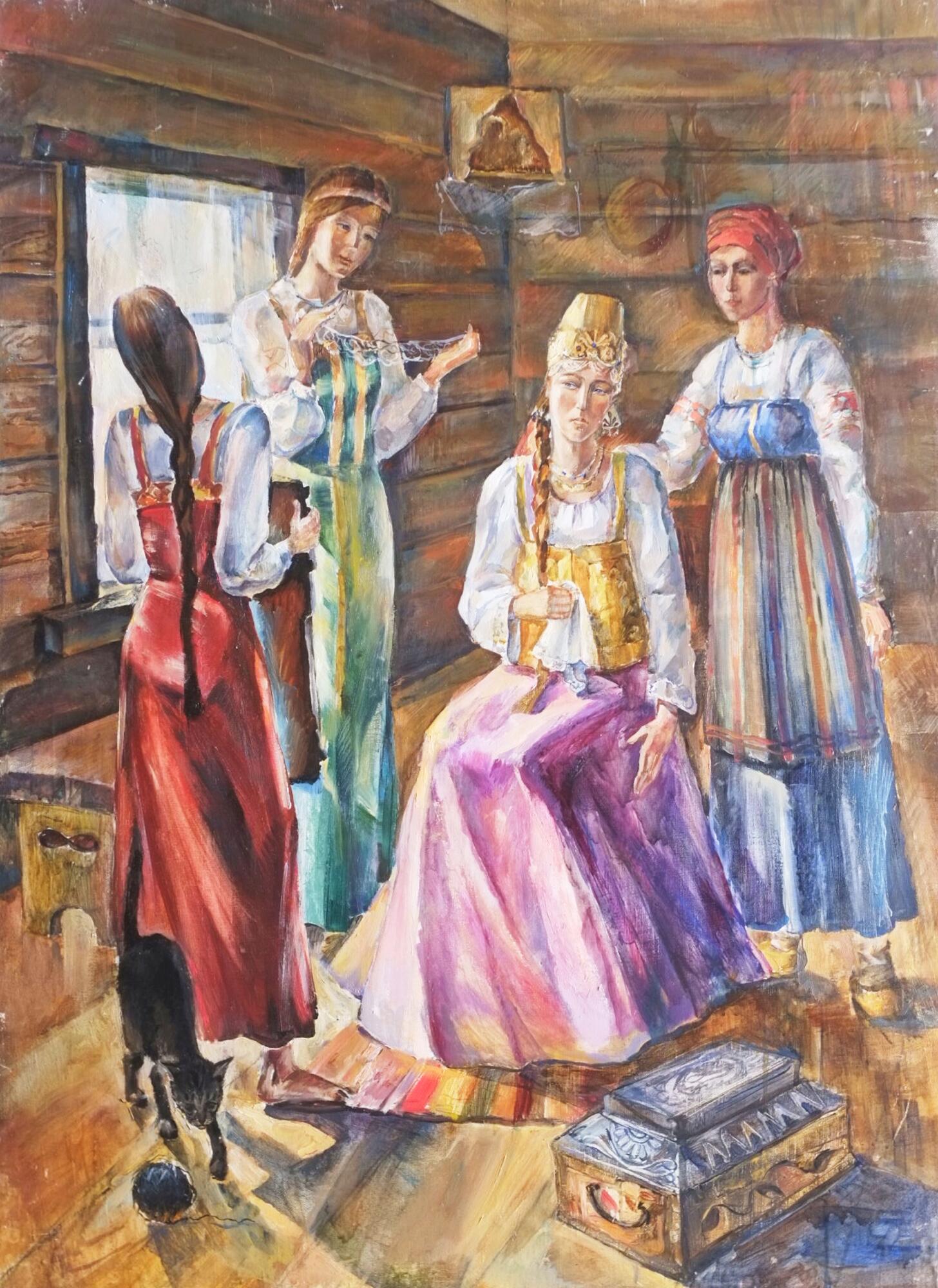


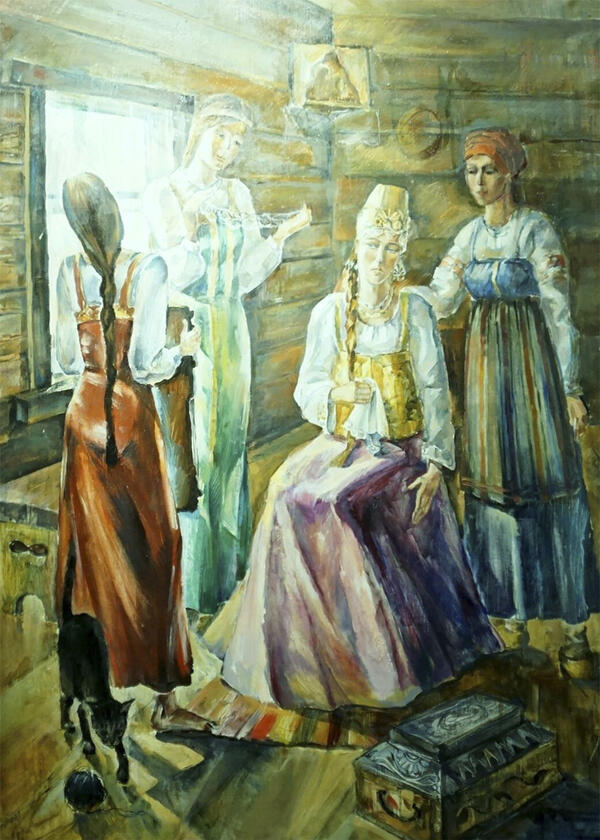
In the genre painting ‘Russian Motifs’ the painter Natalya Zhidko depicted a folk scene, which probably dates back to the time of Tsar Alexei Mikhailovich. This painting, donated to the Varnavino Museum by the Gorky School of Arts, is her graduation project. Nothing more is known about the painting’s creation or about its creator.
In this picture, in the space of a simple village izba, Zhidko placed four girls dressed in Russian folk costumes of the 16th to 17th centuries. Most likely, she depicted a traditional Russian bachelorette party, which was the last pre-wedding meeting of the bride and her friends, when their ritual farewell took place.
At the bachelorette party, one more key ritual of the wedding ceremony also took place: the unweaving of the girl’s braid. The bridesmaids unraveling the braid symbolized the end of the girl’s former life. In many traditions, it is believed that unweaving the braid is accompanied by a “farewell to the girl”s beauty”. The friends braided the bride’s braid for the last time, weaving a ribbon embroidered with pearls and beads into it. Then, with laments and lots of weeping, the girlfriends unraveled the girl’s braid for the last time, and the bride passed the ribbon to her younger sister or to an unmarried friend.
The Russian bachelorette party has a long history: it is mentioned in ancient written monuments and documents, including The Tale of Bygone Years, The Russian Truth, The Charter of Vladimir Vsevolodovich, The Commandments of Metropolitan George, and The Domostroy. Also, national wedding ceremonies were repeatedly described in the notes of foreign diplomats, travelers and merchants. The main features of the traditional Russian wedding didn’t change until the 17th century, when the drastic reforms of Peter the Great affected almost all spheres of life.
During Peter the Great’s reign, Russian wedding ceremonies started to be influenced with Western wedding traditions. European customs were quick to catch on in the capital Petersburg among the wealthy nobility, but most of the society, especially the peasantry, continued to follow the traditional wedding custom. However, as time went by and changes occurred in the socio-economic situation, the nobles, wealthy merchants, clergy and bourgeoisie tended to withdraw from the traditional rituals.
In this picture, in the space of a simple village izba, Zhidko placed four girls dressed in Russian folk costumes of the 16th to 17th centuries. Most likely, she depicted a traditional Russian bachelorette party, which was the last pre-wedding meeting of the bride and her friends, when their ritual farewell took place.
At the bachelorette party, one more key ritual of the wedding ceremony also took place: the unweaving of the girl’s braid. The bridesmaids unraveling the braid symbolized the end of the girl’s former life. In many traditions, it is believed that unweaving the braid is accompanied by a “farewell to the girl”s beauty”. The friends braided the bride’s braid for the last time, weaving a ribbon embroidered with pearls and beads into it. Then, with laments and lots of weeping, the girlfriends unraveled the girl’s braid for the last time, and the bride passed the ribbon to her younger sister or to an unmarried friend.
The Russian bachelorette party has a long history: it is mentioned in ancient written monuments and documents, including The Tale of Bygone Years, The Russian Truth, The Charter of Vladimir Vsevolodovich, The Commandments of Metropolitan George, and The Domostroy. Also, national wedding ceremonies were repeatedly described in the notes of foreign diplomats, travelers and merchants. The main features of the traditional Russian wedding didn’t change until the 17th century, when the drastic reforms of Peter the Great affected almost all spheres of life.
During Peter the Great’s reign, Russian wedding ceremonies started to be influenced with Western wedding traditions. European customs were quick to catch on in the capital Petersburg among the wealthy nobility, but most of the society, especially the peasantry, continued to follow the traditional wedding custom. However, as time went by and changes occurred in the socio-economic situation, the nobles, wealthy merchants, clergy and bourgeoisie tended to withdraw from the traditional rituals.