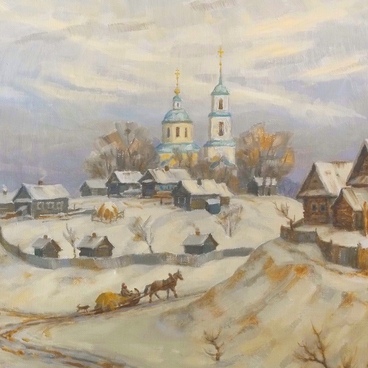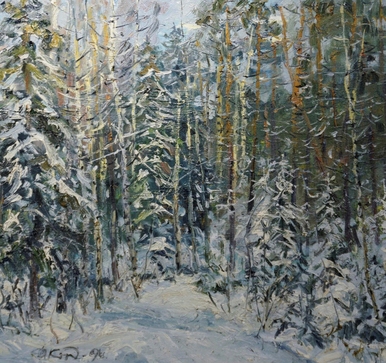
Nikolai Burdastov, Honored Artist of Russia and a brilliant realist painter, was born in the town of Maikop, Krasnodar Region, in 1946. In the 1970s, he studied at the Gorky School of Arts and at the Gerasimov Institute of Cinematography, and in 1982 he was admitted to the Union of Artists of Russia. Until his death in 2015, he constantly searched for new ways to express himself, worked on new paintings, and his works were the centerpieces at numerous city, regional and national exhibitions.
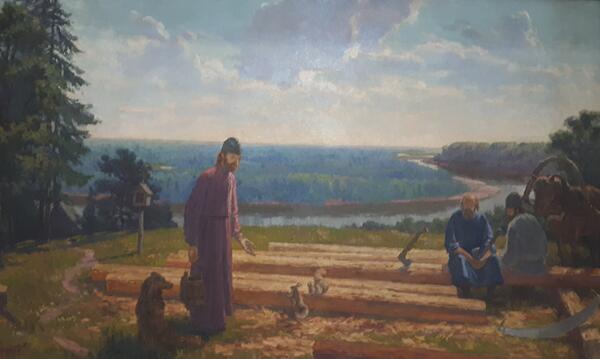
Burdastov created the painting ‘Holy Barnabas the Constructor’ in 1989. It depicts the reverend Barnabas of Vetluga, the patron saint of the taiga river Vetluga’s riverbanks. He is standing next to his dog on the high bank of the Vetluga River, on Krasnaya Gora, where a chapel and cells are being built, which are the first buildings of the future Trinity-Varnavinsky monastery.
This painting has an extraordinary history. At the very end of the 1980s, Burdastov and two other painters were asked to make some paintings for the museum of the working village of Varnavino. When they arrived at the department of culture of the village, one of them was asked to paint a landscape, another was ordered a painting of a border guard killed in 1930, and Burdastov was given the theme “Proclamation of Soviet Power in Varnavino”.
The painter took the task seriously, but he did not find anything interesting in the archives on both the October Revolution and the history of the village. Then Burdastov decided to get to learn, what Varnavino was like before the Soviet regime, and so he found out about the life of the holy hermit monk Barnabas of Vetluga, whom the village was named after. Realizing that a painting with such subject would turn out to be much stronger than a no-plot painting about Soviet functionaries, he went to discuss the new topic with the officials of the culture department. Oddly enough, they not only weren’t against changing the topic, but also provided all the available information about Barnabas: the Soviet regime was on its last legs, and there was almost no censorship anymore.
The painting ‘Barnabas the Constructor’ is still exhibited at the Varnavino Museum, reminding local residents of their great hermit. This painting is also interesting because it is a rare work where the painter turned to a religious subject. Burdastov himself, being an outstanding master of landscape, explained his cautious relationship with religious themes by saying that any landscape already has something spiritual in it, and he simply did not need to add religious overtones to his paintings.
Burdastov created the painting ‘Holy Barnabas the Constructor’ in 1989. It depicts the reverend Barnabas of Vetluga, the patron saint of the taiga river Vetluga’s riverbanks. He is standing next to his dog on the high bank of the Vetluga River, on Krasnaya Gora, where a chapel and cells are being built, which are the first buildings of the future Trinity-Varnavinsky monastery.
This painting has an extraordinary history. At the very end of the 1980s, Burdastov and two other painters were asked to make some paintings for the museum of the working village of Varnavino. When they arrived at the department of culture of the village, one of them was asked to paint a landscape, another was ordered a painting of a border guard killed in 1930, and Burdastov was given the theme “Proclamation of Soviet Power in Varnavino”.
The painter took the task seriously, but he did not find anything interesting in the archives on both the October Revolution and the history of the village. Then Burdastov decided to get to learn, what Varnavino was like before the Soviet regime, and so he found out about the life of the holy hermit monk Barnabas of Vetluga, whom the village was named after. Realizing that a painting with such subject would turn out to be much stronger than a no-plot painting about Soviet functionaries, he went to discuss the new topic with the officials of the culture department. Oddly enough, they not only weren’t against changing the topic, but also provided all the available information about Barnabas: the Soviet regime was on its last legs, and there was almost no censorship anymore.
The painting ‘Barnabas the Constructor’ is still exhibited at the Varnavino Museum, reminding local residents of their great hermit. This painting is also interesting because it is a rare work where the painter turned to a religious subject. Burdastov himself, being an outstanding master of landscape, explained his cautious relationship with religious themes by saying that any landscape already has something spiritual in it, and he simply did not need to add religious overtones to his paintings.