The wonderful landscape ‘Saint-Jean de Luz’ was painted by the painter Dmitry Ganin. He was born in 1959 in the city of Ardatov, near Nizhny Novgorod. He graduated from the Gorky School of Arts, the Department of Painting and Pedagogy, as well as from the Surikov Institute in Moscow. As early as the mid-1980s, he started to regularly participate in large exhibitions, and in 1991 he was admitted to the Union of Artists of the USSR.
His art was widely recognized among the public: in 2008, he was awarded the Nizhny Novgorod Region Prize for the series of landscapes ‘Streets of Nizhny Novgorod’, four years later he won the Nizhny Novgorod Prize and received an honorary diploma from the Russian Ministry of Culture.
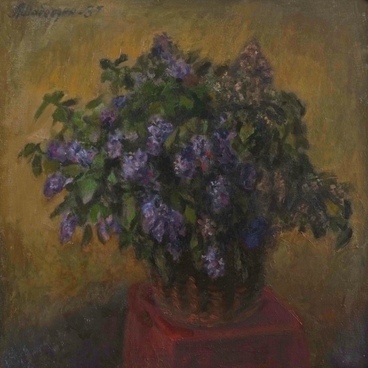
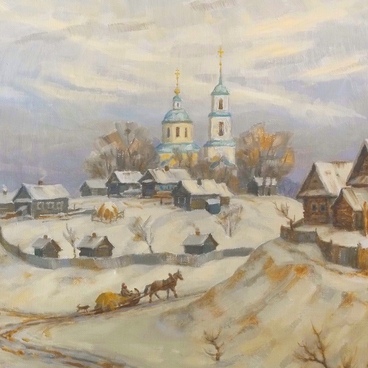
Ganin called himself a disciple of the Russian classical school. ‘Disciple’ is the key word here: in his art, not the already familiar techniques and motifs are important, but the development of the aesthetic position of the Russian classics. The painter has worked a lot in traditional easel genres, including landscapes, portraits, and still life paintings. His style is instantly recognizable, and, as a painter, he possesses the highest contemplative and colorific culture. The art of this painter is rightfully considered a noticeable phenomenon in the artistic life of Nizhny Novgorod.
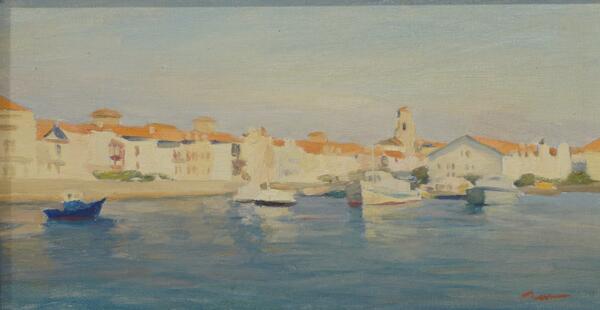
The serene and beautiful landscape ‘Saint-Jean de Luz’ is an excellent example of Ganin’s art. Like many great Russian painters, he was interested by the ancient European architecture, which he depicted on this painting. Saint-Jean de Luz is a town and commune in southwestern France. It is located on the swampland, so the ground floors of houses here were built on special piles: during high tides, the water rose to the very level of the ground floor, so that it turned into a kind of pier. It is this particular feature of the town that the painter emphasized by painting a pier with boats in the foreground.
However, it is not what the town of Saint-Jean de Luz is famous for: in 1660, Louis XIV, known as the Sun King, and Maria Theresa, the Spanish Infanta, got married here. This quiet place was chosen for the wedding, Saint-Jean de Luz being the closest French town to the Spanish border at that time, and the wedding was one of the main points of the Pyrenees agreement on the final armistice between France and Spain in the war of 1635–1659. It is known that the marriage was unhappy and, according to one version, after the death of the Infanta, Louis XIV said that the marriage was the only trouble she caused him.
Ganin called himself a disciple of the Russian classical school. ‘Disciple’ is the key word here: in his art, not the already familiar techniques and motifs are important, but the development of the aesthetic position of the Russian classics. The painter has worked a lot in traditional easel genres, including landscapes, portraits, and still life paintings. His style is instantly recognizable, and, as a painter, he possesses the highest contemplative and colorific culture. The art of this painter is rightfully considered a noticeable phenomenon in the artistic life of Nizhny Novgorod.
The serene and beautiful landscape ‘Saint-Jean de Luz’ is an excellent example of Ganin’s art. Like many great Russian painters, he was interested by the ancient European architecture, which he depicted on this painting. Saint-Jean de Luz is a town and commune in southwestern France. It is located on the swampland, so the ground floors of houses here were built on special piles: during high tides, the water rose to the very level of the ground floor, so that it turned into a kind of pier. It is this particular feature of the town that the painter emphasized by painting a pier with boats in the foreground.
However, it is not what the town of Saint-Jean de Luz is famous for: in 1660, Louis XIV, known as the Sun King, and Maria Theresa, the Spanish Infanta, got married here. This quiet place was chosen for the wedding, Saint-Jean de Luz being the closest French town to the Spanish border at that time, and the wedding was one of the main points of the Pyrenees agreement on the final armistice between France and Spain in the war of 1635–1659. It is known that the marriage was unhappy and, according to one version, after the death of the Infanta, Louis XIV said that the marriage was the only trouble she caused him.