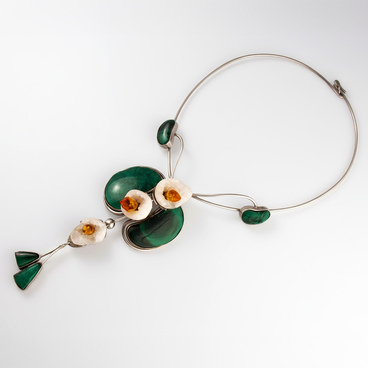
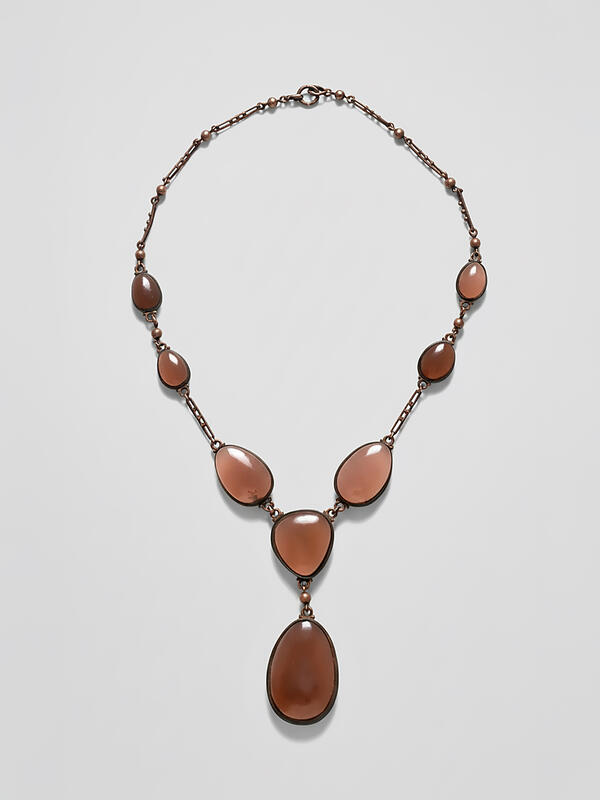
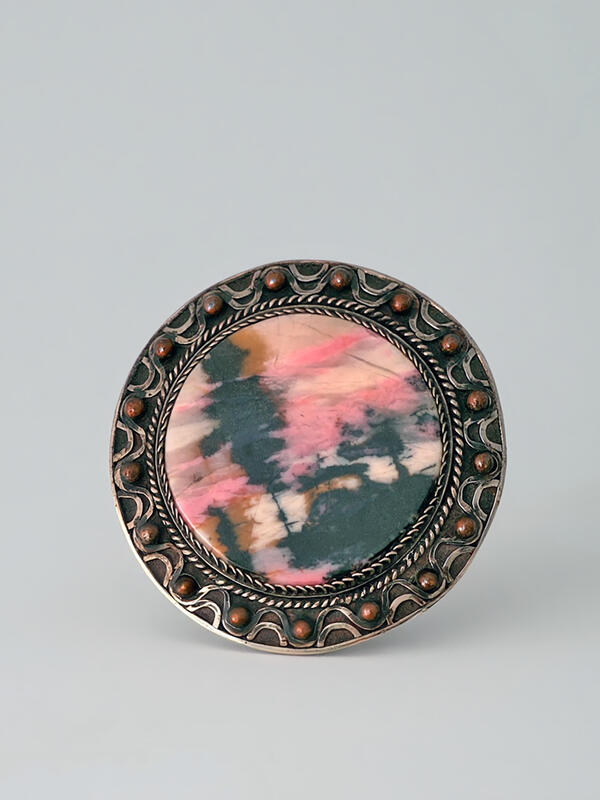
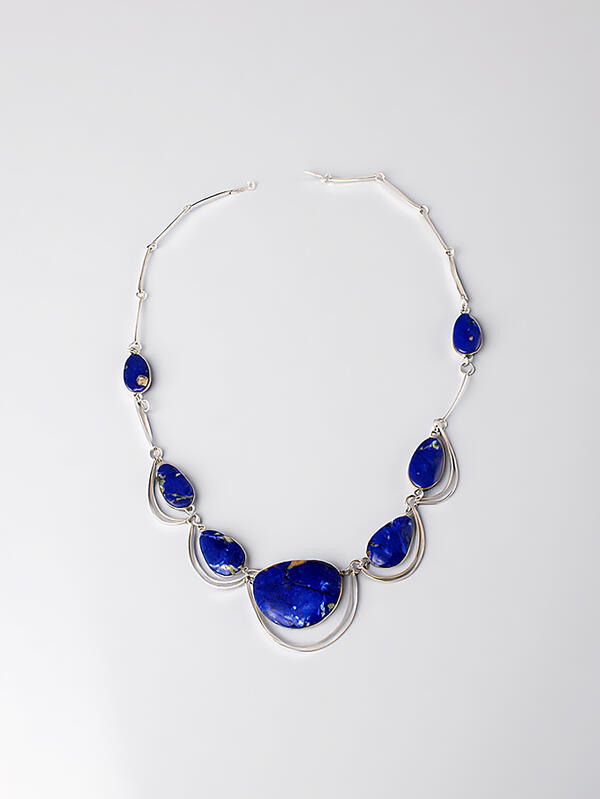
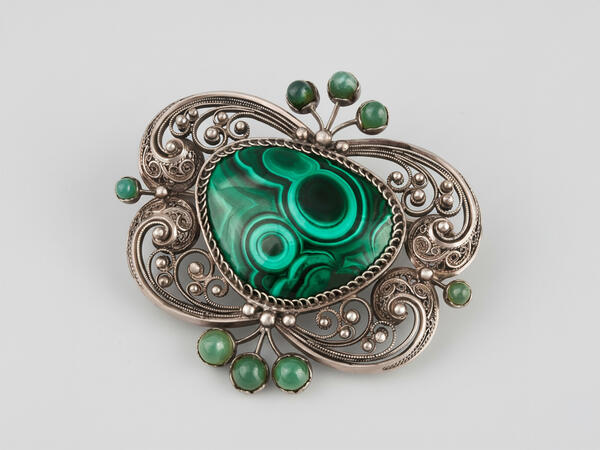
Vladimir Ulyanovich Komarov was one of the finest jewelers of the Urals. In his works, he masterfully combined delicate filigree with natural stone, creating pieces of exceptional artistry. The Ural master was also deeply inspired by history and folk traditions, which often informed his designs.
The “Ural Maiden” ring evokes the heritage of the Urals. The piece consists of several elements. The ring’s base is crafted from openwork twisted wire, adorned with curl-like motifs. Here, the pattern is not merely decorative — it forms an integral part of the composition. The continuous openwork pattern lends the ring elegance and grace. At its center is an oval cabochon of green patterned malachite. The stone is securely held in a smooth bezel setting. Encircling the setting is a delicate border of twisted wire, resembling a fine rope or braided cord.
The choice of stone for the “Ural Maiden” ring is no accident. Immortalized in the tales of Pavel Bazhov, malachite is rightfully considered one of the main symbols of the Urals. It is one of the most popular ornamental stones, prized for its vivid green color, striking natural patterns, ease of carving and polishing. These qualities have made malachite a favorite in jewelry, lapidary art, and decorative and applied arts.
Ornamental malachite was first discovered in Russia in the 1740s in the Urals. By the late 18th and early 19th centuries, it was used not only for small jewelry items but also for monumental works of art that gained international acclaim. During this period, the technique known as “Russian mosaic” emerged, and malachite began to be used as a decorative inlay and cladding material in palaces.
Malachite became a powerful symbol of the Urals largely thanks to the literary legacy of Pavel Petrovich Bazhov. He even titled his famous collection of fairy tales “The Malachite Casket”. The first three tales were published in the 1930s by the Sverdlovsk Book Publishing House in the collection “Pre-Revolutionary Folklore of the Urals”. The first independent edition of “Tales of the Old Urals” appeared in 1939 and included 14 stories. Each subsequent edition was expanded with new tales.
Beyond literature, Pavel Bazhov was actively involved in public life. He served as a deputy in the Supreme Soviet of the USSR — the highest legislative body in the Soviet Union. In this role, he helped bring electricity to numerous collective farms and advocated for workers’ rights.