In the post-war years, there was a revival of interest in folk traditions in Soviet art jewelry. Masters actively turned to time-honored filigree and granulation techniques — methods that remain relevant to this day. The Ural style, in harmony with broader trends in Russian art jewelry, organically combines a reverence for national heritage with innovative craftsmanship. In Vladimir Ulyanovich Komarov’s works, one can note that his dedication to colored stones and masterful command of filigree techniques have remained unwavering.
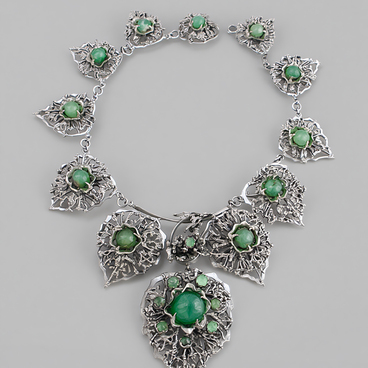
The jewelry set on display is titled “Teremok” in Russian. This word means “a little enchanted house” or “a small home”. In creating the set, the artist drew inspiration from the imagery of Russian folklore. The exquisite, delicate filigree ornamentation lends the set a special elegance, evoking associations with traditional folk floral painting.
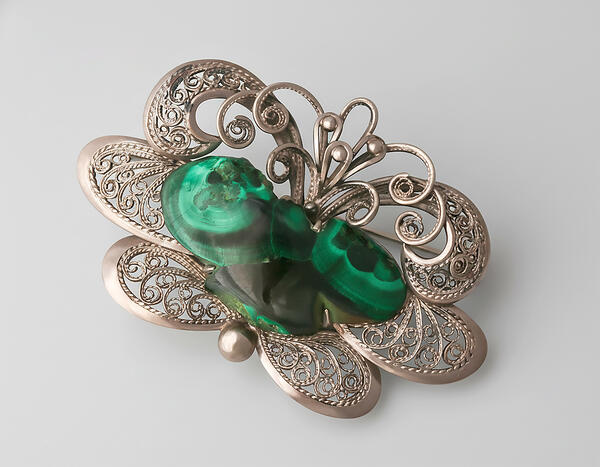
The “Teremok” set includes a brooch and a ring. The brooch features a symmetrical composition: at its center lies a heart-shaped, patterned green malachite cabochon, framed by mirrored, repeating curls of twisted wire adorned with small metal spheres. High cabochons of translucent light-green chrysoprase are set at the junctions of the wirework — three at the top, three at the bottom, and one on each side.
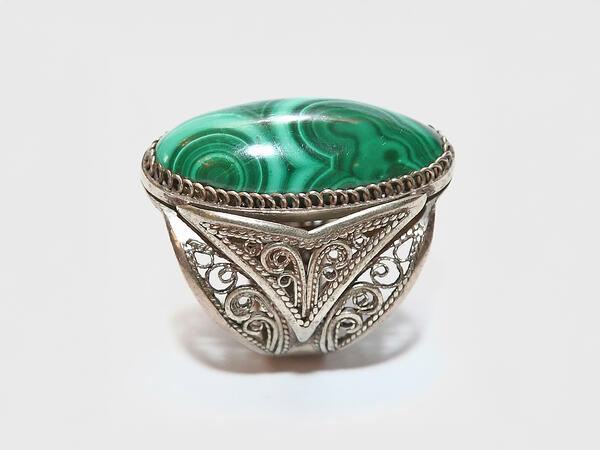
The ring has an asymmetrical form, with an openwork band of twisted wire decorated with curl motifs. At the top, a high chrysoprase cabochon and a large patterned malachite stone are aligned along a single axis.
It is worth noting that the English term “filigree” and the Russian term “skan” refer to the same traditional jewelry technique. This method involves creating intricate openwork patterns from fine metal wire, which is soldered onto a metal base. Traditionally, different metals can be used for making filigree patterns: precious metals such as gold, silver, and platinum, as well as non-precious metals like copper, brass, melchior and nickel silver. Filigree is often further enhanced with granulation — the addition of tiny metal spheres that add texture and sophistication to the piece.
The central element defining the aesthetic of the works on display is malachite, a gemstone celebrated for its unique beauty. Its vivid green hues and swirling, whimsical patterns, combined with ease of carving and polishing, have made malachite highly prized in jewelry, stone carving, and decorative arts.
In Russia, the widespread use of malachite in art jewelry began in the late 18th century, following the discovery of the Gumeshevskoye and Mednorudianskoye deposits in the Urals. By the 19th century, malachite was extensively used in the interior decoration of imperial palaces. The large-scale extraction and artistic application of this stone firmly established Russia’s reputation as a “malachite power”.