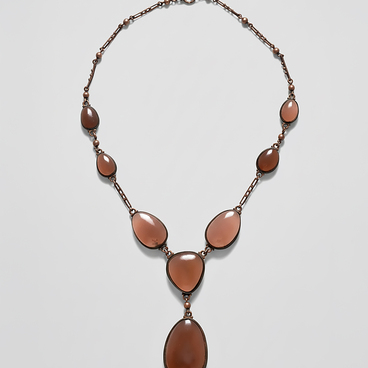
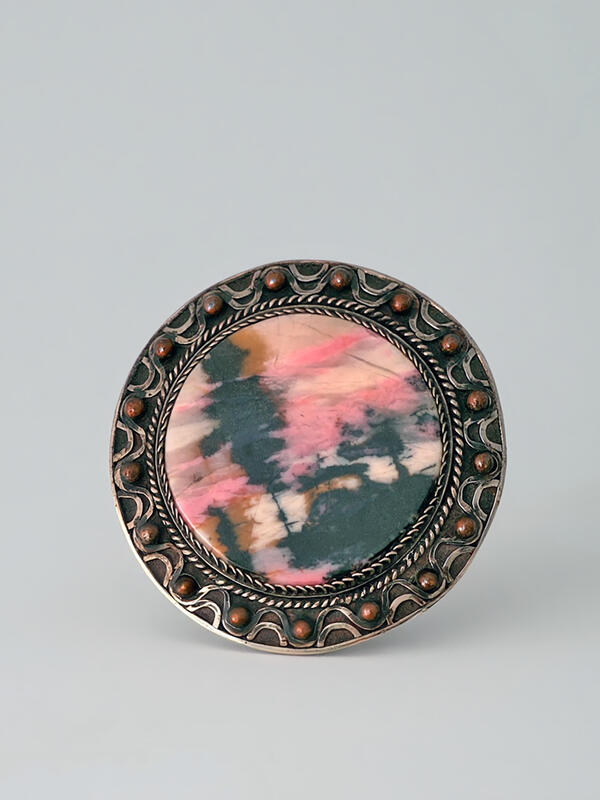
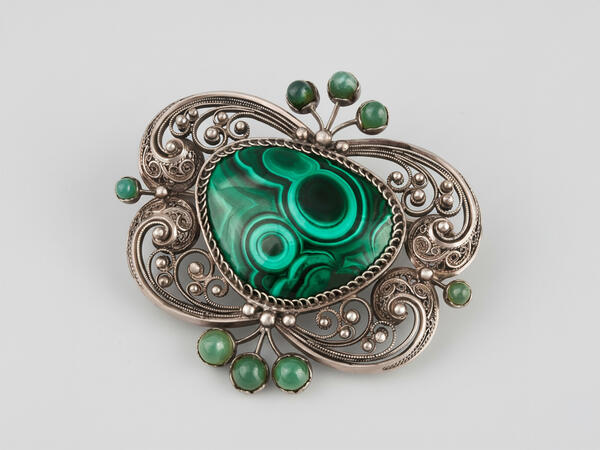
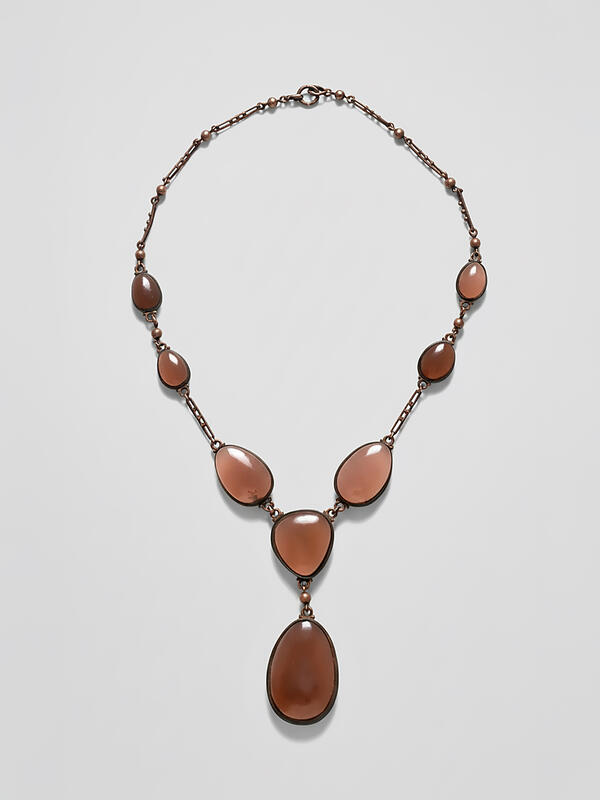
The nature of Russia is incredibly diverse: endless tundras, dense taigas, vast steppes, arid deserts, expansive seas, and deep rivers. This rich landscape has long inspired writers, poets, and artists. Vladimir Ulyanovich Komarov’s “Baikal” necklace pays tribute to Russia’s most iconic lake.
The necklace features a chain composed of rod-like metal links and seven oval plaques of dark blue lapis lazuli with white inclusions, secured in a smooth bezel setting. Five of the stones are further accentuated by a double metal arc.
Lake Baikal, renowned worldwide for its green shores, crystal-clear depths, and unique flora and fauna, lies on the border between the Irkutsk Region and the Republic of Buryatia in southern Eastern Siberia. Poetically called “The Blue Eye of Siberia,” “The Sacred Sea,” and “The Diamond of the Planet,” Baikal is the deepest lake in the world and holds the largest volume of unfrozen freshwater — of exceptional and unique mineral composition.
Komarov chose lapis lazuli to capture the essence of this region — the depth, clarity, and spiritual significance of Baikal’s waters. Lapis lazuli is an ornamental stone prized for its vivid blue, light blue, or violet hues. Geologically, it is a rock composed primarily of lazurite, often veined or speckled with inclusions of other minerals.
Known since antiquity, lapis lazuli was used by the Egyptians and Romans in jewelry, seals, and mosaics. The stone reached these civilizations from the territory of modern-day Afghanistan. The Afghan province of Badakhshan — where lapis lazuli has been mined for millennia — is still considered the world’s most famous source. Badakhshan lapis is regarded as the benchmark for quality and is considered especially valuable.
Lapis lazuli is used to make decorative vases, caskets, figurines, and fine jewelry. Thin slabs are also employed in inlay work and mosaics, as well as for cladding columns, fireplaces, and other architectural elements.
In his works, Vladimir Komarov sought to reflect the natural and cultural characteristics of the regions where his stones originated. Baikal lapis lazuli was discovered in the mid-18th century. It is distinguished by its bright light-blue tone (there are also saturated blue samples, but no dark ones). The presence of white veins of limestone and marble gives Baikal lapis lazuli a distinctive appearance: whimsical streaks and spots form captivating, one-of-a-kind patterns across its surface.