Floral motifs are among the oldest and most enduring forms of ornamentation in the history of decorative and applied art. Across cultures and centuries, botanical elements — both floral and foliate — have retained their symbolic and aesthetic significance, continuing to inspire artists and jewelers.
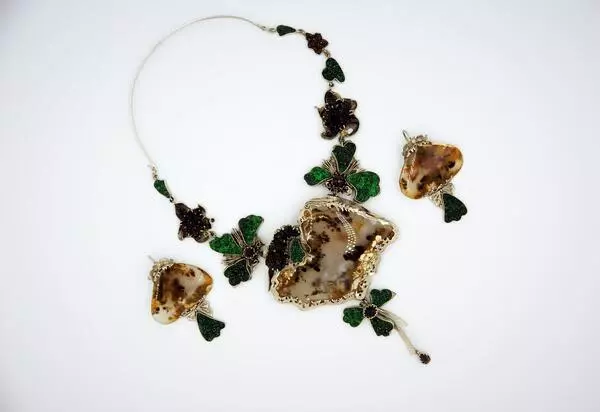
Mikhail Mikhailovich Lesik fully embraces this tradition. One notable example is the jewelry set titled “Quiet Backwater” — a harmonious ensemble comprising a torc-style neckpiece, a bracelet, and earrings. The design evokes the serene beauty of the water lily, with its floating blossoms and broad leaves.
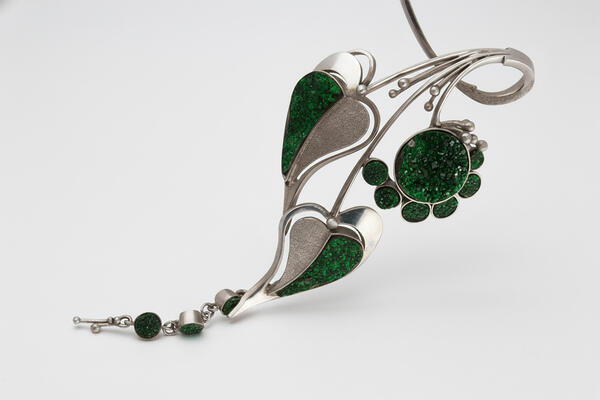
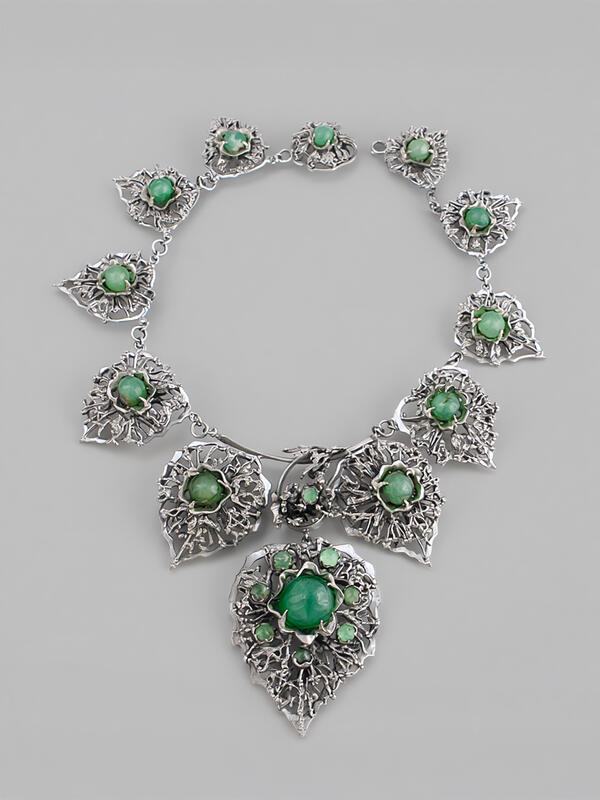
The torc features a rigid metal hoop with a gracefully suspended pendant composed of stone flowers and leaves. The floral elements are crafted from white chalcedony, a microcrystalline variety of quartz, and accentuated by a translucent yellow core. The surrounding leaves are made of patterned malachite. The piece is secured with a discreet hook clasp. The bracelet is designed as a seamless, open band without a clasp, allowing it to be slipped over the wrist. At its center, a flower and bud are flanked by delicately shaped malachite leaves. Similarly, the earrings feature buds mounted along the arms, with a single malachite leaf serving as a pendant.
Lesik demonstrates exceptional mastery in working with these materials: he juxtaposes polished and raw mineral surfaces, creating a dynamic interplay of texture and form. The crystalline luster of the white chalcedony blooms stands in striking contrast to the warm transparency of the amber cores and the silky depth of the malachite leaves.
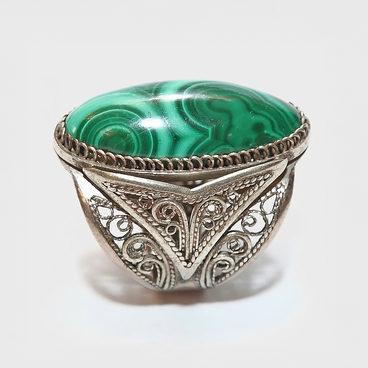
The stones used in this set have unique characteristics. Malachite is a gemstone that is prized for its vivid green color and distinctive natural banding. Its name derives from the ancient Greek “malakos”, meaning “soft”, a reference to its relative softness and ease of carving.
In Russia, malachite gained prominence in the 18th century following the discovery of rich deposits in the Ural Mountains. In jewelry, malachite is typically cut into cabochons and featured in rings, earrings, brooches, cufflinks, and bracelets. It also became a hallmark of decorative arts, extensively used in cabinet furniture: luxury objects such as caskets, vases, table lamps, and inlaid furniture. Today, while Ural deposits are largely exhausted, malachite continues to be sourced primarily from Africa.
Chalcedony is a cryptocrystalline form of quartz, known for its wide spectrum of colors and forms, with over 100 recognized varieties, including moss agate, carnelian, agate, onyx, and chrysoprase. Chalcedony occurs in a variety of tones: from pale gray and bluish gray to milky white — and some specimens are nearly transparent.
Amber, though often referred to as a gemstone, is technically a mineraloid — a fossilized resin from ancient coniferous trees, primarily dating to the Late Cretaceous and Paleogene periods. There are over 300 known varieties of amber, and it has been used by humans since prehistoric times.