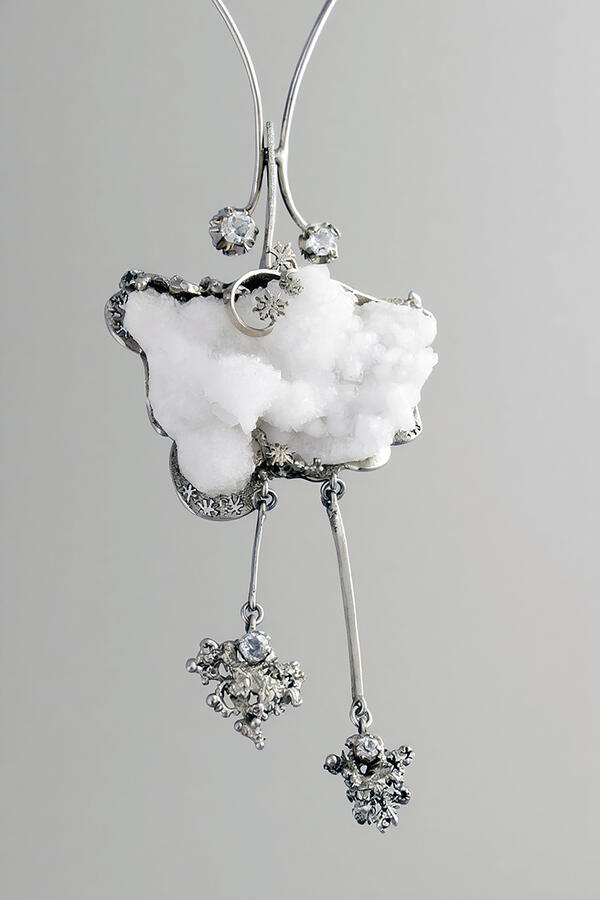
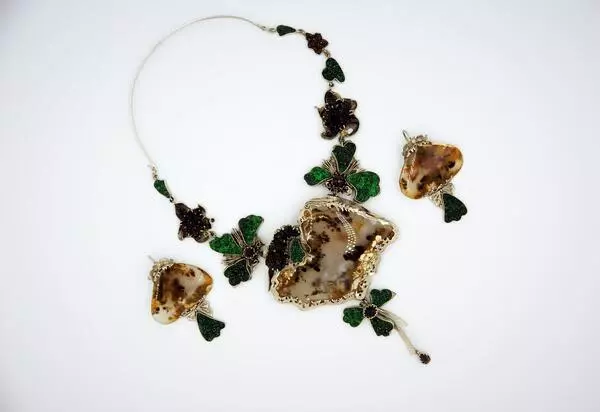
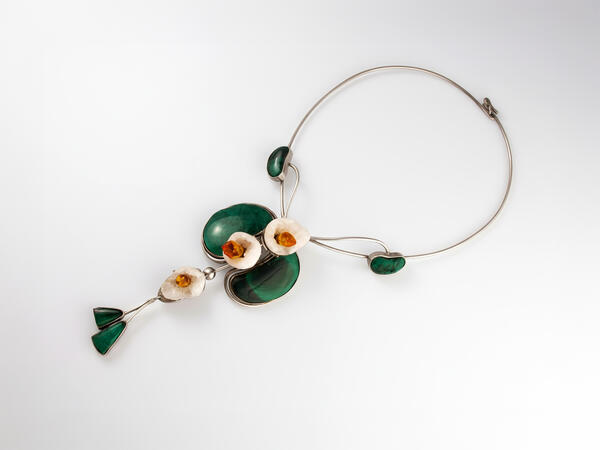
The delicate beauty of the plant world is a central theme in the work of Mikhail Mikhailovich Lesik. In creating the “Little Birch Tree” jewelry set, the artist drew inspiration from the graceful form of a birch leaf. The execution of the set reflects an innovative artistic approach. Lesik experimented extensively with casting techniques until he developed a unique method that, when combined with other techniques, produces a refined and intricately textured surface.
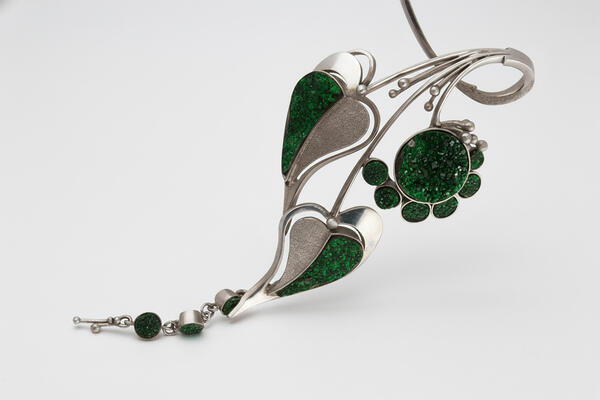
At the heart of the “Little Birch Tree” set is a striking necklace. Its centerpiece is a contoured melchior plate shaped like a birch leaf, which supports a complex three-dimensional structure of finely woven metal filigree resembling delicate, sinuous leaf veins. Through this translucent lattice, delicate “sprouts” of green chrysoprase emerge, culminating in a large, lustrous cabochon.
The central leaf-shaped pendant is the largest element, with progressively smaller leaves arranged in a circular pattern around it, spaced evenly and connected by fine rings. This harmonious motif is echoed in the matching bracelet, while the ring features a chrysoprase cabochon set within an openwork metal frame.
The stone that defines the set — chrysoprase — is a semi-precious variety of quartz prized not for its pattern, but for its vivid green color. The most valuable specimens are those with a saturated, emerald-green hue, uniform color distribution, and high translucency (with a thickness of up to five centimeters). These high-quality stones are often carefully cut and polished into cabochons and flat inlays for fine jewelry.
Slightly less valuable are the apple-green varieties, which typically exhibit limited translucency (up to two centimeters) and may contain milky or opaque zones. The most affordable chrysoprase specimens are pale, unevenly colored stones in bluish-green or yellowish-green tones, often marked by milky-white patches and inclusions of manganese oxides, sometimes forming delicate dendritic patterns. These are classified as ornamental stones and are commonly used in carvings, figurines, and affordable decorative items.
In Russia, chrysoprase is found primarily in the Urals and Eastern Siberia. Ural specimens, known for their rich apple-green tone, have long been valued in both jewelry and decorative arts. Historically, the stone was even used in the interior decoration of imperial palaces, underscoring its status as a symbol of natural beauty, wealth, and refinement.