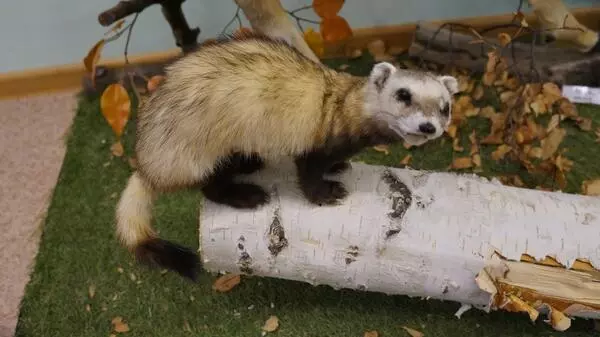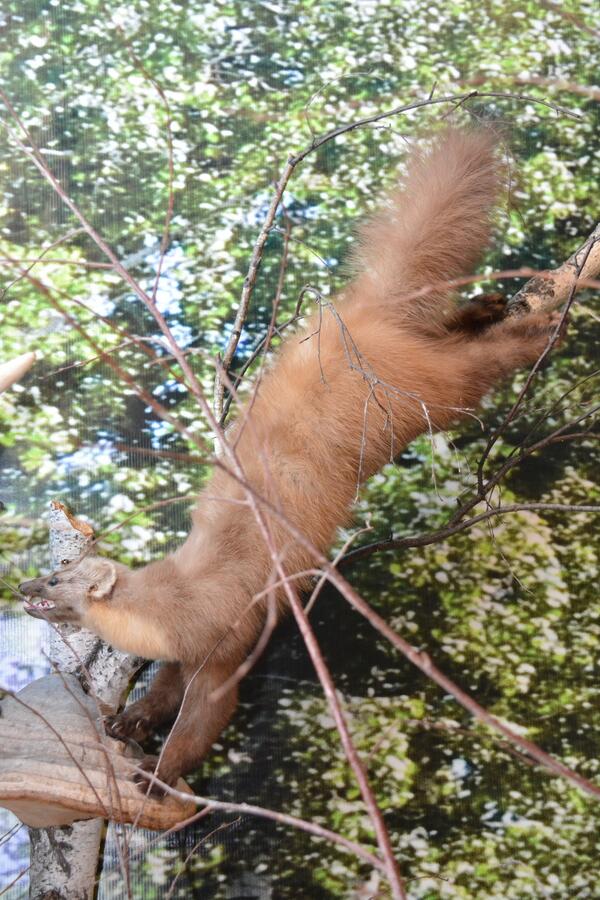
The pine marten is a carnivorous mammal in the family Mustelidae /ˌməˈsteləˌdē/. The marten has a long, supple, and slender body. Its snout is wide and elongated, with a strong jaw and sharp teeth. The eyes are very dark and appear copper red in the night. The bushy tail exceeds half the body length. Its main function is to help the marten keep its balance when jumping and climbing trees. The feet of the marten’s short legs overgrow with fur in winter to increase the sole area and make it easier to move on snow.
The pine marten’s coat can vary in color from pale chestnut brown with a yellowish tint to brown. There is a clear drop-shaped cream-colored or red marking on the marten’s throat that covers the top of its front legs. The marking gives the marten another name in Russia—zheltodUshka, or a yellow soul creature.
The pine marten’s range covers the forests of Europe and Asia. The animal prefers mixed forests and greenwoods abundant with windthrow and hollow trees. The marten can be found in the mountains, but only up to the altitude where trees grow. The animal is a perfect climber and can cover up to four meters when jumping from one tree to another. On land, the marten moves in jumps and leaves paw prints in pairs. This ‘trick’ requires putting hind paws right on the prints left by forepaws. The marten comes out to open spaces only to prey. It has an excellent sense of smell, perfect hearing and eyesight.
The animal is omnivorous and eats small mammals, birds, eggs, reptiles, frogs, snails, insects, and carrion. The marten ‘loves’ squirrels. It usually ambushes them in tree hollows but can chase them in tree branches for a long time if the ambush trick has not worked out. The marten kills its prey by tearing at the back of its head.
The pine marten lives alone. It is only in summer that males and females pair for a while. The female carries two to eight helpless and blind cubs covered with thin down. As they grow up, some of them leave to claim their own territory, while others stay with the mother in the den till the next spring. The lifespan of captive martens reaches 18 years, while a rare marten lives for more than 10 years in the wild.
The pine marten’s coat can vary in color from pale chestnut brown with a yellowish tint to brown. There is a clear drop-shaped cream-colored or red marking on the marten’s throat that covers the top of its front legs. The marking gives the marten another name in Russia—zheltodUshka, or a yellow soul creature.
The pine marten’s range covers the forests of Europe and Asia. The animal prefers mixed forests and greenwoods abundant with windthrow and hollow trees. The marten can be found in the mountains, but only up to the altitude where trees grow. The animal is a perfect climber and can cover up to four meters when jumping from one tree to another. On land, the marten moves in jumps and leaves paw prints in pairs. This ‘trick’ requires putting hind paws right on the prints left by forepaws. The marten comes out to open spaces only to prey. It has an excellent sense of smell, perfect hearing and eyesight.
The animal is omnivorous and eats small mammals, birds, eggs, reptiles, frogs, snails, insects, and carrion. The marten ‘loves’ squirrels. It usually ambushes them in tree hollows but can chase them in tree branches for a long time if the ambush trick has not worked out. The marten kills its prey by tearing at the back of its head.
The pine marten lives alone. It is only in summer that males and females pair for a while. The female carries two to eight helpless and blind cubs covered with thin down. As they grow up, some of them leave to claim their own territory, while others stay with the mother in the den till the next spring. The lifespan of captive martens reaches 18 years, while a rare marten lives for more than 10 years in the wild.