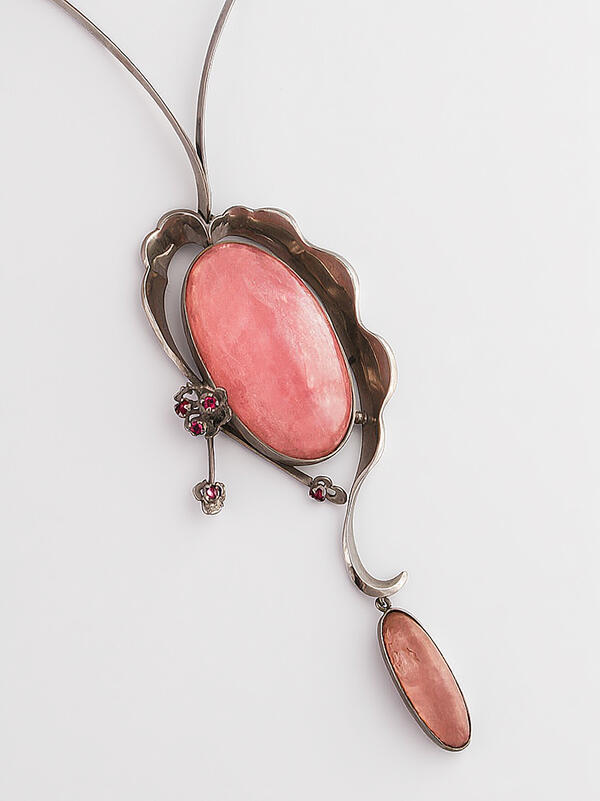
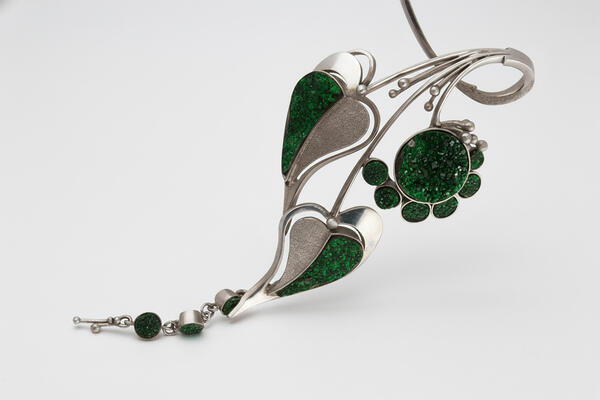
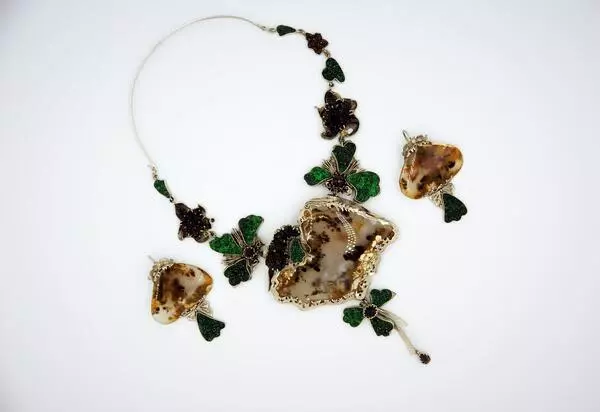
The Ural jeweler Mikhail Mikhailovich Lesik is renowned for creating poetic, sculptural, and pictorial compositions. To fully express his artistic vision, Lesik often sought new expressive means. This search led to a fresh revelation of the aesthetic potential of druses — natural mineral formations. It was precisely this material that he used in the torc-style necklace on display titled “Snowfall”.
For the pendant, the artist selected a seemingly unremarkable fragment of white chalcedony druse, characterized by its raised, uneven, and bristly surface. Through skillful artistry, Lesik transformed this rugged texture into a delicate winter scene. By framing the stone with a metal setting featuring irregular edges and tiny pierced snowflakes, he turned the sharp crystal points into shimmering snowflakes, evoking the quiet magic of a snowy landscape. Druses associated with wintry imagery have since become one of Lesik’s favored materials, reappearing in many of his pieces.
Chalcedony, a mineral of the quartz group, is a silicon-dioxide-based stone known for its remarkable diversity. With over a hundred recognized varieties, it appears in a wide range of colors, structures, and compositions. Among its most celebrated forms are moss agate, carnelian, cacholong, sapphirine, chrysoprase, onyx, and agate.
This exceptional variety ensures chalcedony’s use across numerous fields. In architecture and interior design, it is prized for its durability and visual appeal. In spiritual and ritual practices, chalcedony is believed to possess calming properties and is crafted into prayer beads, talismans, and ceremonial objects.
In industry, homogeneous grades of chalcedony serve as important technical materials. They are used to produce precision components such as support prisms and plates for sensitive instruments, nozzles in synthetic fiber manufacturing, and laboratory mortars.
In jewelry art, the noble varieties of chalcedony are especially cherished. Artisans fashion them into smooth cabochons and polished plates for elegant pieces such as pendants, brooches, rings, and earrings. The stone is also widely used in ornamental carving — transformed by skilled hands into decorative vases, figurines, tabletops, mosaic panels, and even elements of stained glass.