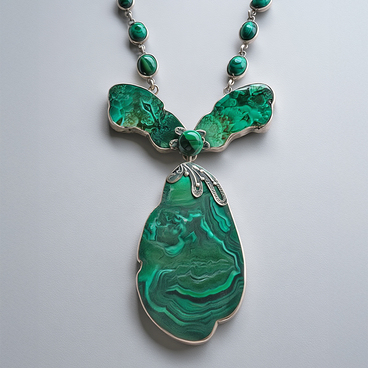
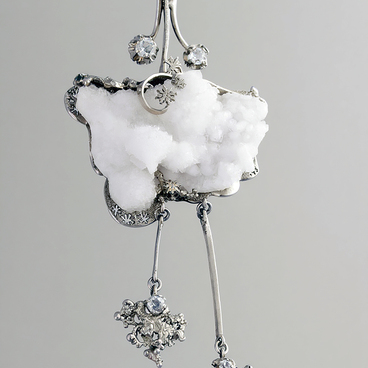
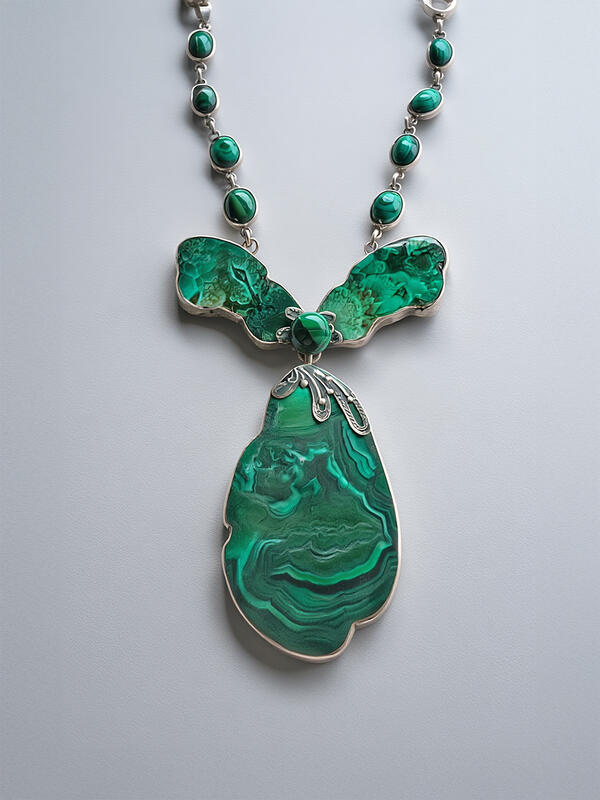
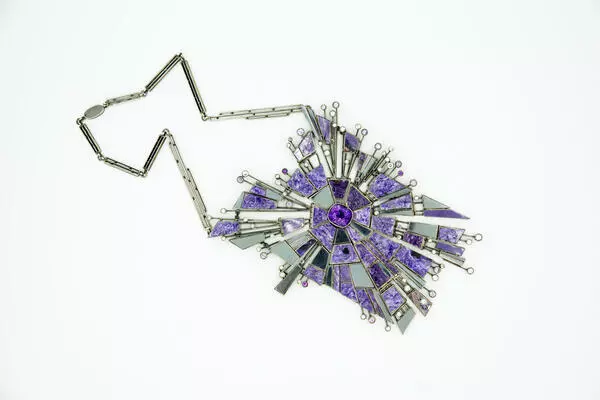
Vladislav Mikhailovich Khramtsov was a pivotal figure in the development of Ural jewelry art. A defining aspect of his work is a deep reverence for the intrinsic beauty of the mineral — a principle central to the Ural artistic tradition. His name is associated with innovative transformations in jewelry design, where form emerges from the stone itself, shaped by its structural and coloristic qualities.
Khramtsov emphasized the continuity of regional heritage, “Traditions existed here in the Urals. It’s an age-old tradition of stone carving. Of course, compositional choices and design elements played their role, but the foundation of the composition was always stone cutting. I consider this love of lapidary art to be the main tradition we uphold. These are deep roots, stretching back to the ancient practices of our stone carvers. In the past, the stone was the focus. It was about a beautiful stone and a very modest setting.”
Khramtsov’s artistic style is remarkably diverse — ranging from classical stone carving techniques to bold explorations in contemporary art, where high-tech structures and paradoxical material combinations coexist. Throughout his career, he explored a wide range of themes: natural motifs, cosmic imagery, fantasy and fairy-tale narratives, Ural legends, and epic tales.
Among these works is the pendant “Tale of a Bogatyr”. The composition features a chain of interlocking metal rings and strips, from which hangs a broad, textured ring with a granulated surface and a prominent spherical element on one side. Inserted into the ring is an elongated piece of rock crystal — a transparent quartz crystal that evokes the image of a warrior’s sword, standing upright like a relic of ancient strength.
Rock crystal is a colorless, transparent variety of quartz. Despite its apparent simplicity — lacking color, inclusions, or complex patterns — it has been a revered material for millennia. Used in seals, vessels, ritual objects, interior design, jewelry, and statuettes, its clarity and purity have long symbolized spiritual transparency and power. In modern times, rock crystal continues to be valued not only in decorative arts but also in optics, radio engineering, and precision instruments.