

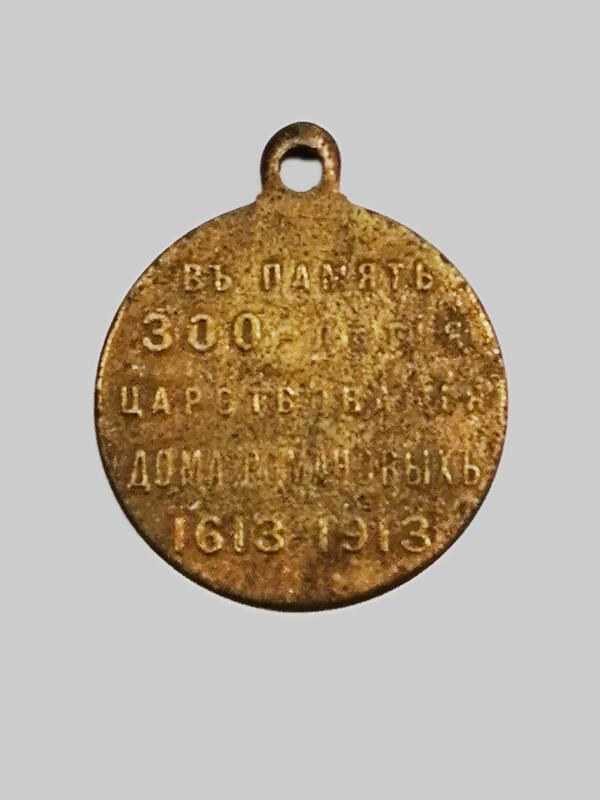
The Karasuksky Regional Museum holds a solid bronze circular commemorative medal in its collection. It was made specially for the 300 year anniversary of the Romanov dynasty, which was celebrated between February and Autumn in 1913.
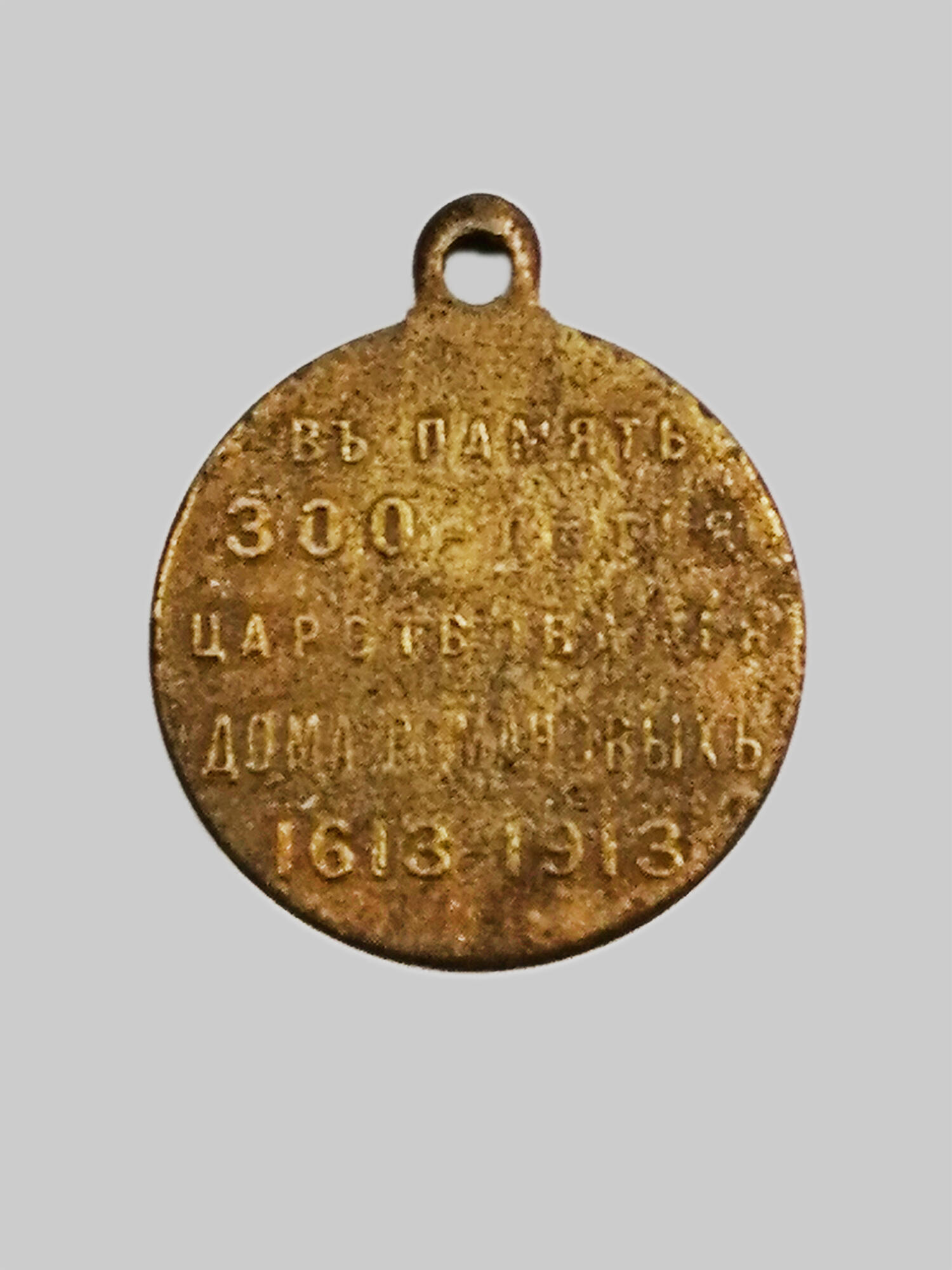
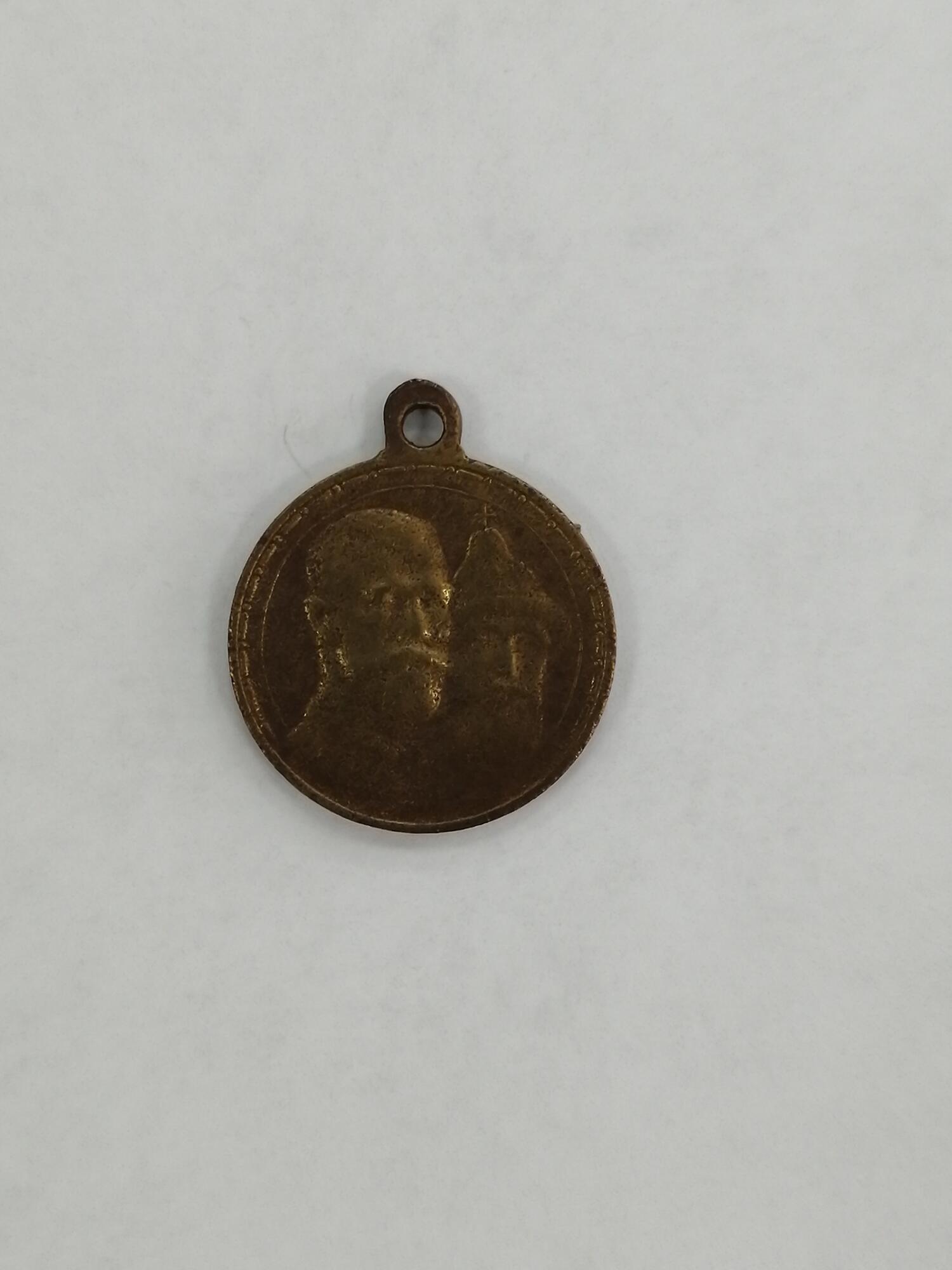
The medal’s obverse features a bust of Tsar Nicholas II - dressed in the uniform of the Fourth Imperial Guard, Rifle Regiment of the Imperial Family - along with the dynasty’s founder, Tsar Mikhail I, dressed in a shoulder mantle and the Monomakh cap. The five-line inscription ‘IN MEMORY OF THE 300 YEAR ANNIVERSARY OF THE ROYAL ROMANOV DYNASTY 1613-1913’ is positioned on the medal’s reverse.
The medal and the nature of the celebrations for the 300-year anniversary of the House of Romanov were approved by the Tsar on 21 February 1913. The main circulation of medals amounted to over 1,500,000, and was produced at the Saint Petersburg mint. By 26 June 1914, the mint had produced no less than 2,028,166 of the medals. The project’s chief was Anton Vasyutinskiy. The artist responsible for the relief on the medal’s obverse was sculptor Mikhail Kerzin.
Russian law at that time allowed the production of medals by private workshops. Medals could therefore differ significantly between different workshops. Some medals prepared by private workshops were made in silver, occasionally with gold plating, and very occasionally were made of gold. Besides this, there were popular versions of the medal to be worn with formal attire, with a smaller diameter of 15-16 mm. This version of the medal had a tag to attach it to a ribbon or strip of fabric. It was worn on one’s chest. The medal’s ribbon was white, yellow and black - the colors of the former flag of the Russian empire.
The medal was awarded to those who, by 21 February 1913, worked in the civil service in the military, naval, civil or judicial departments; members of the State Council and Duma, clergymen of all religious affiliations, current and retired officials, artists in imperial theatres, nurses in the Russian Red Cross, chairmen of township courts, village elders, as well as all those who took part in the preparations for the anniversary celebrations, including medal designers, craftsmen and workers at the Saint Petersburg mint who were producing the medals. These people received the medal for free, but the right to wear it had to be issued formally. Certain groups were allowed to wear the medal, including cadets and footmen of certain classes, the military, police, convoy and prison guards and representatives of the rural population who were participating in anniversary celebrations where the Tsar was present were free to wear the medal.
The medal’s obverse features a bust of Tsar Nicholas II - dressed in the uniform of the Fourth Imperial Guard, Rifle Regiment of the Imperial Family - along with the dynasty’s founder, Tsar Mikhail I, dressed in a shoulder mantle and the Monomakh cap. The five-line inscription ‘IN MEMORY OF THE 300 YEAR ANNIVERSARY OF THE ROYAL ROMANOV DYNASTY 1613-1913’ is positioned on the medal’s reverse.
The medal and the nature of the celebrations for the 300-year anniversary of the House of Romanov were approved by the Tsar on 21 February 1913. The main circulation of medals amounted to over 1,500,000, and was produced at the Saint Petersburg mint. By 26 June 1914, the mint had produced no less than 2,028,166 of the medals. The project’s chief was Anton Vasyutinskiy. The artist responsible for the relief on the medal’s obverse was sculptor Mikhail Kerzin.
Russian law at that time allowed the production of medals by private workshops. Medals could therefore differ significantly between different workshops. Some medals prepared by private workshops were made in silver, occasionally with gold plating, and very occasionally were made of gold. Besides this, there were popular versions of the medal to be worn with formal attire, with a smaller diameter of 15-16 mm. This version of the medal had a tag to attach it to a ribbon or strip of fabric. It was worn on one’s chest. The medal’s ribbon was white, yellow and black - the colors of the former flag of the Russian empire.
The medal was awarded to those who, by 21 February 1913, worked in the civil service in the military, naval, civil or judicial departments; members of the State Council and Duma, clergymen of all religious affiliations, current and retired officials, artists in imperial theatres, nurses in the Russian Red Cross, chairmen of township courts, village elders, as well as all those who took part in the preparations for the anniversary celebrations, including medal designers, craftsmen and workers at the Saint Petersburg mint who were producing the medals. These people received the medal for free, but the right to wear it had to be issued formally. Certain groups were allowed to wear the medal, including cadets and footmen of certain classes, the military, police, convoy and prison guards and representatives of the rural population who were participating in anniversary celebrations where the Tsar was present were free to wear the medal.