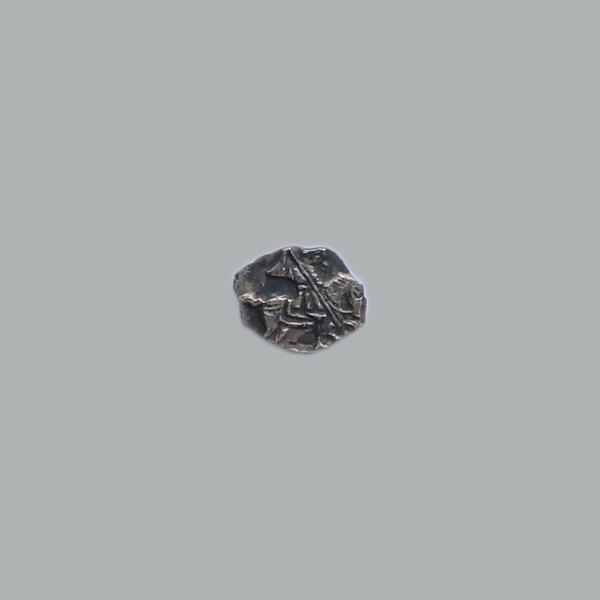
The numismatic collection of the Karasuksky Regional Museum includes an oval-shaped solid silver wire coin, with a face value of a kopek. The coin weighs around 0.25 g, with 0.24 g of that being pure silver. The silver itself is 960 silver. The silver type refers to the number of milligrams of pure metal in one gram of the alloy.
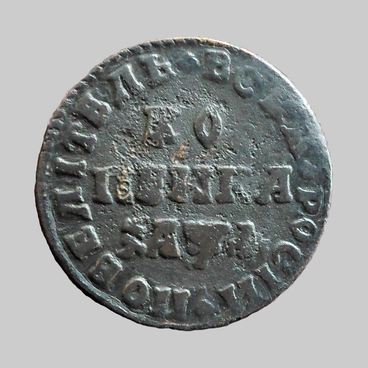
A rider without a greatcoat, but with a spear in his right hand is depicted on the coin’s obverse. Three letters are written under the horse’s legs, indicating the coin’s year of issuance. A three-line inscription containing the name and title of the ruler is displayed on the coin’s reverse: ‘ПTРЪ ЕЗИЕ O/BИЧЪ’ (Tsar Peter Alyozievich, or Tsar Peter Alekseyevich).
The one-man rule of Peter the Great started after the death of his older brother, Ivan Alekseyevich, in 1696. This was the year that Russia started to date ‘wire kopeks’ - coins minted on flattened pieces of silver wire. The ‘Chinese Mint’ became the first Russian mint to start issuing dated silver kopeks. In 1700, the second mint was establish in the building of the former Zemsky Prikaz (department of urban issues and police) on Red Square. The Chinese Mint was named ‘The Old Mint’ in documents. In 1701, two further mints were set up, including the Kadashyovsky Mint. Yuri Frobus was the designer of coin stamps at this Mint between 1701 and 1708.
Production of ‘wire kopeks’ was halted at every mint in January 1718. A unique trait of kopeks produced between 1701 and 1709 at the Kadashyovsky Mint is that the design and inscriptions are raised significantly. The rider on the coin’s obverse was always depicted without a greatcoat. The inscriptions on the reverse are a shortened version of ‘Tsar Peter Alekseyevich’. All of the reverse stamps are characterized by noticeably raised large letters and the use of the letter ξ (pronounced ‘ksi’) in the patronymic name. The carefully cut letter is slightly different on each stamp. Dots have been added around the edges of the inscription, rendering it circular in shape.
The museum’s coin, according to Grishin and Kleschinov’s ‘Catalogue of Russian Medieval Coins 1533-1717’ was embossed by stamp No. 96. The obverse sides of these coins were embossed by stamps No. 42, 43, 44, and 45. However, the number of lines on the rider’s costume and the shape of the horse’s tail indicate that it could only have been embossed by stamp No. 42. This means that this coin’s number is No. 2062. These coins were produced in large quantities at the Kadashyovsky Mint in 1706.
A rider without a greatcoat, but with a spear in his right hand is depicted on the coin’s obverse. Three letters are written under the horse’s legs, indicating the coin’s year of issuance. A three-line inscription containing the name and title of the ruler is displayed on the coin’s reverse: ‘ПTРЪ ЕЗИЕ O/BИЧЪ’ (Tsar Peter Alyozievich, or Tsar Peter Alekseyevich).
The one-man rule of Peter the Great started after the death of his older brother, Ivan Alekseyevich, in 1696. This was the year that Russia started to date ‘wire kopeks’ - coins minted on flattened pieces of silver wire. The ‘Chinese Mint’ became the first Russian mint to start issuing dated silver kopeks. In 1700, the second mint was establish in the building of the former Zemsky Prikaz (department of urban issues and police) on Red Square. The Chinese Mint was named ‘The Old Mint’ in documents. In 1701, two further mints were set up, including the Kadashyovsky Mint. Yuri Frobus was the designer of coin stamps at this Mint between 1701 and 1708.
Production of ‘wire kopeks’ was halted at every mint in January 1718. A unique trait of kopeks produced between 1701 and 1709 at the Kadashyovsky Mint is that the design and inscriptions are raised significantly. The rider on the coin’s obverse was always depicted without a greatcoat. The inscriptions on the reverse are a shortened version of ‘Tsar Peter Alekseyevich’. All of the reverse stamps are characterized by noticeably raised large letters and the use of the letter ξ (pronounced ‘ksi’) in the patronymic name. The carefully cut letter is slightly different on each stamp. Dots have been added around the edges of the inscription, rendering it circular in shape.
The museum’s coin, according to Grishin and Kleschinov’s ‘Catalogue of Russian Medieval Coins 1533-1717’ was embossed by stamp No. 96. The obverse sides of these coins were embossed by stamps No. 42, 43, 44, and 45. However, the number of lines on the rider’s costume and the shape of the horse’s tail indicate that it could only have been embossed by stamp No. 42. This means that this coin’s number is No. 2062. These coins were produced in large quantities at the Kadashyovsky Mint in 1706.