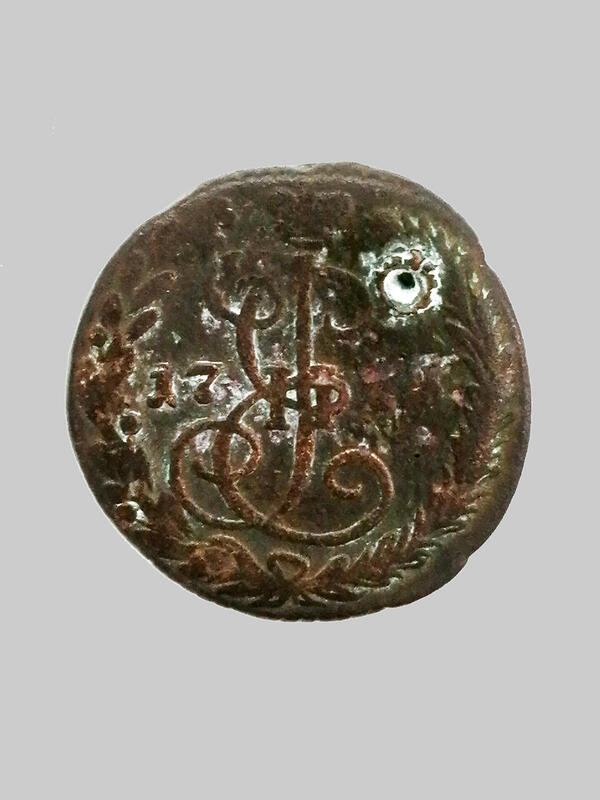
The Karasuksky Regional Museum holds a copper denga coin in its collection. The coin was minted by the Yekaterinburg Mint in 1771. 2,910,000 of these coins were minted. The Moscow coat of arms is depicted on the obverse - the Great Martyr Saint George, without a mantle, gallops on horseback, striking a dragon with his spear. On the reverse, Catherine II’s cipher is positioned under the imperial crown. The cipher consists of the Russian letters ‘I’, for Empress, ‘E’ for ‘Catherine’ and the Roman numeral II for ‘the second’.
The cipher of ruler at the time was often embossed onto coins of different values. The first such symbols appeared on coins minted during Peter I’s reign. It was a cipher consisting of four interwoven letter P’s and four interwoven Roman numeral I’s.
A cipher is a design which combines initials. Most commonly, it takes the first letter of one’s forename and surname, and less commonly includes the first letter of one’s patronymic name. The letters were generally capital letters, combined using ornamental ligatured script. A ruler’s cipher would usually also contain a letter relating to their title and a number relating to their regnal number. Ciphers would occasionally be decorated with crowns or wreaths. Essentially, a cipher is a sophisticated monogram with the initials being more intricately interwoven and additional decorations and patterns. If the letters could only refer to one person, then the cipher will be simpler than if it is connected to a more than one person.
An important detail to note is the coin’s corded edge, or rim. It is covered in equally spaced vertical cuts. The peculiarity of the coin’s edge meant that it could be identified by Vladimir Bitkin’s ‘Composite Catalogue of Russian Coins’ as a denga - a coin with a value of half a kopek. Similar coins, such as kopeks, had a latticed edge - that is, with criss-crossed cuts, pointing in different directions. No other kopeks minted in 1771 were found to have this corded edge in other coin catalogues.
This type of denga was used during the reign of Empress Catherine II. At this time, copper coins used across the nation were minted at the Yekaterinburg (with the designation EM), Moscow Red (MM or without designation), Sestroretsky (SM or without designation), Saint Petersburg (SPM), Anninsky (AM and without designation), Suzunsky (km) and Tavrichesky ™ mints. Counterfeit five-kopek coins, with the EM cipher but without the Yekaterinburg mint designation, were minted at the Avesta mint in Sweden.
The cipher of ruler at the time was often embossed onto coins of different values. The first such symbols appeared on coins minted during Peter I’s reign. It was a cipher consisting of four interwoven letter P’s and four interwoven Roman numeral I’s.
A cipher is a design which combines initials. Most commonly, it takes the first letter of one’s forename and surname, and less commonly includes the first letter of one’s patronymic name. The letters were generally capital letters, combined using ornamental ligatured script. A ruler’s cipher would usually also contain a letter relating to their title and a number relating to their regnal number. Ciphers would occasionally be decorated with crowns or wreaths. Essentially, a cipher is a sophisticated monogram with the initials being more intricately interwoven and additional decorations and patterns. If the letters could only refer to one person, then the cipher will be simpler than if it is connected to a more than one person.
An important detail to note is the coin’s corded edge, or rim. It is covered in equally spaced vertical cuts. The peculiarity of the coin’s edge meant that it could be identified by Vladimir Bitkin’s ‘Composite Catalogue of Russian Coins’ as a denga - a coin with a value of half a kopek. Similar coins, such as kopeks, had a latticed edge - that is, with criss-crossed cuts, pointing in different directions. No other kopeks minted in 1771 were found to have this corded edge in other coin catalogues.
This type of denga was used during the reign of Empress Catherine II. At this time, copper coins used across the nation were minted at the Yekaterinburg (with the designation EM), Moscow Red (MM or without designation), Sestroretsky (SM or without designation), Saint Petersburg (SPM), Anninsky (AM and without designation), Suzunsky (km) and Tavrichesky ™ mints. Counterfeit five-kopek coins, with the EM cipher but without the Yekaterinburg mint designation, were minted at the Avesta mint in Sweden.