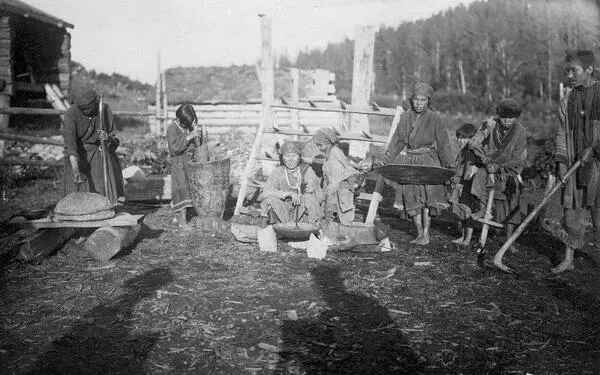
The traditional main activities of the indigenous Shors included hunting, fishing, gathering and slash-and-burn agriculture, which was later replaced by arable farming under the influence of Russian settlers. The ethnographer Galina Mikhailovna Patrusheva writes that the Shors used to spend several weeks in temporary dwellings, “hoed [the ground] with an ‘abyl’ and harrowed with a thick branch.”
The Shors mainly cultivated barley, wheat, and hemp. In the autumn, they pulled the ears of corn out by hand (over time knives came into use, followed by a sickle in the early 19th century and later a scythe). The crop was cleared of the soil and collected in small sheaths. Then the roots were cut off, the sheaths were dried in the sun and burned in calm weather on fires in cleared areas. The ears of corn were clamped between two flat wooden boards so that only the hard straw “whiskers” were burned.
The ears were threshed with wooden sticks flaring at the ends (prototypes of flails), cleared from the chaff, and winnowed on a hand tool called “sargash”. Then the grains were fried in a brazier and ground in a hand mill to obtain cereals and talkan (white barley and dark wheat) flour.
The mill consisted of two millstones — solid stone discs, placed one above the other. The lower millstone was immovable. The top one had a round hole in the middle for putting grain, and a small recess for a lever on the side. The lever was used to set the millstones in motion and make them rotate clockwise. Flour came from under the bottom stone and was collected into the box.
Since the grains were crushed unevenly, after the grinding, the product was sifted through a sieve with a leather bottom: the flour went through, while the bran and seeds remained at the top. Millstones were also used for grinding salt and plants.
Over time, the millstones wore down, their surface became smooth,
ineffective, and required sharpening. In the villages there was a special caste
of artisans who specialized in making millstones and repairing individual parts
of the mill.