Until the first half of the 20th century, the Shor people in the Kemerovo region practiced nettle and hemp weaving. In the autumn, hemp was pulled out, collected and dried indoors, threshed with sticks and winnowed to remove the chaff. The dried stems were broken in the middle, the remaining fibers were stripped apart and tied into bundles (this work was called “kendir soyoraga”, that is, “threshing hemp”).
To connect the fibers into a thread, their ends were moistened with saliva, softened with teeth, and slightly twisted with the index finger. The thread was wound into a round tube and placed in a birch bark box. This process was called “kendir ulanna”.
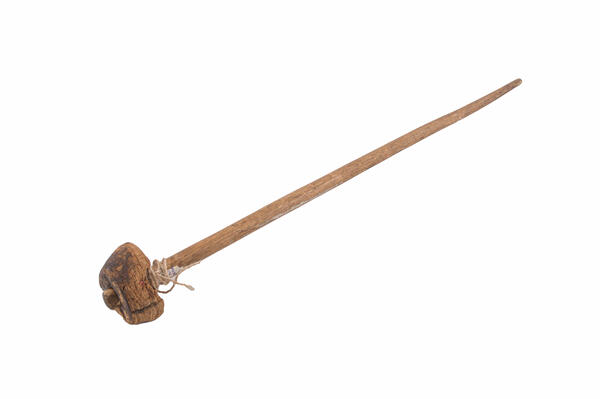
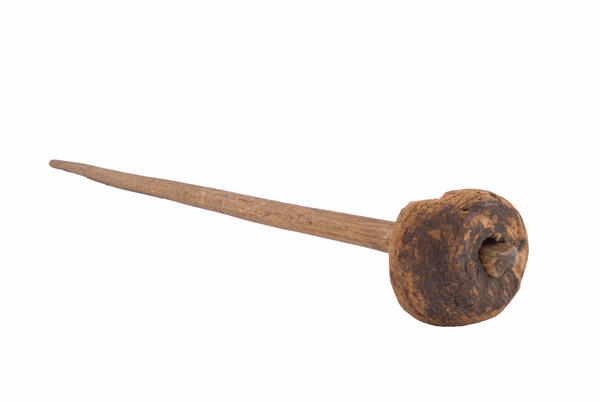
The next stage was spinning, when a spindle (“aik”, or “iik”) was used. This device for twisting fibers into yarn was carved from a single piece of wood, usually bird cherry. The smooth cone-shaped shaft was round in cross-section and had an oblique notch near the bottom to provide a secure anchorage for the thread.
Usually, there was a spindle whorl between the shaft and the notch — it was called “aik-pazhi” or “orchikpazhi”. It was a disk that was flat on one side and convex on the other, with a round hole in the middle. The whorl functioned as a flywheel, maintaining the strong and uniform rotation of the spindle.
The spindle was set in motion with the right hand, while using the left hand to hold the thread that was twisting clockwise. Spinning was laborious and monotonous: spinners had to pull, twist and wind the threads again and again. Their hands quickly got tired, and labor productivity was quite low. During the spinning process, the joined fibers were passed through a hook or ring attached to the ceiling or a wall.
Unlike their Russian counterparts, Shor craftswomen did not wind threads into yarn balls. The yarn was left on the spindles, and then it was rewound directly into a frame onto stakes driven into the wall of the house. The circumference of such a frame could reach 12 arshins (about 8.5 meters).
The yarn was bleached: a cauldron was filled with water and birch or aspen tar, the yarn was boiled for two or three days and washed down by the local river.
Kendyr fabric was used both for sewing clothes and
for various household needs.