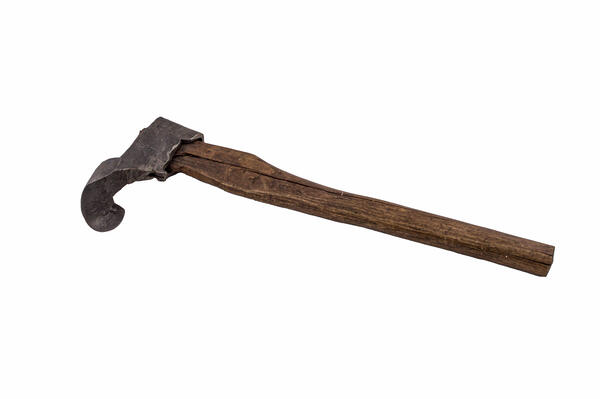
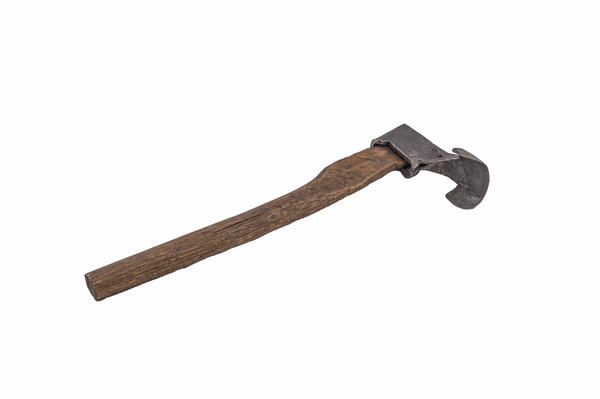
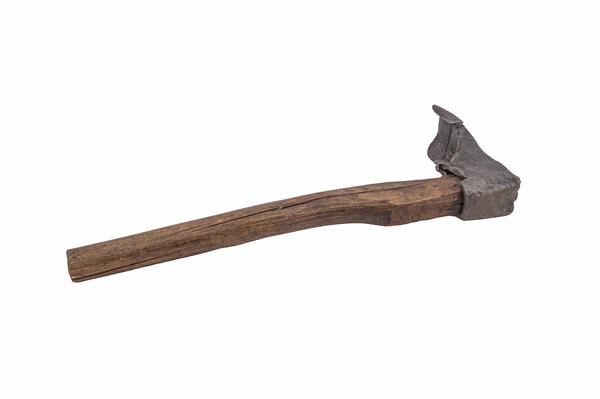
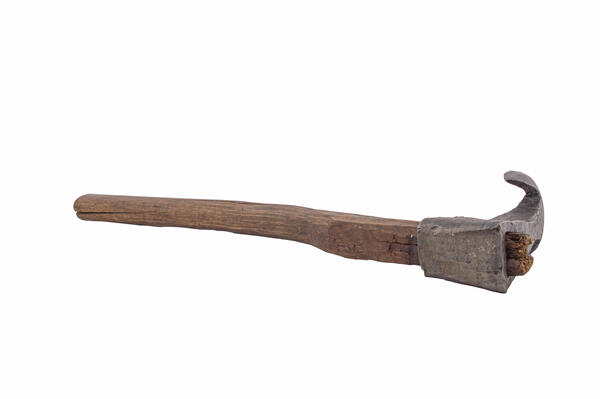
The adze and the ax were, according to the historian Andrey Nikolayevich Toropov, the oldest and most popular carpentry tools. The Soviet archaeologist Boris Aleksandrovich Kolchin believed that the design of the adze, which remained unchanged until the 20th century, originated back in the 9th –10th centuries.
These tools vary in weight: heavier ones are more suitable for rough rather than for fine work; depending on its function, the blade can be straight or rounded.
An adylga adze looks like an ax. The straight, round-section handle of the adze was made smooth. It gradually decreased in diameter, starting from the working part. An iron tip was attached perpendicularly to the thicker end — a forged blade with short rounded corners and convex sides. The tip gradually becomes a rectangular rod to be attached to the handle. The working edge of the blade was sharpened.
Back in the 19th century, the economy of the Shors seemed very ascetic, but already in the first half of the 20th century, their equipment, including kitchen utensils, became quite varied. In everyday life they used metal, wood, birch bark, and less often leather utensils. Wood and birch bark processing was traditionally considered an occupation for men.
Small dishes and cups were cut out of birch burl. To create larger hollow-carved dishes, the Shors cut down the trunks and roots of birch trees with axes, processed the workpiece with an adylga adze and then with a knife. For porridges and stews, hemispherical bowls were made that could have a low tray. Various containers for drinks, low wide dishes for meat or fish, ladles for pouring liquid food, spoons, smoking pipes, and troughs were in demand.
Skis and hunting sleds were made from flexible bird cherry wood. Cedar and fir were required for construction, furniture, and traps.
Strong and stable dugout boats were hollowed out
from aspen trunks. Thanks to their light weight and flat bottom, they were
easily dragged over the rapids of mountain rivers. The rounded blade of the
adze enabled the Shors to carve out wood from the inside of the trunk carefully
and accurately, without splinters.