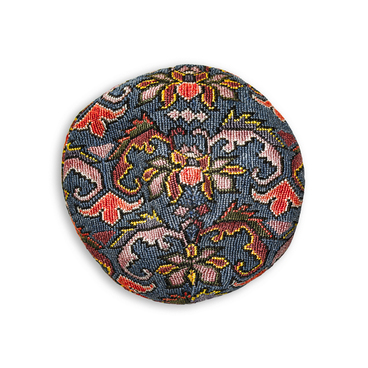
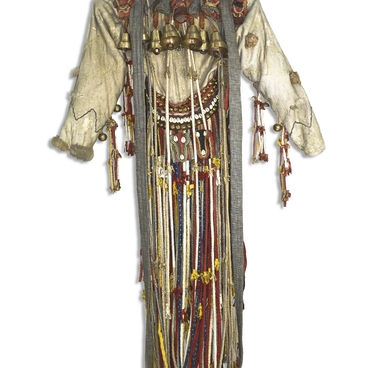
The ensemble of women’s Tatar clothing consisted of a long camisole, tunic dress, shawl and kalfak, as well as pants and shoes. The camisole had a V-shaped neckline. It was long and fitted, reaching up to the thigh or ankles.
Women wore metal bracelets on their hands. Rings, earrings and beads were also common jewelry. Tatar women’s hair was decorated with a variety of plait ornaments. Both in summer and winter, the representatives of this ethnic group wore hats. Winter hats were decorated with fur and summer hats with a large number of adornments. The latter were shaped like men’s skullcaps or hats.
Such kalfak headdresses were a direct borrowing from the Tatars of the Volga region and the Urals. They were put on the head using a special headband. Adult women tucked all their hair under the kalfak, which young women could not do: their caps were usually small in size.
Headdresses were made of different colors of velvet. As Islam came to Siberia, the choice of color became limited. Siberians bought kalfaks made mostly of blue velvet, which symbolized the sky. Besides, they chose items of green color and its shades, which symbolized the green expanses of local forests.
The headdress from the museum’s collection was made of dark green cotton velvet. The slightly elongated vertically semicircular top was made of a single piece of fabric. The rectangular strip of the crown was sewn to it.
The lining was made of beige colored cotton fabric with blue and red lines. Two metal hooks were sewn to this kalfak, one at the back of the upper part and the other at the back of the lower part of the crown. They were used to fix the kalfak on the head. The front part was decorated with embroidery made of white beads. Flower buds and leaves formed a vegetal pattern.
Such kalfaks were used
as a festive item of clothing by Siberian Tatars in the second half of the 19th
— first quarter of the 20th century. The kalfak presented in the exhibition was
purchased from a resident of Omsk Fatima Ponomaryova in the early 20th century.
By that time, the common European city clothes, which were made in accordance
with the fashion, had penetrated into the local Tatars’ community. Traditional
costumes began to give way.