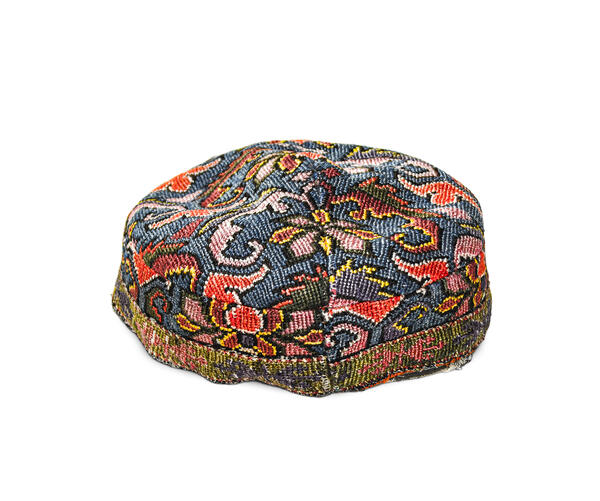
The tyubeteika, also called arakchin, was a universal headdress for the people of Volga region, Central Asia, Urals, Caucasus, Western Siberia and Crimea, and it was an integral part of Tatar clothing. In pre-Islamic times people believed that the tyubeteika, covering the top of the head and forehead, protected the wearer from spoilage and evil eye. Gradually it became obligatory for Muslims to wear a headdress in public places.
The way the tyubeteikas looked showed the status and origin of the owner. For people of wealthy class, they were often made of natural and expensive fabrics and decorated with gold threads. On weekdays this headdress was put on the frontal part of the head, on holidays it was allowed to wear it on the back of the head. The tyubeteika from the museum’s collection was handmade in the middle of the 20th century from jacquard fabric with black cotton lining.
The tyubeteika was the most widespread type of men’s headdress among the Tatars of the Omsk region. It was worn all year round. Such headdresses were usually made of expensive fabrics — plush, velvet, and later corduroy. They were decorated with embroidery, beads and coins.
In the 1930s–1950s, the fashion for tyubeteikas spread everywhere in the USSR. The headdress was depicted on postage stamps, appeared in movies and literature. The tyubeteika at that time, at least in the European part of the USSR, was no longer perceived by people as a religious or national headdress.
This type of headgear became popular mainly among the artistic intelligentsia, scientists, engineers, as well as students and schoolchildren. The reason for this fashion trend was that the tyubeteika began to symbolize brotherly friendship with the peoples of Central Asia.
In the second half of the 20th century, factory-made tyubeteikas became widespread. In winter, the Tatars of the Omsk region wore round national hats with the crown made of cloth and the trim made of fur. They also wore ear-flapped “Russian-style” hats.
Nowadays, the tyubeteika
has a decorative function for the majority of urban Tatars, but it is also worn
as a symbol of belonging to certain nationalities and religions. The tyubeteika
is most popular among Tatars, Turkmens, Uzbeks, Tajiks, Uyghurs, and partly
among Kazakhs.