The cloak of an Altai shaman was handmade approximately at the end of the 19th century. Such a garment was used during kamlanie ritual, worshiping the spirits of the earth, Erlik — the deity of the lower world, his sons, and blood spirits.
Shamanism is based on three premises: the belief in the plurality of human souls; the belief in the existence of helper spirits and in the shaman as a link between the spirits and humans; and the idea of a three-part structure of the world (upper, middle and lower worlds). According to one of the myths, the first shaman was trained in kamlanie ritual by the ruler of the underworld. This probably earned shamanism the name “Black Faith”.
Along with black shamans, the Altai people had a class of white shamans. The first group was associated with all levels of the universe, the latter — exclusively with celestial deities. White shamans were the heads of families and clans, who performed priestly functions and performed tribal sacrifices. Unlike black shamans, white shamans did not enter ecstatic states, but rather imitated.
Black shamans did not participate in life cycle rituals (birth, marriage, pregnancy and death), but were responsible for curing people who were believed to be victims of malicious spirits. They were also involved in fortune telling and controlling the weather. Shaman’s paraphernalia included a tambourine with a beater and a walking stick.
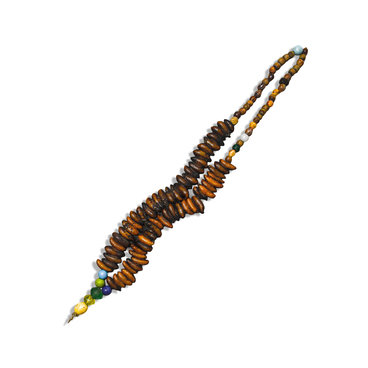
The costume in which the shaman performed his kamlanie rituals played an important role. The cloak from the museum’s collection is a short coat with long sleeves and numerous strings with pendants. It was sewn from reindeer skins with fur inside, decorated with fabrics, feathers, metal and glass buttons, bells, shells and beads.
The cloak has a round collar, which was decorated with fur trimming and wide sleeves. The back of the cloak was decorated with a strip of red leather with seven dolls made of multicolored chintz and sateen sewn on it. These dolls symbolized the daughters of the supreme light god Ülgen.
A wrought iron bow with
an arrow was sewn on the left shoulder with nine metal bells placed below it.
During the ritual, the shaman moved, and the bells made a sound that, according
to beliefs, scared away evil spirits. Two images of snakes were stitched on the
shoulder seams. They were regarded as intermediaries between the upper, middle
and lower worlds.