Until the early 20th century, the Shors practiced weaving, pottery, net weaving, wood and leather processing. They made skis and saddles, dugout boats, dishes, and furniture. All this was made, as a rule, not for sale, but only for household needs.
The Shors usually used nettle and hemp threads. They wove on a loom and the resulting “kendyr tybeg” fabric was used to make clothes and boot shafts (the poorer Shors had to make do with “kendyr” items). Men and women wore practically the same clothes and shoes.
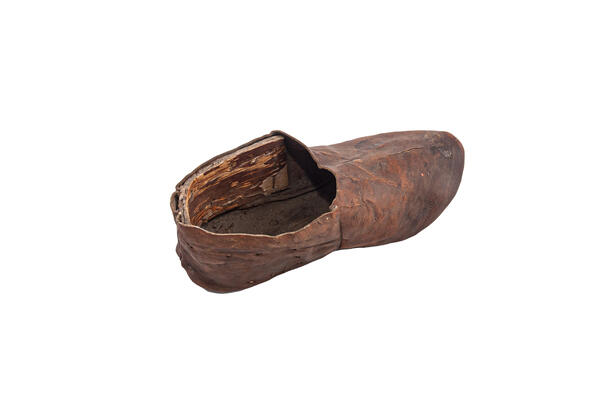
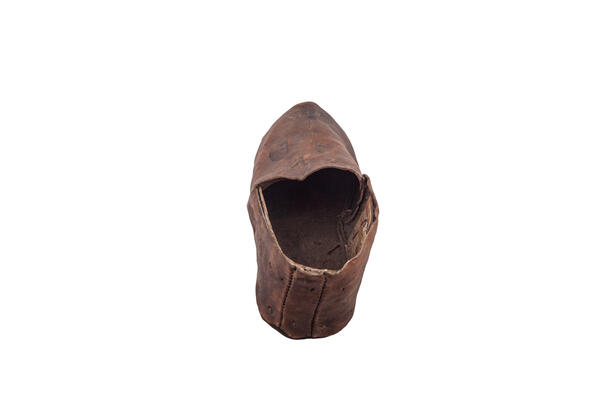
Women’s leather galoshes were called “charyk”. They were similar in cut and shape to men’s “uduk” boots but did not have boot shafts. Such shoes were cut from rawhide that had been treated with smoke. The shaft could consist of a single piece or three separate parts: the sole, the front part and the heel. The parts were fastened together with Altai wapiti tendons or “kendyr” (nettle or hemp) threads.
For the sole, the thickest and strongest parts of the skin were selected: for a cow — from the backbone, for a horse — from the rump. The front parts were cut from thinner and softer material, the heel part was strengthened with a birch bark insert sewn with large stitches. Birch bark made galoshes keep their shape, be more comfortable and last longer.
Galoshes were always made spacious, so that they would fit loosely. This was necessary because Shor women did not have socks, so they wrapped their feet in a thick layer of “azagat” (“ozangat”) grass, like sedge. This grass was collected at the beginning of summer, tied into bunches, dried on a tree, and then used as foot wraps.
Researchers trace this model of footwear to the traditional common Turkic one, finding its analogues among the Turks, Kumyks, Azerbaijanis, Karachais and Balkars. Shor women wore charyk until the first quarter of the 20th century.
At the beginning of the 20th century, traditional Shor
clothing continued to be sewn only in remote southern uluses. Most locals began
wearing Russian dresses, trousers and shirts made from purchased cloth and
calico, caps, coats, shawls, and boots.