Font
Color
Graphics
Изображение точки

To see AR mode in action:

1. Install ARTEFACT app for iOS or Android;

2. Find the exhibition «The Indigenous People: Lifeways and Trades»

3. Push the «Augmented reality» button and point your phone's camera at the exhibit;

Скрыть точки интересаПоказать точки интереса
Показать в высоком качестве

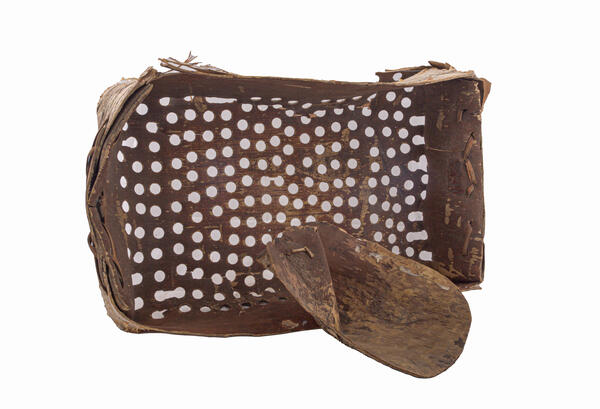
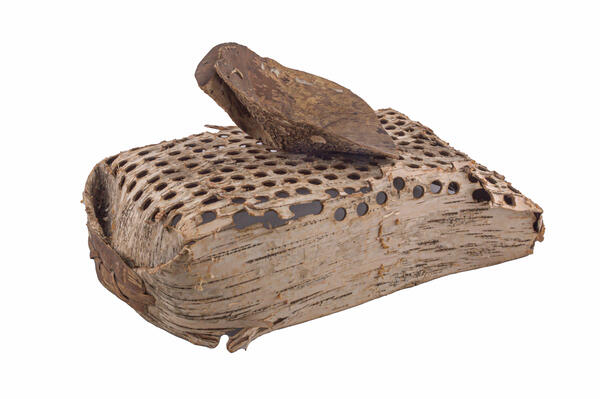
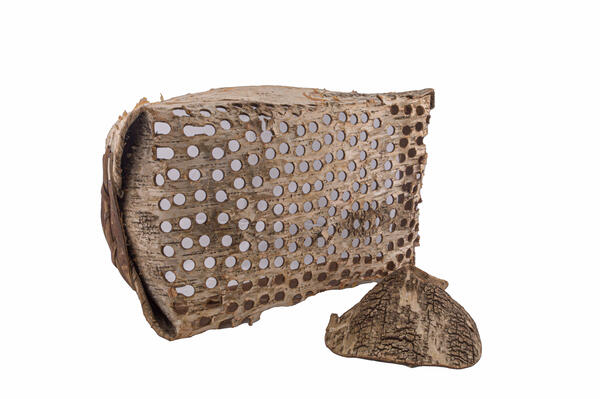
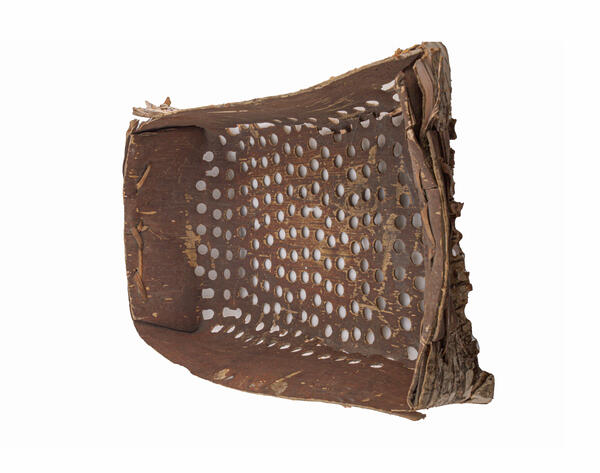
Sieve

Creation period
the early 20th century
Place of сreation
Gornaya Shoria, the Russian Empire
Dimensions
50x30,5x13,5 cm
Technique
birch bark; weaving, stitching
0
Open in app
#2

The Shors compensated for the shortage of agricultural products by foraging, including pine nut harvesting. In the first half of the 19th century, this activity was turned into a business — the surpluses were sold to Russian merchants. Previously, nuts were collected in smaller quantities and exclusively for local consumption.

Ethnographic texts mention a delicious Shor dish called “toktsok” — balls made from a mixture of crushed pine nuts with shells, honey and talkan flour. Nuts were of great importance to hunters in the summer and autumn.

In commercial cedar forests, each family had its own plot. The Siberian educator of the 19th century, Alexander Vasilyevich Adrianov, wrote:
#4

The right of every Shor to harvest nuts or hunt animals is always strictly limited to a certain place; the entire habitat of the Tubalars [including the Shors] is divided into sections of the ‘taiga’, and each is ruled by one or another clan (soyok).

#5

In the taiga camp, the Shors built temporary pole or permanent log houses and barns to store fishing equipment. Sometimes such tools were made right on the spot.

Cones were collected on the ground after gusty winds, pulled from tree crowns or knocked down by using special mallets to tap bare inaccessible trunks.

The cones were put away for some time to get rid of the resin. Then they were ground on a wooden notched grater, the nuts were extracted and winnowed by tossing in a “sargash” birch bark box. According to the “Essays” of Leonid Pavlovich Potapov, “an adult worker could hardly winnow about 1.5 centners” of grain or nuts per day.

To sift the crushed nuts from the chaff, a birch bark sieve with large cells was used. During the work, the peeled nuts fell onto the linen that was spread beneath, and the scales and large pieces of dirt remained in the sieve and were thrown away.

The presented sieve is made from a single piece of birch bark with the outer layer facing out. The sides of this low, slightly elongated rectangular box were made slightly raised and stitched along the top edge with straight stitches. The corners were bent into a triangle, pressed with rectangular strips of birch bark, and additionally reinforced with a horizontal bird cherry rod.

#6
Sieve
#3
read morehide
00:00
00:00
1x

Sieve

Creation period
the early 20th century
Place of сreation
Gornaya Shoria, the Russian Empire
Dimensions
50x30,5x13,5 cm
Technique
birch bark; weaving, stitching
0
Point your smartphone camera to open in the app
Share
VkontakteOdnoklassnikiTelegram
Share on my website
Copy linkCopied
Copy
Open in app
To see AR mode in action:
  1. Install ARTEFACT app for 
  2. iOS or Android;
  3. Find and download the «Paintings in Details» exhibition
  4. Push the «Augmented reality» button and point your phone's camera at the painting;
  5. Watch what happens on your phone screen whilst you flip through the pictures.
 
We use Cookies
Cookies on the Artefact Website. We use cookies to ensure that we give you the best experience on our website. If you continue without changing your settings, we'll assume that you are happy to receive all cookies on the Artefact website. However, if you would like to, you can change your cookie settings at any time.
Learn more about useHide
Content is available only in Russian

X

Нашли опечатку?...

%title%%type%