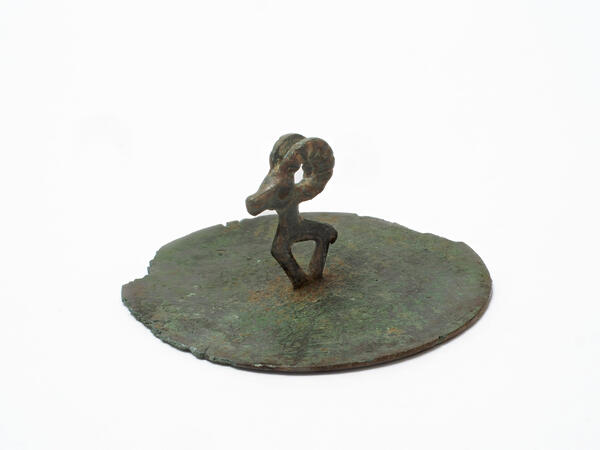
The museum collection contains a bronze mirror, which is about 2500 years old. Instead of an anchor, there is a figurine of a goat with two steeply curved horns on the back of the mirror. The legs of the animal almost converge in one point, the artisan made the eyes in the form of small indentations, and the tail was made in the form of a short lowered protrusion. The mirror has a diameter of 6.4 centimeters.
The artifact was found in 2001 during excavations led by the Tomsk archaeologist and Doctor of Historical Sciences Lyudmila Pletneva. The mirror was located on the monument of the 6th — 4th century B.C., on the settlement of Shelomok II.
The study of the settlement provides insight into the religious views of the people who used to live in this territory. During the excavations, the scientists found a ritual object with an area of 27 square meters. In ancient times, it was a building with 21 circles of masonry stones and one circle containing the fragments of ceramic dishes.
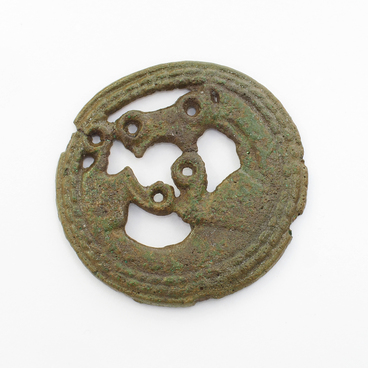
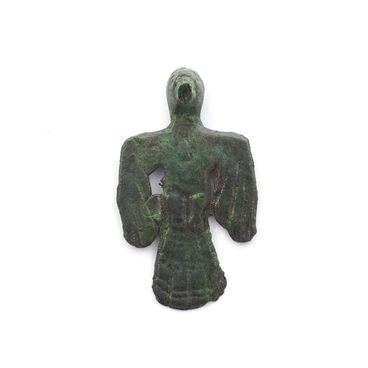
In the center, the researchers found several bronze objects: figures of a lion, a deer, a panther curled up in a circle and an image of two horses. As well as two embroidered patches and two mirrors, including one with the image of a goat. The horses, the deer, and the mirror were found next to each other. The lion’s figure was found standing on the northern side, the panther was to the northeast, and the mirror with the goat was found on the southern side. All the items were facing upwards. Their location at a certain distance and in a certain order indicates that some ritual actions were performed at this settlement.
The Shelomok people believed that each animal occupied a certain place in accordance with their views on the world’s structure. The members of the Scythian-Siberian cultures used to divide the world into the Upper and Lower ones. Predators were considered the representatives of the Lower World, while the goat, the deer and the horse belonged to the Upper World.
The image of a goat is quite common among the cultures of the Scythian-Siberian circle. The animals could be depicted statically, or in a jump — in this case, the goat’s hind legs were bent to the front, like the figure on the mirror found during excavations. In some cultures, the animal was depicted with a beard, and in others, as in Shelomok, it was beardless.
The figure of the goat is depicted in the Scythian-Siberian animal style. The images of animals were divided into four characteristic groups: ungulates (deer, goats, wild boars, and elks), birds of prey, feline predators, and fantastic animals that combined different features — winged or horned horses, griffins, and others. Each animal had an iconic pose: deer and goats were often depicted standing on the tips of their hooves, and predators were coiled in a circle.
The artifact was found in 2001 during excavations led by the Tomsk archaeologist and Doctor of Historical Sciences Lyudmila Pletneva. The mirror was located on the monument of the 6th — 4th century B.C., on the settlement of Shelomok II.
The study of the settlement provides insight into the religious views of the people who used to live in this territory. During the excavations, the scientists found a ritual object with an area of 27 square meters. In ancient times, it was a building with 21 circles of masonry stones and one circle containing the fragments of ceramic dishes.
In the center, the researchers found several bronze objects: figures of a lion, a deer, a panther curled up in a circle and an image of two horses. As well as two embroidered patches and two mirrors, including one with the image of a goat. The horses, the deer, and the mirror were found next to each other. The lion’s figure was found standing on the northern side, the panther was to the northeast, and the mirror with the goat was found on the southern side. All the items were facing upwards. Their location at a certain distance and in a certain order indicates that some ritual actions were performed at this settlement.
The Shelomok people believed that each animal occupied a certain place in accordance with their views on the world’s structure. The members of the Scythian-Siberian cultures used to divide the world into the Upper and Lower ones. Predators were considered the representatives of the Lower World, while the goat, the deer and the horse belonged to the Upper World.
The image of a goat is quite common among the cultures of the Scythian-Siberian circle. The animals could be depicted statically, or in a jump — in this case, the goat’s hind legs were bent to the front, like the figure on the mirror found during excavations. In some cultures, the animal was depicted with a beard, and in others, as in Shelomok, it was beardless.
The figure of the goat is depicted in the Scythian-Siberian animal style. The images of animals were divided into four characteristic groups: ungulates (deer, goats, wild boars, and elks), birds of prey, feline predators, and fantastic animals that combined different features — winged or horned horses, griffins, and others. Each animal had an iconic pose: deer and goats were often depicted standing on the tips of their hooves, and predators were coiled in a circle.