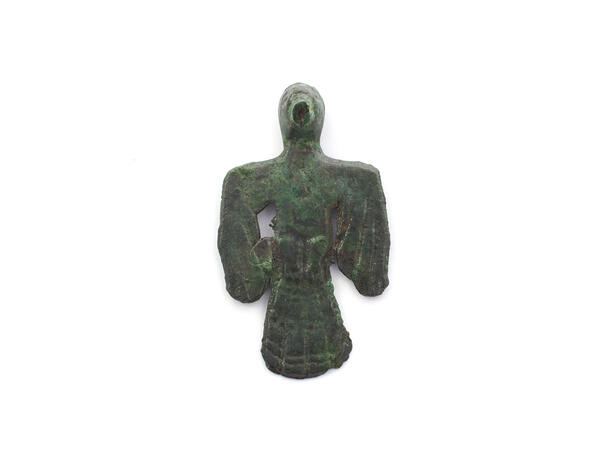
The bronze figurine of the bird was found in 2013 during the archaeological excavations of the ancient settlement of Timiryazevo 3. Archaeologist Dmitry Rybakov led the expedition, which was organized by the Seversk Museum.
The researchers attribute the monument to the Kulai culture. It dates back to the 4th or the early 5th century A.D. The Kulai culture was named like that because of Mount Kulayka where a bronze pot with bronze and silver castings was first found. The main Kulai site is located in the Chainsky district of the Tomsk region.
The craftsman cast the bronze figurine of the bird from the front view. Its wings are lowered and its paws are tightly clenched. It has a strong beak of medium length, flanked by two eyes in the form of grooves. A drop-shaped dent was carved into its broad chest. Its plumage is rendered by slanting and vertical lines and its tail is decorated with three additional grooves, one of which is edged.
The Kulai culture appeared in the 5th century B.C. and existed for a thousand years. The Kulai tribes lived in the taiga zone of the Tomsk region. In the 3d century B.C. because of severe cold weather, they moved to the south and reached the Altai Mountains. In the middle of the first millennium A.D., the Kulai tribes migrated in the direction of Salekhard, Barnaul, Tara, and Achinsk.
These tribes practiced farming, hunting and fishing as their basic occupations. Therefore, they built their settlements near the bodies of water and erected fortresses with a complex defensive system of ditches and earth walls in high and naturally protected places.
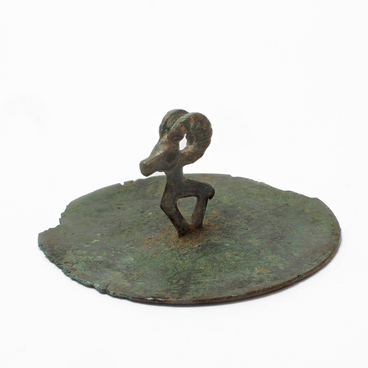
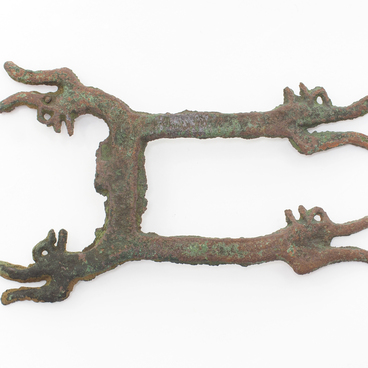
The Kulai culture had some distinctive features. The tribes made arrows with special rocket-shaped tips and decorated everyday objects with the ‘duck’ stamp (a zigzag pattern). However, the most characteristic and recognizable feature of the culture was opencast. Such bronze items were made in special molds.
Early Kulai castings were ‘skeletal’: artisans necessarily depicted the ribs and spine. The heart or aorta was often cast inside the skeletal base in the form of an oval, a circle, or a triangle. According to the Kulai people, these elements were the representation of the soul, the sign of a living being. Later, when the casting became solid and the style of depiction changed, the tradition of depicting these elements continued.
The researchers attribute the monument to the Kulai culture. It dates back to the 4th or the early 5th century A.D. The Kulai culture was named like that because of Mount Kulayka where a bronze pot with bronze and silver castings was first found. The main Kulai site is located in the Chainsky district of the Tomsk region.
The craftsman cast the bronze figurine of the bird from the front view. Its wings are lowered and its paws are tightly clenched. It has a strong beak of medium length, flanked by two eyes in the form of grooves. A drop-shaped dent was carved into its broad chest. Its plumage is rendered by slanting and vertical lines and its tail is decorated with three additional grooves, one of which is edged.
The Kulai culture appeared in the 5th century B.C. and existed for a thousand years. The Kulai tribes lived in the taiga zone of the Tomsk region. In the 3d century B.C. because of severe cold weather, they moved to the south and reached the Altai Mountains. In the middle of the first millennium A.D., the Kulai tribes migrated in the direction of Salekhard, Barnaul, Tara, and Achinsk.
These tribes practiced farming, hunting and fishing as their basic occupations. Therefore, they built their settlements near the bodies of water and erected fortresses with a complex defensive system of ditches and earth walls in high and naturally protected places.
The Kulai culture had some distinctive features. The tribes made arrows with special rocket-shaped tips and decorated everyday objects with the ‘duck’ stamp (a zigzag pattern). However, the most characteristic and recognizable feature of the culture was opencast. Such bronze items were made in special molds.
Early Kulai castings were ‘skeletal’: artisans necessarily depicted the ribs and spine. The heart or aorta was often cast inside the skeletal base in the form of an oval, a circle, or a triangle. According to the Kulai people, these elements were the representation of the soul, the sign of a living being. Later, when the casting became solid and the style of depiction changed, the tradition of depicting these elements continued.