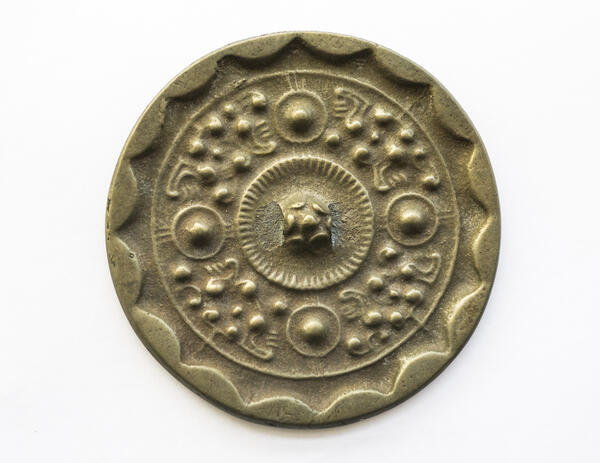
The bronze disc-shaped mirror with the “star nebulae” (or “star clouds”) ornament on one side was made in the period from the 2nd century BCE to the 1st century CE. The basis of the composition of such objects were hemispherical projections on a round base.
In the process of creating the mirror, the craftsman made a looped handle and applied a floral ornament to it. Along the side, he made a molded geometric decor. This type of mirror was widespread in ancient China. The object from the museum’s collection is similar to the well-known types of Chinese mirrors of the end of the first millennium BCE, but it is a local replica.
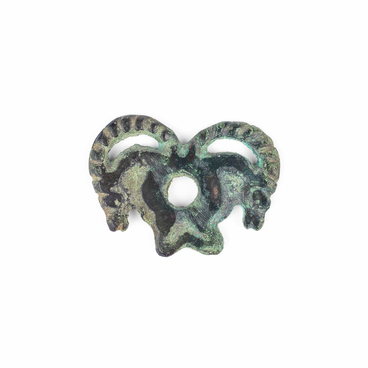
In May 2002, bronze objects, discovered by a local resident Gennady Markovich Pyrin, were donated to the Sayanogorsk Museum of Local Lore. He found a number of artifacts while plowing the land in a suburban area in the city of Sayanogorsk, in a large bronze cauldron. Scientists identified the find as a treasure trove of an ancient caster and attributed most of the items to the Tesin archaeological culture of the Xiongnu-Sarmatian era.
A series of more ancient items, from the Early Scythian time, was also revealed in the treasure trove. These items, as well as production waste, were probably used as sources of metal. The main type of alloy of the Tes caster was arsenic bronze, an alloy of copper with arsenic. The craftsman produced buckles, spoon-shaped pendants, buttons, and rings typical of the Tes time. In addition, he was engaged in casting replicas of Chinese mirrors and bells.
In the area of the Middle Yenisei in the territory of the Republic of Khakassia and the south of the Krasnoyarsk Territory, archaeologists have discovered a large number of ancient treasures of various types and periods. The territorial placement of individual cauldrons and hoards was concentrated in several areas, which is explained by the location of winter shelters and the migration from them to summer sites at the beginning of the spring season. Scientists believe that the local cattle breeders performed the rituals of “abandonment of inventory, ” for which they had to return to the next wintering.
The tradition of laying
treasures in non-ferrous metal cauldrons fits into a fairly extensive
chronological interval. Researchers dated this period to the end of the first
millennium BCE — the middle of the first millennium CE.