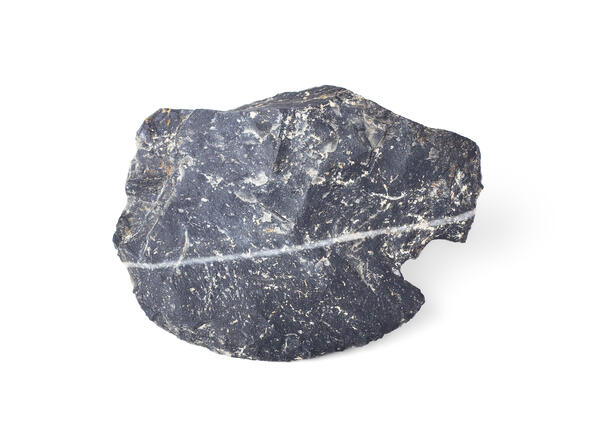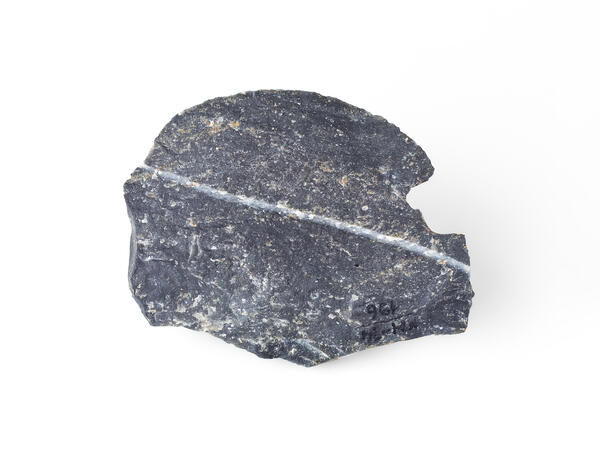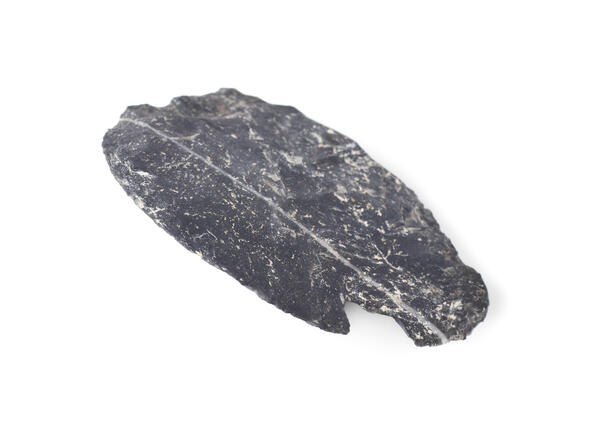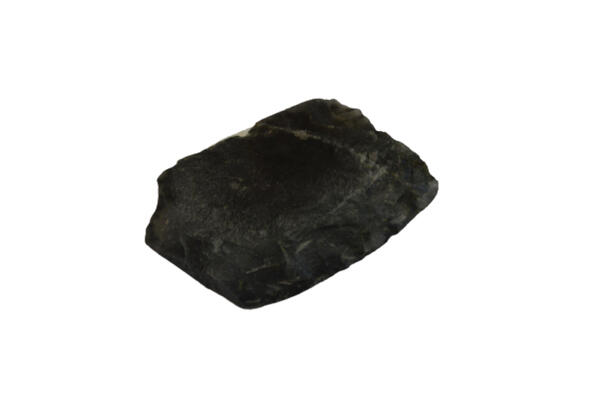
This scraper from the museum’s collection was created from flint; it had several working edges with blades. Such tools were used for cutting and processing animal skins. Scrapers were made from large chips-flakes of stone.
The object was discovered during the excavations of the multi-layered site “Kantegir I, ” which was dated to the period from 14 to 16 thousand years ago. In 1965, the work of the Sayano-Tuvan expedition in the flood zone of the Sayano-Shushenskaya hydroelectric power plant under construction marked the beginning of a systematic study of the Paleolithic sites of the Upper Yenisei. Important work was conducted by the third (Paleolithic) crew, which was part of the expedition led by Doctor of Historical Sciences Sergey Nikitich Astakhov. The site was discovered in 1973.
The finds of this site were characterized by a pebble splitting technique. The main blank was a flake. A variety of chisel-shaped racloirs and scrapers dominated among the tools. The bulk of the raw materials for the production of stone tools were mined in the same area, from the river pebbles. The researchers found out that ancient people preferred to use such rocks as siltstone, quartzite, and hornfels. Some of the high-quality raw materials (colored flint) were brought from the outside already in the form of tool blanks.
A primitive man in the described area always had to deal with the lack of high-quality raw materials, as evidenced by numerous traces of attempts to use rocks unsuitable for splitting. The settlement was a cluster of hearths and work sites. This suggests that primitive humans repeatedly lived in this favorable place for them.
Judging by the materials of the site, the settlement occupied an area of several hundred square meters. Stone processing was carried out mainly at the hearths or on work sites specially removed a few meters from the hearths.
The Late Paleolithic
inhabitants of the Western Sayan were engaged in hunting for the Siberian goat,
especially in the mountainous Kantegir. The specificity of this animal habitat
determined the fact that hunting for it was mainly individual. Hunting was
carried out with spears and darts that had bone and stone tips.