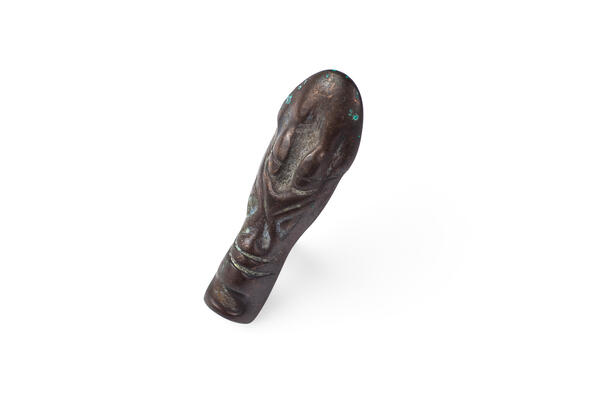
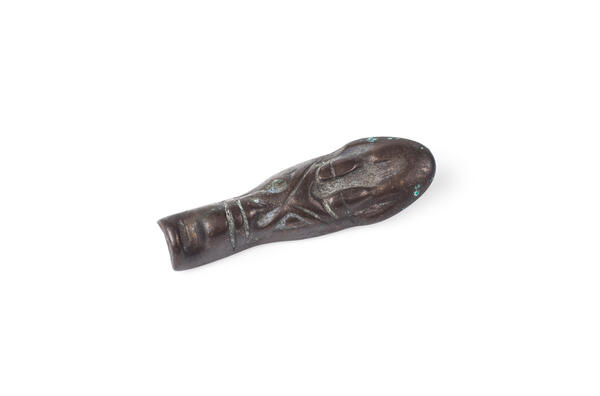
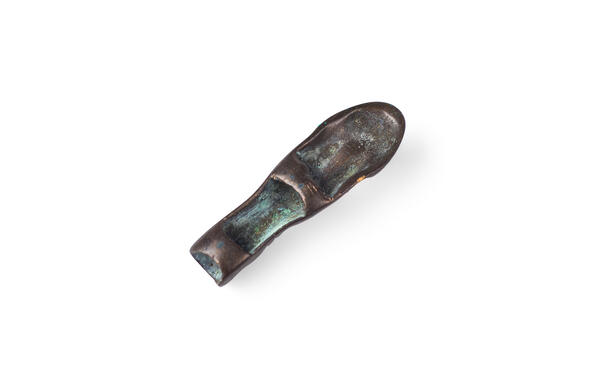
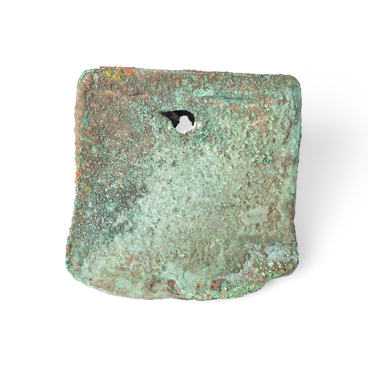
The spoon-shaped clasp with an anthropomorphic image was made of bronze. Archaeologists have found such objects in many burials of the 2nd–1st centuries BCE on the territory of Transbaikal, Southern and Western Siberia, and Central Asia. Among the finds, the researchers discovered both metal (bronze and iron) and bone spoon-shaped items. In Western Siberia, they were found in the burial grounds of the Sargat culture, and on the Middle Yenisei they were found among the objects of the Tes culture. Spoon-shaped clasps were discovered by scholars in almost all burial complexes and treasure troves of the Hunnic period; they became a kind of marker of this era.
In May 2002, a local resident donated to the Sayanogorsk Museum of Local Lore the bronze objects of the treasure, which he discovered in a suburban area. An analysis of 158 objects — rings, spoon-shaped pendant clasps, buckles, pronizkas (charm beads), plaques, openwork plates, buttons — determined that most of the artifacts should be attributed to the Tes culture. Three quarters of the items were made by ancient craftsmen from arsenic bronze. The arsenic content in the alloy ranged from 1–2 percent to 15–20 percent. Only 28 products contained tin, apparently obtained as a result of melting from Scythian tin bronzes.
One part of the spoon-shaped objects received a smooth surface, the other was shaped into images of animal heads. Such objects were found by researchers in both adult and children’s burials of different sexes. Consequently, their use was not segmented. Studying these objects, scholars had questions about their functional purpose. They couldn’t decide if they were buckles, special clasps, or belts and straps endings. Marianna Artashirovna Devlet, a Soviet and Russian archaeologist, adhered to the latter version.
The discovery of a
similar object in another mound was interpreted by such archaeologists as
Vladislav Alexandrovich Mogilnikov and Alexey Pavlovich Umansky in the same
way. In turn, Vladimir Vasilyevich Bobrov defined them as clasps of the rotary
type. Natalia Viktorovna Polosmak, considering the discovery of a spoon-shaped
rod in one of the burials in the neck area, also assumed its use as a clasp.