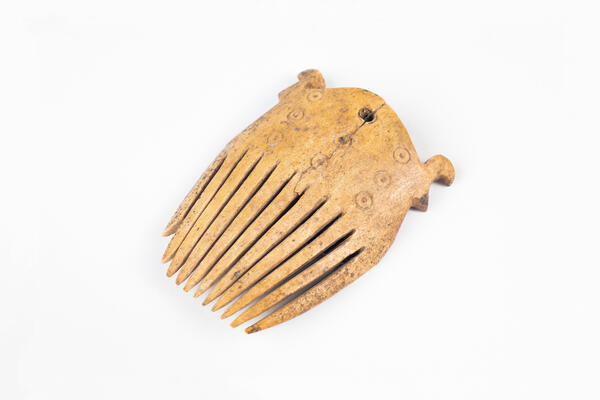
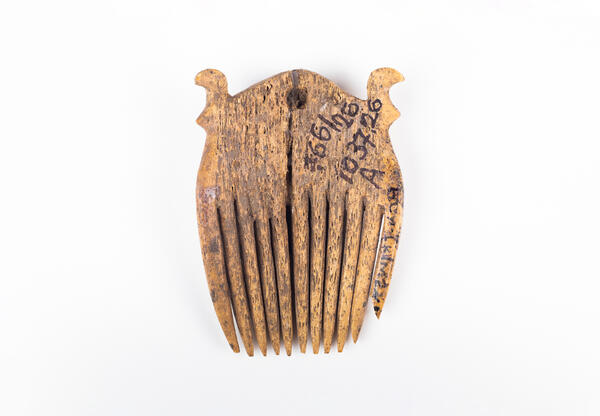
The comb from the museum’s collection with a circular pattern and a figured carving in the upper part was made of bone. This artifact was discovered in 2007 by a team of archaeologists of the Beya expedition, led by Margarita Nikolaevna Pshenitsyna. The team excavated Tagar mounds on the construction site of the Sayanogorsk Aluminum Smelter. During that time, another burial was found in the village of Beya on a plot of land during plowing.
Some of the archaeologists, whose leadership was assigned to Lyudmila Anatolyevna Sokolova, went to investigate the ancient monument and carry out rescue archaeological work. In the course of their work, researchers managed to identify that this find was a large burial ground of the same Tagar culture of the 9th–3rd centuries BCE, widespread on the territory of the Khakass-Minusinsk Basin.
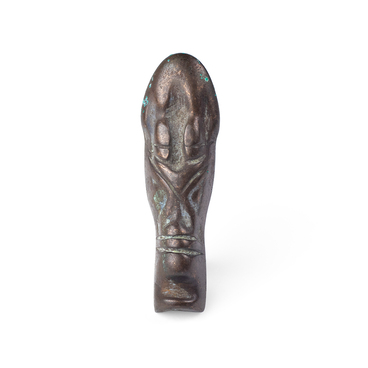
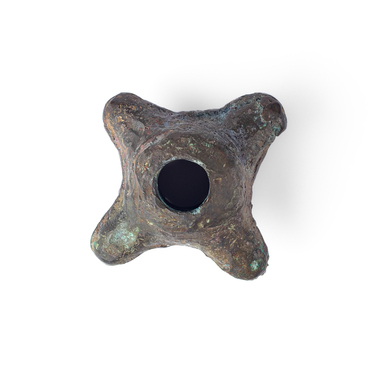
It turned out that the grave was used for burials during three chronological periods. First, a paired burial was performed, which was severely damaged during subsequent burials, and much later an elderly man was placed in the upper tier of the grave without accompanying equipment. At the first burial, were found a bronze knife with a mushroom-shaped cap, an awl with a tiered top, and a decoration — a bone comb with a circular pattern.
The Tagar people successfully hunted animals, primarily for the purpose of obtaining furs, meat and leather. From their bones and horns they made various decorations and weapons — arrowheads, knife handles, harpoons. In Tagar burials, bags or cases were often found that were hung from a belt and contained objects such as knives, awls, daggers, bronze mirrors, bone or horn combs.
Tagar bone combs usually
had a complex shape, were often adorned with a circular pattern, with the upper
part of the comb sometimes made slotted and decorated in an animal style. Less
often archaeologists encountered simple shapes, for example rectangular combs
with a round loop for hanging. If such items were not intended for combing
hair, they had fewer teeth than their more functional counterparts. Judging by
the size and number of teeth on this artifact, it served as a decoration.