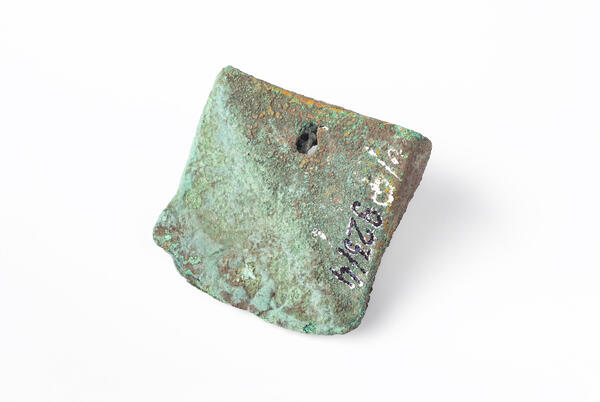
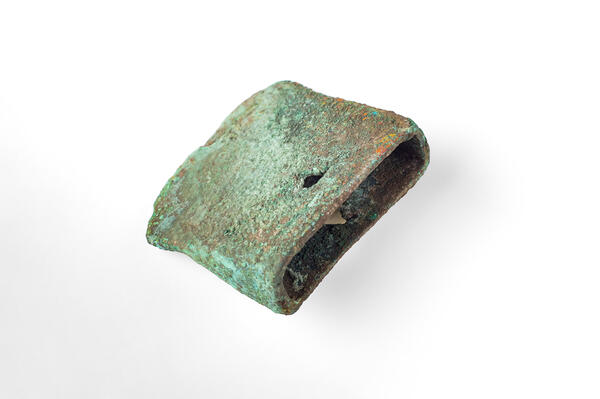
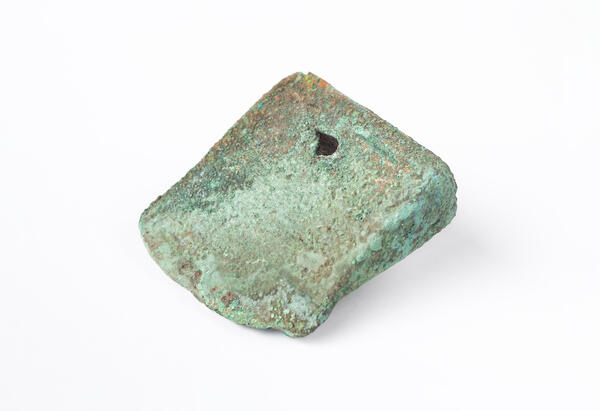
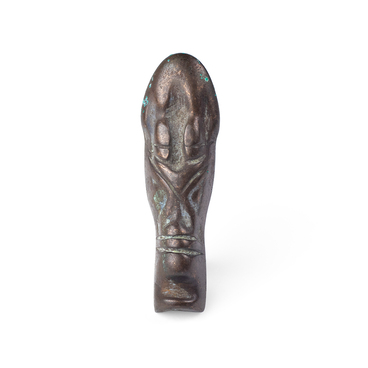
This shaft-hole bronze celt from the collection of the Sayanogorsk Museum was made before our era, approximately in the period from the 8th to the 2nd century. The craftsman left it unornamented, gave it wedge and trapezoidal shape, made a rounded working edge, an arc-shaped blade, through holes on each side and a shaft hole for fixing the handle.
Over the centuries, the surface of the bronze object has become uneven, and a patina has formed on it. A large number of bronze celts were found in the studied burial mounds of the Tagar culture. Soviet academics found out that they were used throughout the entire period of the existence of the culture. The celts were the first truly widely available woodworking tools. They were widespread in many cultures of the Bronze Age.
A distinctive feature of the celt’s design was the absence of a butt. In its place, the craftsman made a shaft hole, placing it perpendicular to the blade, into which the handle was inserted. At the same time, if the blade was parallel to the handle, the tool could be used as an ax, and if the blade was perpendicular to the handle — as a hoe or chisel.
The handles that were made for this weapon could be straight or have a bend at an angle of up to 90 degrees. The chopping part of the celt ax expanded slightly towards the blade. Notably, the craftsmen did not make really wide blades.
The qualitative difference of a shaft hole construction for some celts of the early Iron Age in Western and Central Siberia was the fastening of stops on the wedge. For this reason, through holes were created on the wide edges of the objects. The holes that were created as a result of the application of casting technology were also used as a place for additional fastening of the handle. Hence the term “nail holes.”