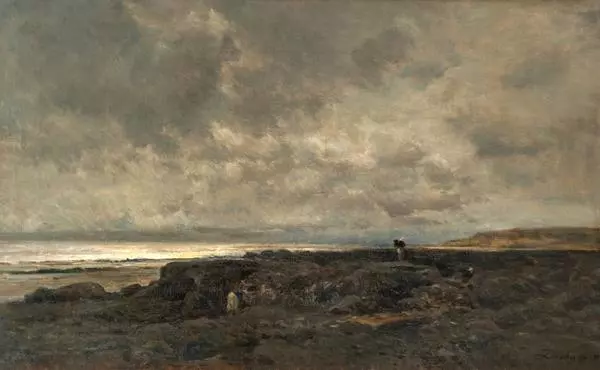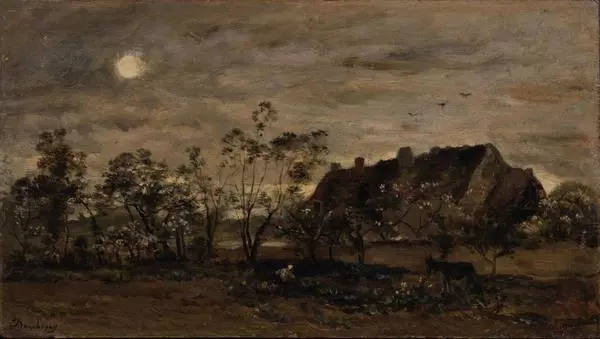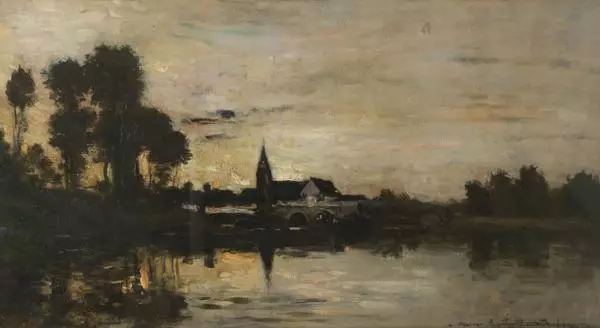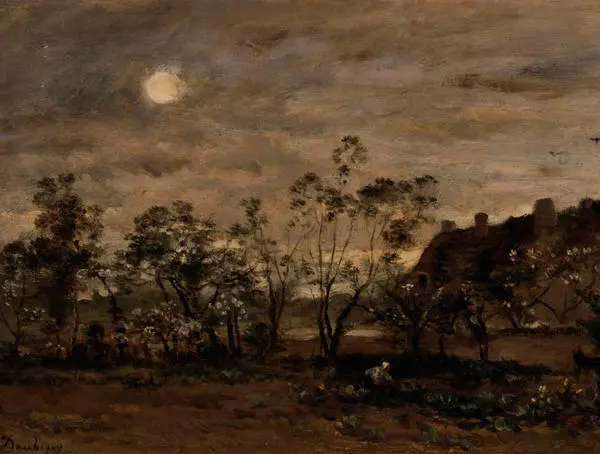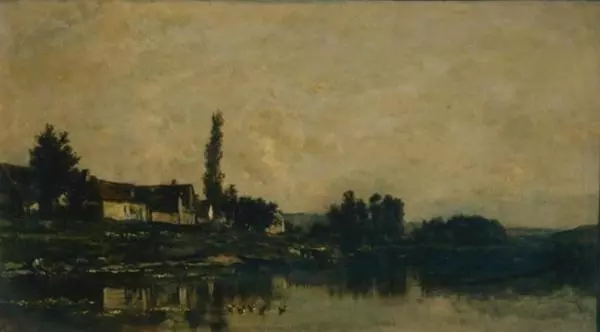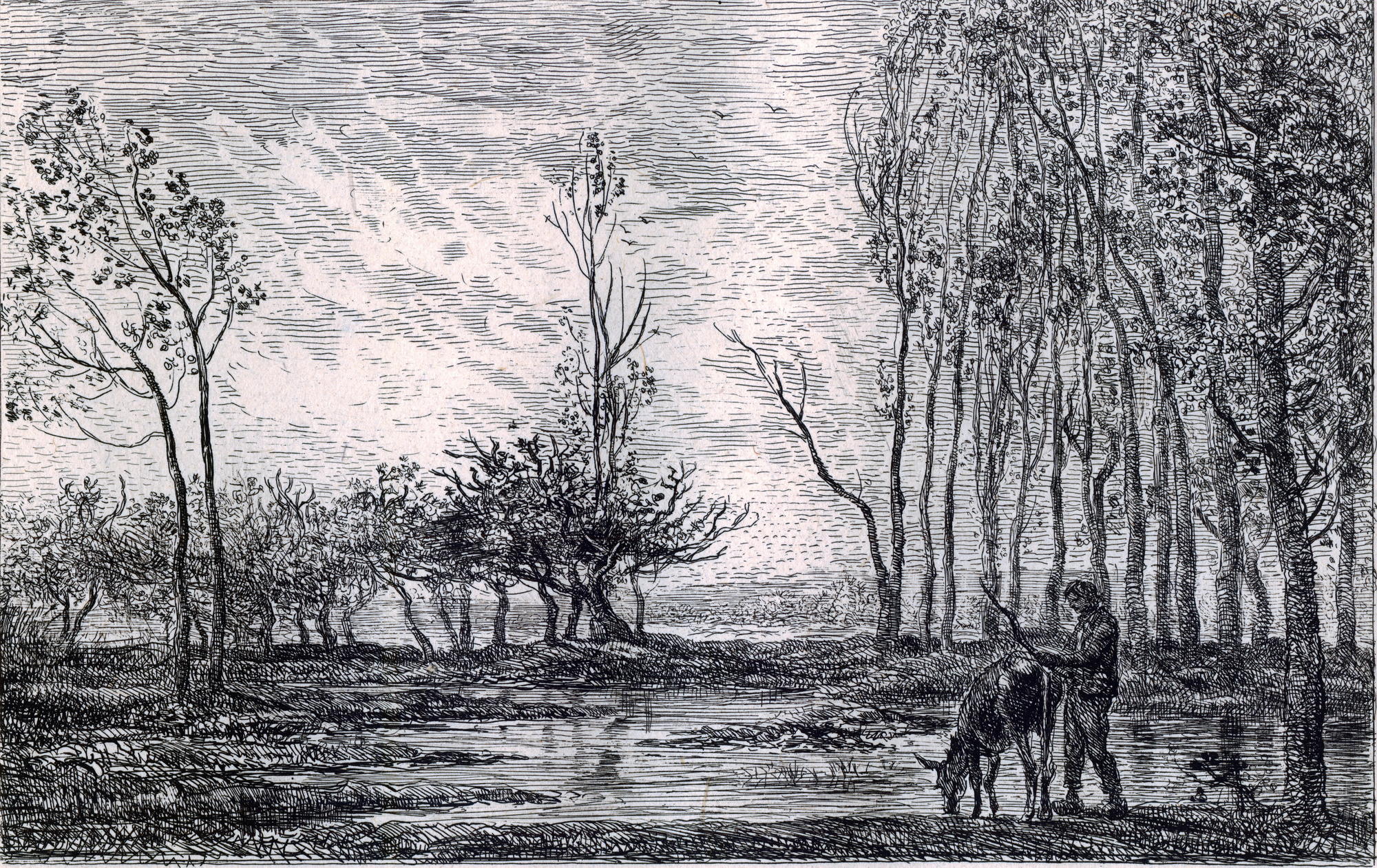


Charles-François Daubigny’s etching “The Setting Sun” is on display at the Irbit State Museum of Fine Arts. Daubigny (1817–1878), a French painter and printmaker, was a leading figure of the Barbizon School. He inherited his vocation from his father, Edme-François Daubigny, also a painter and engraver.
Daubigny first exhibited at the Paris Salon in 1838, presenting landscapes rooted in the classical tradition. Yet it was not until the early 1850s that he gained widespread recognition. His mature, realistic style was forged through dedicated plein air work — evident in the hundreds of drawings and studies he produced directly from nature.
Although he rarely painted in the village of Barbizon itself — the favored retreat of his fellow Barbizon artists — his artistic vision and technique are deeply aligned with the school’s principles. The Barbizon painters sought refuge from urban life and societal ills, finding solace in nature’s unspoiled beauty and using its harmony to critique the dissonance of modern civilization.
Daubigny, however, pushed beyond his predecessors. He pursued an unprecedented immediacy in capturing the landscape, deliberately avoiding idealization and rigid compositional order. His exceptional sensitivity to light and atmosphere set him apart. For Daubigny, the essence of visual expression lay not in precise line or meticulous detail, but in color and its most delicate tonal gradations — an approach that would profoundly influence the Impressionists.
Indeed, Daubigny actively championed the next generation of artists. In 1868, he played a crucial role in helping Claude Monet and other future Impressionists secure a place in the Paris Salon, acting as both advocate and mediator before the conservative jury.
In the early 1840s, Daubigny turned intensively to etching — a medium ideally suited to his nuanced rendering of nature’s atmospheric moods. His celebrated series of etchings, published between 1850 and 1851, is widely regarded as one of the crowning achievements of 19th-century French printmaking.
He favored humble, everyday rural scenes: expansive plains, tranquil rivers, riverside villages, blooming orchards, and vineyards. Particularly drawn to the liminal hours of dawn and dusk, Daubigny captured the poetic resonance of light during these fleeting moments.
Close to Camille Corot — the pioneer of the “mood landscape” — Daubigny, like his mentor, sought not only to depict nature’s outward appearance but also to evoke its inner spirit.