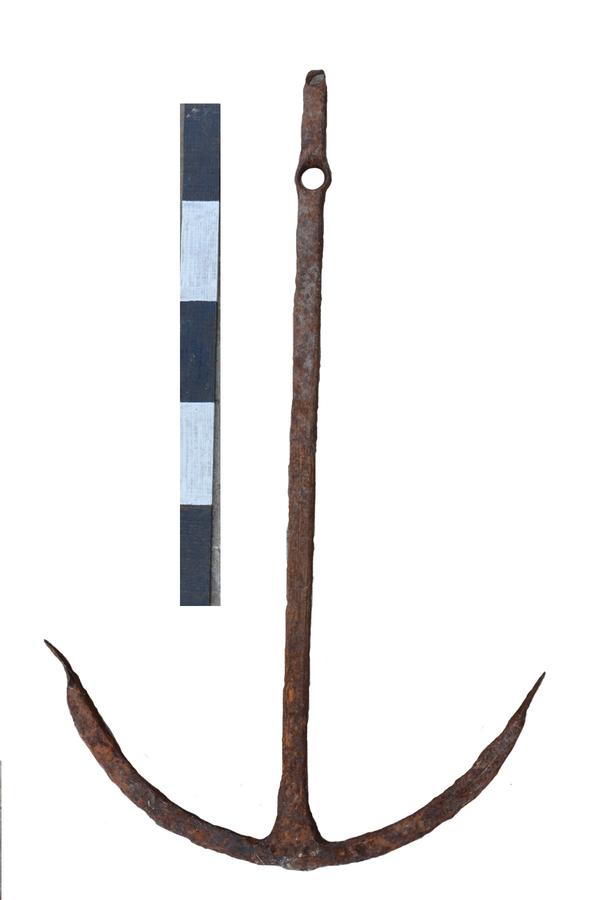
Before the introduction of the Admiralty anchor, the forked Pering anchor was used. Its manufacture was extremely labor-intensive, and the welding of individual parts was difficult, which is why such anchors were often fragile and unreliable.
The idea of abandoning the fork was expressed by Sir William Parker — Admiral of the Royal Navy, First Sea Lord, and Knight of the Order of the Bath. He also decided to change the principle of connecting the arms and shank and their dimensions — to reduce the width and increase the thickness of the shank and arms. As a result, the cross-section of the shank and arms became elliptical.
In 1840, William Parker patented his invention. Tests showed that it was more efficient and cheaper than its predecessor. Its high quality was recognized beyond Great Britain, including in the Russian Empire. Russian craftsmen contributed their own improvements, making the anchor dig into the bottom faster and improving the anchorage strength in loose soil.
However, by the mid-19th century, anchor production in England experienced a crisis. Many blacksmiths ignored reference models and recommendations when determining the product’s shapes and proportions, which resulted in the production of low-quality products and increased risk of accidents.
In 1852, the Admiralty appointed a committee to assess the quality of various anchors. It identified the best design that embodied the best features of the Parker anchor, Pering anchor, and other proven models. It was called the Admiralty Pattern Anchor, or simply the Admiralty anchor.
A hole was made in the widened part of the shank for a round stock, which was secured with a chain and a keep pin. The stock end, bent at a right angle, was folded along one-eighth of the shank while still inserted in the hole.
There was a ball at each end of the stock. One of them prevented the stock from getting disconnected from the shank when the anchor was weighed, the other prevented it from digging too deep into the soft soil.
When the Admiralty Pattern Anchor is cast, it contacts the ground with one crown (fluke) at first, and as the chain is laid out, both flukes touch the ground.