The anchor is one of the earliest inventions in the history of mankind. As a historical source, an anchor reveals a lot of information about the ship’s place of manufacture and routes, particularly trade routes.
The main purpose of the anchor is to secure a vessel to the bed of a body of water near the shore and at acceptable depths in the open sea. Initially, a stone was most likely used for this purpose. It was tied securely with a liana or an animal sinew rope and thrown overboard. Sacks and baskets filled with a weight (usually stones) were sometimes used for the same purpose in ancient times. Such primitive anchors were unreliable because the stone could slip out of the loop, and the sack could tear.
Over time, the anchor design was improved by a rim that helped secure the rope. Later, a special hole was added through which the rope was threaded. Some researchers suggest that even before the Common Era, there were wooden inserts that helped secure the anchor in the ground. These inserts became the prototype of the modern anchor flukes.
The first anchor with two flukes, a stock, and a crossbar is believed to have been invented in Southeast Asia around the 3rd millennium BC. In the Mediterranean region, the earliest anchors of this type date only to the 8th century BC.
Alexander Vasilyevich Okorokov and Andrey Valeryevich Kulagin wrote, “In ancient Greece, a newly forged anchor was consecrated in the temple of Zeus <…> It was believed that the sacred signs [hammered out on the stock] would protect seafarers from evil forces and help them return home quickly and successfully.”
According to the images on medieval miniatures and coins, the shape of anchors used in the Middle Ages remained unchanged until the 18th century, except for minor modifications in production processes.
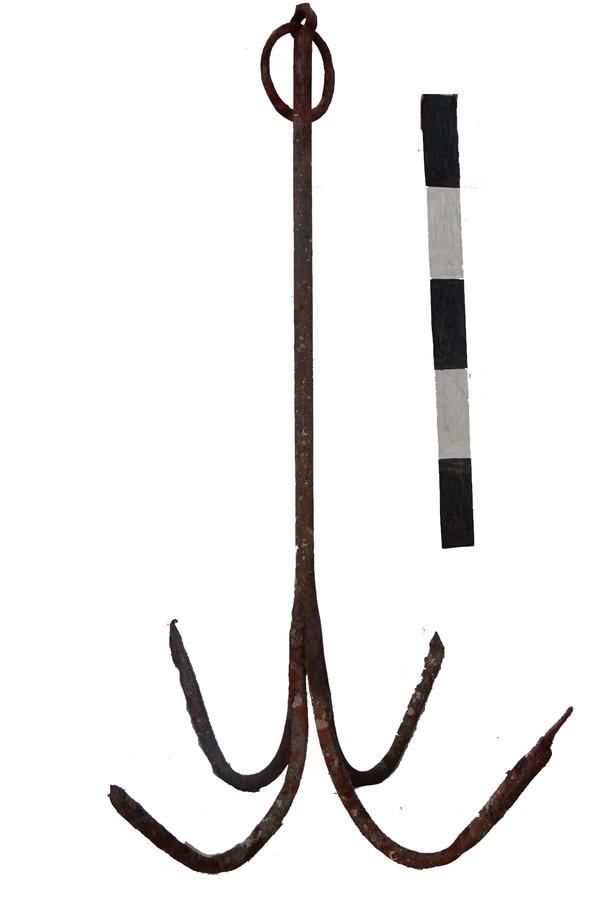
According to researchers, light and reliable three-, four-, five-, and even six-fluke “cat” anchors were first used on Scandinavian ships. This shape was adopted by the seafarers of the Mediterranean region, including the Genoese, Venetians, and Byzantines who engaged in active trade with the Black Sea ports, Syria, Egypt, Arabia, and India.
The so-called cat anchors were easily attached to the sides of ships. In addition to their main function, they were used as grappling hooks in naval boarding action.