Font
Color
Graphics
Изображение точки

To see AR mode in action:

1. Install ARTEFACT app for iOS or Android;

2. Find the exhibition «The Annunciation Cathedral»

3. Push the «Augmented reality» button and point your phone's camera at the exhibit;

Скрыть точки интересаПоказать точки интереса
Показать в высоком качестве

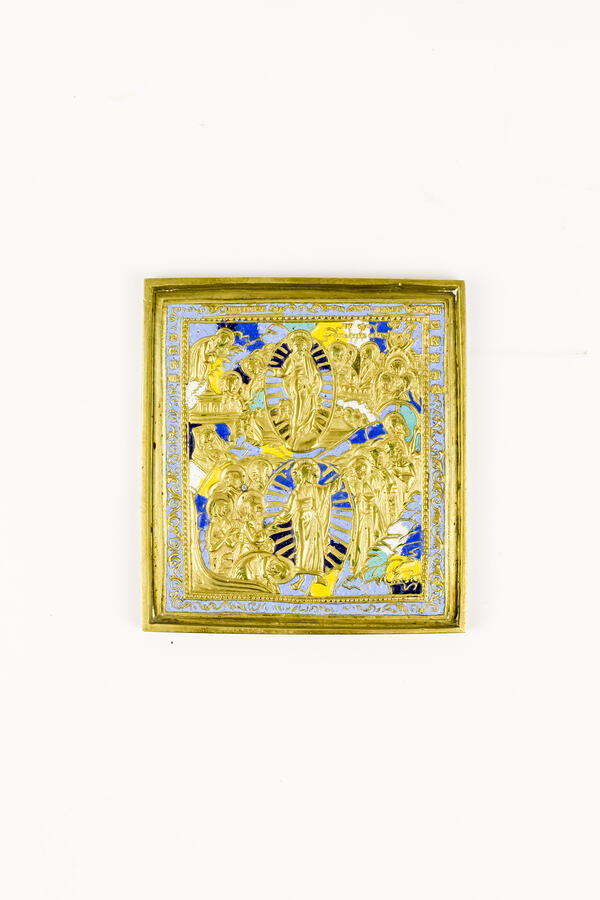
Resurrection of Christ and Harrowing of Hell

Creation period
the 19th century
Place of сreation
Russian Empire
Dimensions
11x10 cm
Technique
copper casting, polychrome enamel
0
Open in app
#1
Resurrection of Christ and Harrowing of Hell
#4
The icon “The Resurrection of Christ and Harrowing of Hell” was made by an unknown author in the 19th century. He cast it out of copper and decorated it with colored enamel. Copper images were especially in demand among the Old Believers: during processing, the metal first melted on fire, and they considered the flame to be a symbol of purification.

According to the Orthodox faith, “The Resurrection of Christ” is revered as the main icon of the Easter holiday. Often, icon painters combine this plot with “Harrowing of Hell”. As a rule, the scenes of these events are placed one above the other: the Savior is twice depicted in full length. The upper figure of Christ stands in the tomb surrounded by Angels. Below, He tramples on the doors of the gates of hell.

The plot of this type of icons is based on the apocryphal (that is, not included in the Bible) gospel of Nicodemus. It says that while the Savior’s body was remaining in the grave, His spirit shattered the gates of hell and descended there.

#5
And immediately the King of glory, the mighty Lord by His power trampled death, and seizing the Devil, tied him up, gave him up to eternal torment and carried away his earthly father our Adam and the prophets, and all the saints who are in hell, into His radiance.
#2
Both figures of Christ are usually depicted surrounded by an oval halo. Heavenly glory is a special radiant sign that signifies the divine nature of the character. If we simplify this concept, its meaning can be explained as follows: the Lord can be present in the world invisibly, secretly, and can manifest himself in glory — that is, in all the power of divine light.

As a rule, on icons of this type, the Lord’s cloak is depicted slightly raised: since He no longer descends into hell, but rises out of it — therefore, the characteristic depiction of the folds of the clothes. In the icon from the museum collection, this feature is only hinted at.

Among the souls that Christ brings out of Hell, Adam and Eve are the most noticeable ones. Icon painters usually depict them getting up from their knees — symbolizing that they used to be in a fallen state, but now the Lord has granted them forgiveness. Adam’s arm is usually shown to be saggy and weak. This is also a symbol: it means that a man cannot save himself without God’s help.
#3
read morehide
00:00
00:00
1x

Resurrection of Christ and Harrowing of Hell

Creation period
the 19th century
Place of сreation
Russian Empire
Dimensions
11x10 cm
Technique
copper casting, polychrome enamel
0
Point your smartphone camera to open in the app
Share
VkontakteOdnoklassnikiTelegram
Share on my website
Copy linkCopied
Copy
Open in app
To see AR mode in action:
  1. Install ARTEFACT app for 
  2. iOS or Android;
  3. Find and download the «Paintings in Details» exhibition
  4. Push the «Augmented reality» button and point your phone's camera at the painting;
  5. Watch what happens on your phone screen whilst you flip through the pictures.
 
We use Cookies
Cookies on the Artefact Website. We use cookies to ensure that we give you the best experience on our website. If you continue without changing your settings, we'll assume that you are happy to receive all cookies on the Artefact website. However, if you would like to, you can change your cookie settings at any time.
Learn more about useHide
Content is available only in Russian

X

Нашли опечатку?...

%title%%type%