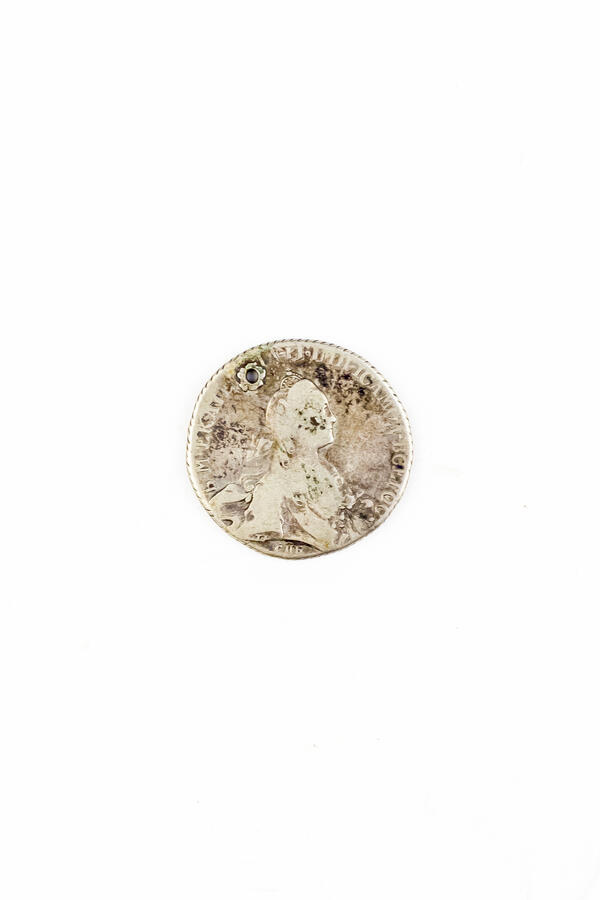
The museum houses a white metal coin with a profile portrait of Empress Catherine II.
This image of the Empress became popular after Fyodor Rokotov had painted the famous coronation portrait — it even began to be mentioned as the “Rokotov’s Type.” Researchers believe that the profile is similar to an antique cameo and therefore has a “perfect, timeless character.” That is why it was well suited for minting coins and medals.
Since the coin has a hole drilled, it can be assumed that it was part of a “monisto” — a woman’s necklace. Such jewelry pieces look like necklaces made of one or more threads with coins, beads, semi-precious stones, corals, amber and other elements.
Such monisto necklaces were common in many cultures: among the Gypsies, among the Russians, among the peoples of the Volga region — Mordovians, Chuvashes, Bashkirs. Many women had two versions of necklaces at home: one for everyday use with three or seven coins and one for festive occasions. The latter ones were much more elegant and heavier, women wore them to church or for social events. A proper monisto necklace had to include several foreign or rare coins. For different peoples, the weight of such jewelry could reach several kilograms and amount to more than a hundred pendants.
There were different manufacturing techniques. Women made holes in the coins and put a thread through the holes. Girls also sewed round collars and attached the jewelry with threads to the fabric. This necklace was important for the family and was passed down through generations from the mother to the eldest daughter. The rest of the daughters had to make their own necklaces.
Such necklaces were considered a talisman and also helped identify the social status of their owner. After the revolution, the Soviet authorities began to confiscate this jewelry, as well as grain or livestock, from wealthy families. People hid them in secluded places, buried them underground. But during the Great Patriotic War, many people made their own decision and handed their jewelry over for melting: precious metals were required to create weapons, and people gave their last valuable items to help the army.
This image of the Empress became popular after Fyodor Rokotov had painted the famous coronation portrait — it even began to be mentioned as the “Rokotov’s Type.” Researchers believe that the profile is similar to an antique cameo and therefore has a “perfect, timeless character.” That is why it was well suited for minting coins and medals.
Since the coin has a hole drilled, it can be assumed that it was part of a “monisto” — a woman’s necklace. Such jewelry pieces look like necklaces made of one or more threads with coins, beads, semi-precious stones, corals, amber and other elements.
Such monisto necklaces were common in many cultures: among the Gypsies, among the Russians, among the peoples of the Volga region — Mordovians, Chuvashes, Bashkirs. Many women had two versions of necklaces at home: one for everyday use with three or seven coins and one for festive occasions. The latter ones were much more elegant and heavier, women wore them to church or for social events. A proper monisto necklace had to include several foreign or rare coins. For different peoples, the weight of such jewelry could reach several kilograms and amount to more than a hundred pendants.
There were different manufacturing techniques. Women made holes in the coins and put a thread through the holes. Girls also sewed round collars and attached the jewelry with threads to the fabric. This necklace was important for the family and was passed down through generations from the mother to the eldest daughter. The rest of the daughters had to make their own necklaces.
Such necklaces were considered a talisman and also helped identify the social status of their owner. After the revolution, the Soviet authorities began to confiscate this jewelry, as well as grain or livestock, from wealthy families. People hid them in secluded places, buried them underground. But during the Great Patriotic War, many people made their own decision and handed their jewelry over for melting: precious metals were required to create weapons, and people gave their last valuable items to help the army.