All over the world, porcelain Easter eggs are associated with Russia: it was in our country that the tradition of painting and giving Easter eggs was born.
The imperial family assigned a special role to the distribution of Easter eggs even during the reign of Alexei Mikhailovich. In his reign, there was a whole rite of celebrating Easter. Historian Ivan Zabelin wrote that on this day “the boyars, okolnichy [boyars in one of the highest ranks], duma noblemen and clerks, the butler, courtiers and clerks, stewards, solicitors and noblemen of Moscow” received up to 37,000 natural and artificial eggs from the tsar’s family. All the later rulers celebrated Easter on a similar scale.
The first porcelain egg was prodcued in 1749: it was made by the manager of the Imperial Porcelain Factory, Dmitry Vinogradov. Later, he began to supply the royal court with about 200 exclusive handmade porcelain eggs on an annual basis. During the reign of Alexander III and Nicholas II, this number increased to 2,000 and then to about 5,000.
The most expensive items were the Easter eggs with the saints and images of “Twelve Feasts” — the twelve most important church dates. It took the artist up to 40 days to paint one such item.
Most often, eggs were made in such a way that they could be hung: so the owner could place an expensive item in the most revered place under the shelf with icons. For this reason, there was a special hole left: a ribbon with a bow was inserted through the egg at the bottom and a loop was made at the top. Until the 1820s, painted porcelain eggs were made only at the Imperial Porcelain Factory, but later private factories also started producing similar decorations.
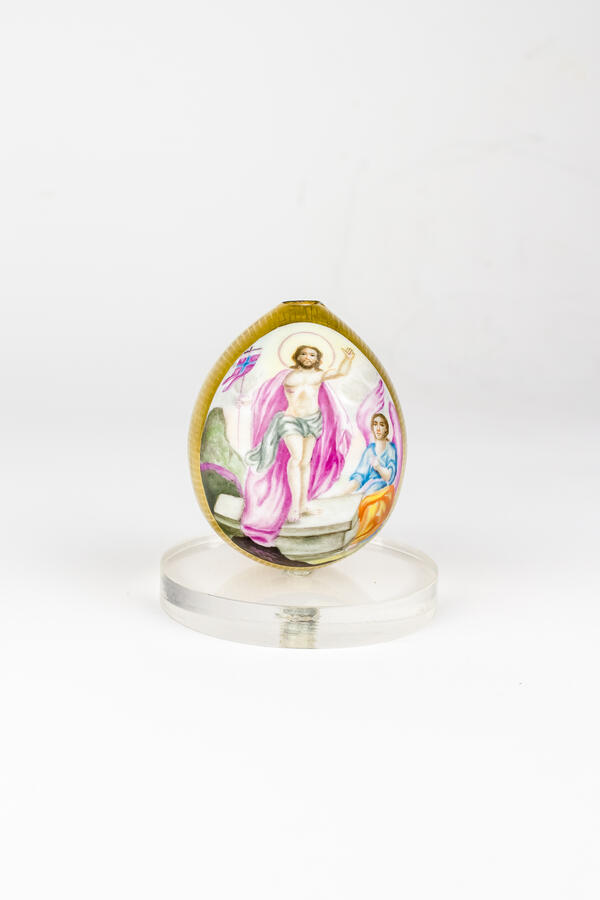
The exhibit from the museum collection features “The Resurrection of Christ” — the main symbol of the Easter celebration. In the center of the composition is Jesus Christ, he stands on the gates of hell and holds the banner of victory over death in his right hand. To his left, the icon painter depicted one of the Angels, who said to those who came to the tomb,
The imperial family assigned a special role to the distribution of Easter eggs even during the reign of Alexei Mikhailovich. In his reign, there was a whole rite of celebrating Easter. Historian Ivan Zabelin wrote that on this day “the boyars, okolnichy [boyars in one of the highest ranks], duma noblemen and clerks, the butler, courtiers and clerks, stewards, solicitors and noblemen of Moscow” received up to 37,000 natural and artificial eggs from the tsar’s family. All the later rulers celebrated Easter on a similar scale.
The first porcelain egg was prodcued in 1749: it was made by the manager of the Imperial Porcelain Factory, Dmitry Vinogradov. Later, he began to supply the royal court with about 200 exclusive handmade porcelain eggs on an annual basis. During the reign of Alexander III and Nicholas II, this number increased to 2,000 and then to about 5,000.
The most expensive items were the Easter eggs with the saints and images of “Twelve Feasts” — the twelve most important church dates. It took the artist up to 40 days to paint one such item.
Most often, eggs were made in such a way that they could be hung: so the owner could place an expensive item in the most revered place under the shelf with icons. For this reason, there was a special hole left: a ribbon with a bow was inserted through the egg at the bottom and a loop was made at the top. Until the 1820s, painted porcelain eggs were made only at the Imperial Porcelain Factory, but later private factories also started producing similar decorations.
The exhibit from the museum collection features “The Resurrection of Christ” — the main symbol of the Easter celebration. In the center of the composition is Jesus Christ, he stands on the gates of hell and holds the banner of victory over death in his right hand. To his left, the icon painter depicted one of the Angels, who said to those who came to the tomb,