

The altar hand blessing cross is the most important attribute in an Orthodox church. It is kept on the altar table –a special table in the middle of the altar for performing sacraments. The cross is one of the three obligatory accessories of the altar, along with the altar gospel and the antimins — a special piece of cloth with a small relic of a martyr sewn into it.
The priests use the altar hand blessing cross at the end of the Liturgy: they bless the faithful, and the parishioners must touch the cross with their lips. This attribute is also needed for the sacraments of baptism, wedding, anointing of the sick and others.
Crosses were the most popular product made by copper casting. Many museums house several crosses at once. They differ in purpose, size and ornamentation. There are quite a few altar hand blessing crosses of the 19th — early 20th centuries. They were cast in different regions: in the Urals, in the Vladimir, Novgorod and Petersburg governorates, in Moscow and the Moscow region, in the remote Old Believer sketes (communities). Copper-cast items became widespread not only among the Old Believers, but also among the Orthodox Christians.
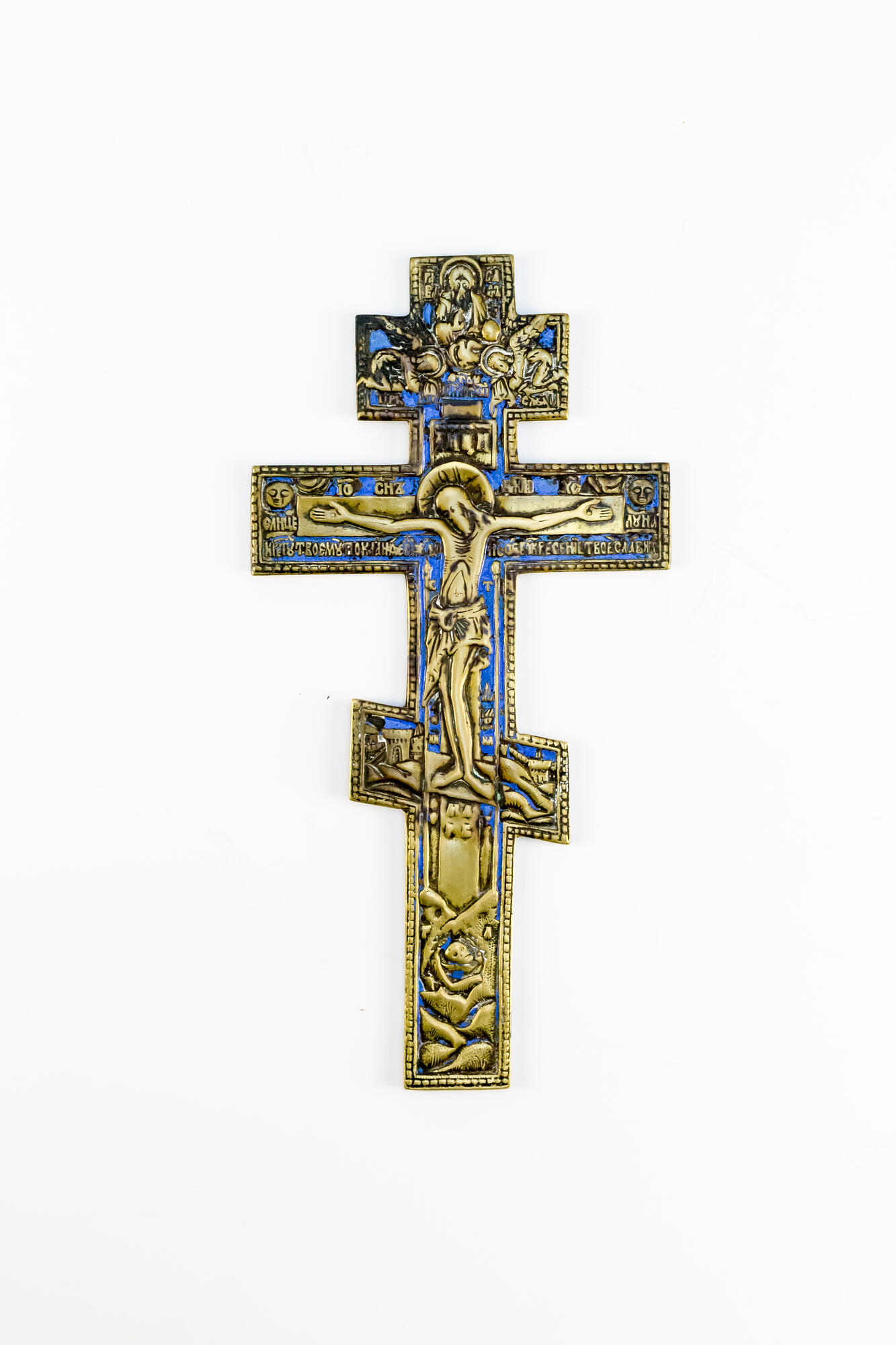
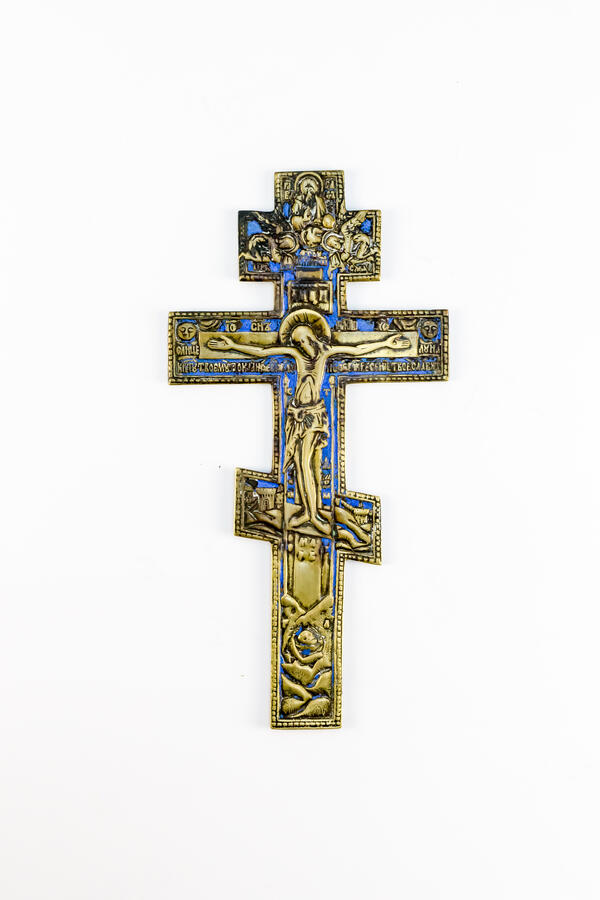
The cross from the museum collection is cast in copper and decorated with enamel. It can be attributed to the Old Believer art. There are several details that support this assumption. First, it is the slanting crossbar at the bottom. Old Believers always depicted them on eight-pointed crosses: during the Crucifixion, the Roman soldiers nailed the feet of Jesus Christ to a plate of this type. Secondly, there are the images of the Sun and the Moon at the ends of the middle crossbar. These images that had the form of round signed masks were mandatory for Pomor crosses. In addition, the Pomor Old Believers most often used blue enamel.
In the center of the composition, the author placed the Calvary cross with the figure of the crucified Jesus Christ. There is an inscription on the bottom edge of the crossbar. It is the title line of the sticheron to the Cross of the Lord,
The priests use the altar hand blessing cross at the end of the Liturgy: they bless the faithful, and the parishioners must touch the cross with their lips. This attribute is also needed for the sacraments of baptism, wedding, anointing of the sick and others.
Crosses were the most popular product made by copper casting. Many museums house several crosses at once. They differ in purpose, size and ornamentation. There are quite a few altar hand blessing crosses of the 19th — early 20th centuries. They were cast in different regions: in the Urals, in the Vladimir, Novgorod and Petersburg governorates, in Moscow and the Moscow region, in the remote Old Believer sketes (communities). Copper-cast items became widespread not only among the Old Believers, but also among the Orthodox Christians.
The cross from the museum collection is cast in copper and decorated with enamel. It can be attributed to the Old Believer art. There are several details that support this assumption. First, it is the slanting crossbar at the bottom. Old Believers always depicted them on eight-pointed crosses: during the Crucifixion, the Roman soldiers nailed the feet of Jesus Christ to a plate of this type. Secondly, there are the images of the Sun and the Moon at the ends of the middle crossbar. These images that had the form of round signed masks were mandatory for Pomor crosses. In addition, the Pomor Old Believers most often used blue enamel.
In the center of the composition, the author placed the Calvary cross with the figure of the crucified Jesus Christ. There is an inscription on the bottom edge of the crossbar. It is the title line of the sticheron to the Cross of the Lord,