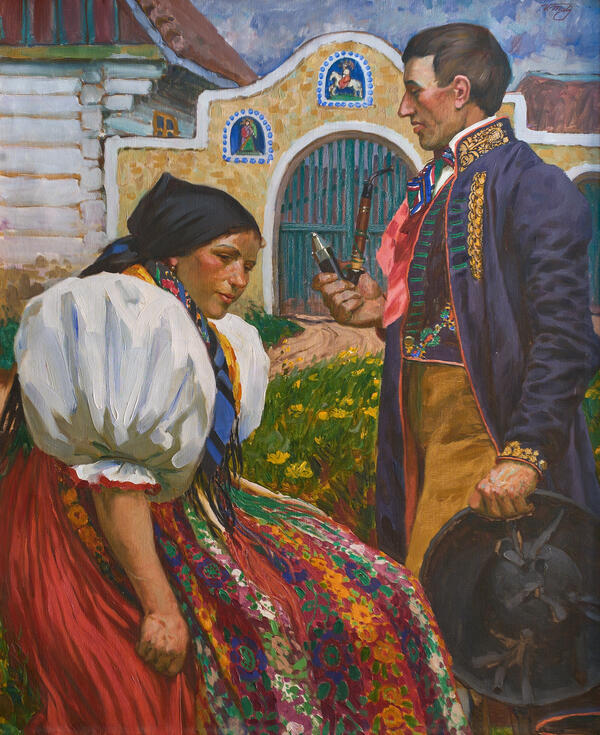
The main part of the collection of foreign art housed in the Astrakhan Art Gallery consists of works from the collection of the Austrian merchant Otto Yakovlevich Wiblinger.
Wiblinger was born in Vaduz, Liechtenstein. Together with his young wife Josephine, he came to Astrakhan in 1893. From 1893 to 1914, Wiblinger, as a representative of the trading company “Ivan Kattus in Vienna”, exported caviar to Europe.
Otto Wiblinger amassed a collection that included objects of Eastern art, European glass, ceramics, sculpture, painting, and books about art. The main part of his fine art collection was represented by works by Russian artists, including Boris Kustodiev, Ivan Goryushkin-Sorokopudov, Grigory Maltsev, and Leonid Veselovsky. Wiblinger was friends with Astrakhan artists and helped organize their exhibitions. In Wiblinger’s collection, there were only two artists that represented the European school of painting — Vaclav Maly and Franz Tomashu.
On the eve of World War I, Wiblinger left Astrakhan forever, leaving his collection behind. At the initiative of Pavel Mikhailovich Dogadin, the works were transferred to the Astrakhan Gallery in 1918 even before its official opening.
Vaclav Maly was a Czech folk artist. He was born on February 19, 1874 in the urban part of Prague — Bubeneč, which is located between the neighborhoods of Dejvice and Holešovice.
From 1900 to 1906, Vaclav Maly studied at the Academy of Fine Arts in Prague under Czech painting professors Vaclav Brožík and Hanuš Schwaiger, who are known mainly for genre scenes and views of Prague.
Vaclav Maly’s style is manifested primarily in
works devoted to the theme of peasant life and depictions of peasants in
traditional national costumes. The Czech researcher Toman Prokop described Maly
as follows,